
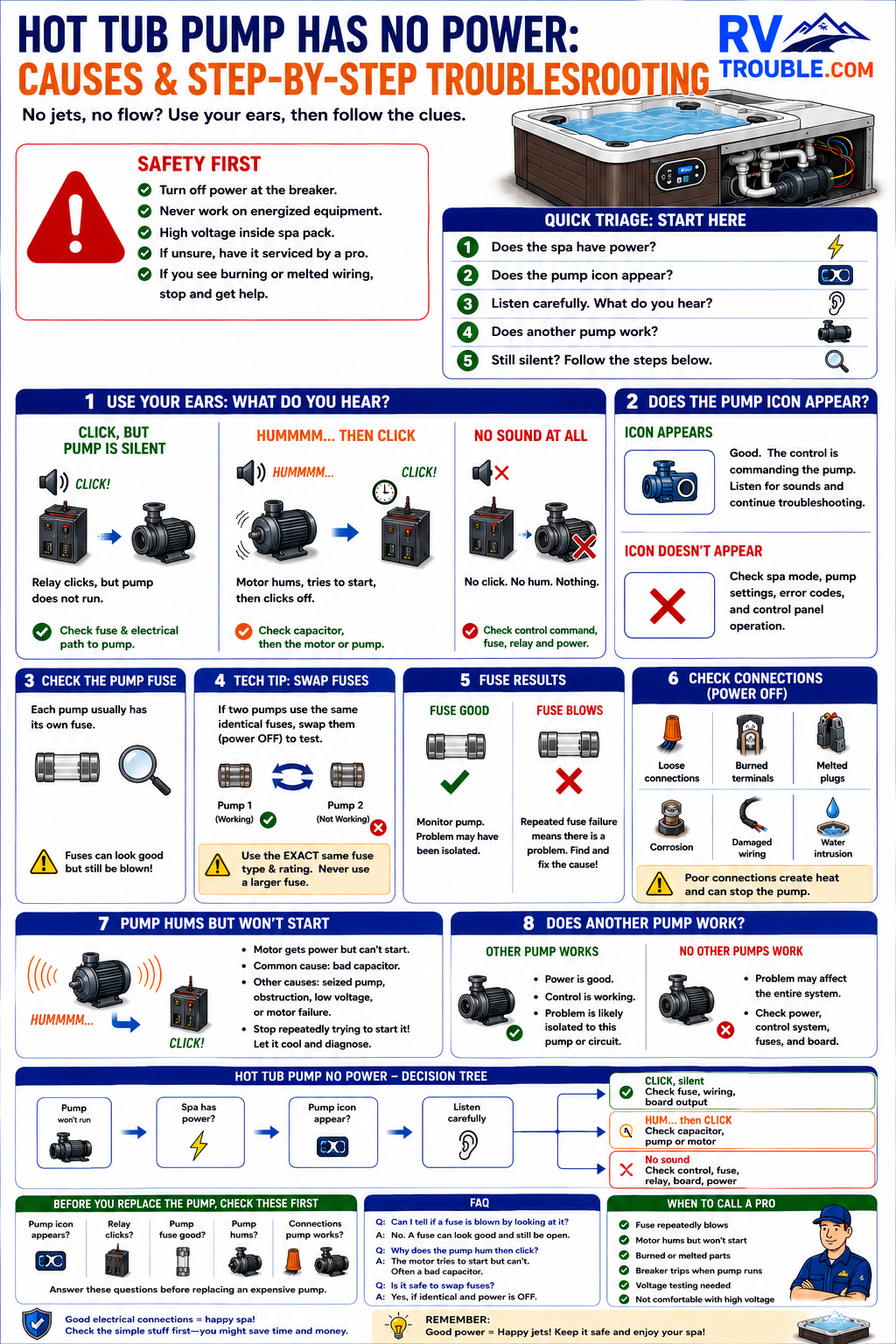
A hot tub pump that won’t run doesn’t automatically mean the pump has failed.
The problem could be a blown pump fuse, tripped breaker, control setting, damaged wiring, failed relay, circuit-board problem, or the pump itself.
One of the first things I do when diagnosing this problem is surprisingly simple:
I listen to the spa.
If the spa has power and the pump icon appears on the topside control, the sounds coming from the equipment area can provide valuable clues.
A relay click with no pump activity tells me something very different from a motor that hums for several seconds and then clicks off.
Before replacing the pump or circuit board, use these symptoms to determine which direction the diagnosis should go.
Quick Triage: Start Here
Turn the pump on from the topside control and watch the display.
Does the pump icon appear?
YES → Listen carefully near the equipment compartment.
What do you hear?
Relay clicks, but pump is completely silent:
The circuit board appears to be trying to operate the pump. Check the pump fuse and electrical supply to the pump.
Pump hums for several seconds and then you hear a click:
The pump is receiving power but may not be able to start. A bad capacitor or other pump/motor problem becomes much more likely.
No click, no hum, nothing:
Check the spa’s operating mode, control command, board output and electrical supply.
Pump icon doesn’t appear:
The spa may not actually be commanding the pump to operate. Check settings, modes, error conditions and the topside controls before blaming the pump.
Safety Stop
Hot tubs contain high-voltage electricity immediately beside water.
Troubleshooting inside the equipment compartment may expose you to line-voltage electrical connections.
Turn off power at the breaker before:
- Removing electrical connections
- Removing or swapping fuses
- Disconnecting the pump
- Inspecting circuit-board connections
- Handling wiring
Never assume a circuit is de-energized simply because the pump isn’t running.
Voltage measurements on energized spa equipment should only be performed by someone qualified and comfortable working around high-voltage electrical systems.
If you see burned wiring, melted connections, water around electrical components or other signs of electrical damage, stop troubleshooting and have the spa professionally serviced.
Check First: Does the Hot Tub Have Power?
Before diagnosing the pump, confirm that the spa itself is powered.
Check:
- Is the topside display illuminated?
- Are there error messages?
- Do other pumps operate?
- Does the circulation pump operate, if equipped?
- Do the lights work?
- Is the GFCI/breaker on?
If the entire spa is dead, this isn’t primarily a pump troubleshooting problem.
You need to diagnose why the spa itself has no power.
If everything else works but one pump doesn’t, continue below.
Step 1: Is the Spa Actually Calling for the Pump?
Press the appropriate pump button.
Watch the topside display.
Most controls display a pump or jet icon when they’re commanding the pump to operate.
Pump icon appears
Good. The control system appears to recognize your request.
Now listen.
Pump icon doesn’t appear
Before opening the equipment compartment, check:
- Operating mode
- Pump settings
- Active error codes
- Control-panel operation
- Whether the pump is available in the current operating state
The pump can’t operate normally if the control system isn’t telling it to run.
Step 2: Use Your Ears
This is one of my favorite first diagnostic checks because it requires no test equipment.
Stand near the equipment compartment and activate the pump.
Listen carefully.
You’re trying to distinguish between three basic symptoms:
CLICK — but the pump remains silent
This can indicate that the pump relay is operating.
The circuit board appears to be trying to send power to the pump, but the pump isn’t operating.
A blown pump fuse becomes one of my first suspects.
HUMMMMM… then CLICK
This points me in a completely different direction.
The pump motor appears to be receiving power and attempting to start.
If it hums for several seconds and then you hear a click, the motor’s overload protection may be opening because the motor isn’t starting properly.
A failed capacitor is a common possibility, although other pump or motor problems can produce similar symptoms.
Nothing at all
No relay click.
No hum.
No pump activity.
Now I start looking farther upstream at the control command, relay/board, fuse and electrical circuit.
Step 3: Check the Pump Fuse
Many spa circuit boards have individual fuses protecting pump circuits.
And here’s something important:
You Cannot Reliably Tell Whether a Pump Fuse Is Good by Looking at It
A fuse can appear perfectly normal and still be open internally.
Don’t assume a fuse is good simply because you can’t see anything burned or broken.
The proper way to verify a fuse is with an appropriate electrical test, such as a continuity test, with power disconnected and using proper electrical procedures.
There is also another diagnostic technique I sometimes use.
Technician Tip: Comparing Pump Fuses
Many hot tubs have more than one pump, and the circuit board may have a separate fuse protecting each pump circuit.
If the board uses identical fuse types and identical ratings for two pump circuits, swapping those identical fuses can sometimes help determine whether the problem follows the fuse.
For example:
Pump 1 works.
Pump 2 doesn’t.
If both circuits use the exact same fuse specification, exchanging the fuses may help confirm whether the suspect fuse is faulty.
If Pump 2 begins working and Pump 1 stops working, you’ve found a strong clue.
Important Safety Rules
Turn off and verify power is disconnected before touching circuit-board fuses.
Never substitute a different fuse rating.
Never install a larger fuse to “see if it works.”
Never bypass a fuse.
Never replace a fuse with anything other than the manufacturer’s specified type and rating.
If you’re unsure whether two fuses are actually interchangeable, don’t swap them.
Step 4: If the Fuse Is Blown, Ask Why
Finding a blown fuse doesn’t necessarily finish the diagnosis.
Fuses usually open for a reason.
A replacement fuse that operates normally afterward may indicate an isolated event.
But if the fuse blows again, stop replacing fuses.
Repeated fuse failure can indicate:
- Pump motor problem
- Shorted wiring
- Damaged pump cable
- Water intrusion
- Electrical component failure
- Circuit-board problem
Repeatedly installing new fuses without finding the cause can create additional damage and potentially an electrical hazard.
Step 5: Pump Hums but Won’t Start
If the motor hums when commanded on, the troubleshooting direction changes substantially.
The motor is apparently attempting to operate.
Possible causes include:
- Failed capacitor
- Seized motor
- Mechanical obstruction
- Damaged motor
- Pump electrical problem
- Low or incorrect voltage
A capacitor problem is particularly worth considering when the motor hums but doesn’t begin rotating.
Don’t Keep Trying to Start It
Repeatedly energizing a motor that only hums can cause the motor to overheat.
If you hear:
HUM → several seconds → CLICK
stop repeatedly pressing the pump button.
The click may be the motor’s thermal overload opening as the stalled motor heats up.
Allow the pump to cool and diagnose why it isn’t starting.
Step 6: Check for a Seized Pump
With power completely disconnected, a qualified person can determine whether the pump/motor rotates freely according to the pump manufacturer’s service procedures.
A pump that can’t physically turn won’t start even if the electrical system is working correctly.
Possible causes include:
- Seized bearings
- Motor failure
- Debris
- Internal pump damage
If the pump is seized, replacing fuses or circuit-board components won’t solve the underlying problem.
Step 7: Inspect the Pump Wiring and Connections
With power disconnected, inspect accessible pump wiring and connections.
Look for:
- Loose connectors
- Burned terminals
- Melted plugs
- Damaged wiring
- Corrosion
- Water intrusion
- Discolored connections
Pay particular attention to connections at the circuit board and pump.
High-current pump circuits can generate heat at poor electrical connections.
If you discover burned or melted components, don’t simply reconnect them. The underlying cause needs to be identified and repaired.
Step 8: Does Another Pump Work?
If the spa has multiple pumps, compare them.
Other pump works normally
This tells you several useful things.
The spa has power, the control system is operating at least partially, and the problem may be isolated to:
- One pump
- One pump fuse
- One relay/output
- One wiring circuit
Neither pump operates
Now consider something affecting both circuits:
- Incoming power
- Control system
- Shared electrical supply
- Board problem
- Operating condition or error
This is another reason multi-pump spas can sometimes be easier to diagnose — the working pump gives you something to compare against.
Step 9: Circuit Board and Relay Problems
Hearing a relay click is useful, but it doesn’t prove that proper voltage is actually reaching the pump.
A relay can operate mechanically while still having:
- Burned contacts
- Damaged board connections
- Failed solder joints
- Other electrical faults
At this stage, diagnosis may require energized voltage measurements.
This is where I strongly recommend professional electrical diagnosis.
Testing an energized hot tub circuit board exposes you to potentially lethal voltage in an environment containing water.
Hot Tub Pump Has No Power Decision Tree
Pump won’t run
↓
Does the spa itself have power?
NO → Diagnose spa power/GFCI problem
YES → Continue
↓
Does the pump icon appear?
NO → Check control command → settings → error conditions → topside/control system
YES → LISTEN
↓
RELAY CLICK + SILENT PUMP
Check:
Pump fuse → wiring/connections → board output → pump
↓
HUM + CLICK
Suspect:
Capacitor → seized pump → motor problem
Stop repeatedly attempting to start the pump.
↓
NO CLICK + NO HUM
Check:
Control command → fuse → relay/board → electrical circuit
↓
Multiple pumps?
Compare the working pump’s circuit with the non-working pump circuit.
Most Common Causes
1. Blown Pump Fuse
One of my first checks when I hear the board relay activate but the pump remains completely silent.
Remember: you cannot reliably determine whether the fuse is good just by looking at it.
2. Bad Pump Capacitor
A common suspect when the motor hums but can’t start.
3. Loose or Burned Electrical Connection
Pump circuits carry significant current, making good electrical connections important.
4. Seized Pump or Motor
The pump receives power but can’t physically start rotating.
5. Failed Pump Motor
Internal motor failure can prevent operation even when the electrical supply is correct.
6. Circuit-Board or Relay Problem
The control may call for the pump without successfully supplying the correct voltage.
7. Control or Operating Condition
Sometimes the control system simply isn’t commanding the pump to operate.
Before You Replace the Pump, Check These First
A pump that doesn’t run isn’t necessarily a bad pump.
Before replacing it, determine:
Does the pump icon appear?
Do you hear the relay click?
Is the pump fuse good?
Does the pump hum?
Are the electrical connections intact?
Does another pump operate?
Is the pump receiving the correct electrical supply?
Those answers can prevent replacing an expensive pump unnecessarily.
When to Book Service
Have the spa professionally diagnosed if:
- A fuse repeatedly blows
- The pump hums but won’t start
- Wiring is burned or melted
- There is water near electrical components
- A relay clicks but the pump circuit still has no output
- Circuit-board testing is required
- Energized voltage measurements are necessary
- The pump appears seized
- The breaker trips when the pump starts
- You’re uncomfortable working around high-voltage electrical equipment
Service Call Prep
Before contacting a technician, note:
- Whether the spa has power
- Whether other pumps work
- Whether the pump icon appears
- Whether you hear a relay click
- Whether the pump is completely silent
- Whether the motor hums
- Whether you hear a click after the motor hums
- Whether the pump fuse has been tested
- Whether a replacement fuse blows again
- Any error codes on the display
Those observations can give the technician a significant head start.
Why a Hot Tub Pump Can Have No Power
The pump doesn’t operate independently.
When you press the pump button, the control system receives the request and commands the appropriate circuit-board output.
The board’s relay switches the electrical supply to the pump circuit, which may be protected by its own fuse.
That gives us a basic path:
Topside control → Circuit board → Relay → Fuse/protection → Wiring → Pump
A failure anywhere along that path can result in a pump that doesn’t operate.
And that’s why listening is so useful.
A relay click tells us the troubleshooting process has progressed farther down that chain.
A motor hum tells us we’ve progressed farther still.
Instead of immediately asking:
“Is the pump bad?”
ask:
“How far did the command get?”
That’s a much better way to diagnose the problem.
Frequently Asked Questions
Why does my hot tub pump have no power?
Possible causes include a blown pump fuse, wiring problem, circuit-board/relay failure, control problem or pump failure. Determine whether the spa is commanding the pump and listen for relay or motor sounds before replacing anything.
Why do I hear a click when I turn my hot tub pump on?
The click may be the circuit-board relay activating. If the pump remains completely silent afterward, check the pump fuse and electrical circuit before assuming the pump has failed.
Why does my hot tub pump hum but not run?
A humming motor is generally receiving power but unable to start. A failed capacitor is a common possibility, but a seized or damaged pump/motor can produce similar symptoms.
Can I tell whether a hot tub pump fuse is blown by looking at it?
Not reliably. A fuse can look normal and still be electrically open. Proper testing is necessary to confirm its condition.
Does every hot tub pump have its own fuse?
It depends on the control system. Many multi-pump spa circuit boards provide separate fuse protection for individual pump circuits, but designs vary. Refer to the manufacturer’s documentation for your particular control system.
Can I swap hot tub pump fuses for testing?
Only if the two fuses are confirmed to be the exact same type and rating, and only with electrical power completely disconnected. Never substitute a different fuse rating or bypass fuse protection.
Why does my pump hum and then click?
The motor may be trying unsuccessfully to start and then opening its thermal overload. A capacitor or pump/motor problem should be investigated before repeatedly trying to operate it.
Related Articles:
- Hot Tub Pump Keeps Running? Here’s What to Check First
- Hot Tub Pump Making Noise? Here’s What the Sound Usually Means
- Hot Tub’s Pump Isn’t Starting? 10 Common Causes and How to Fix Them.
Written by Dan Harvickson (Founder of Last Mountain Tech) Pool and Spa Specialist