
How to Tell If a Hot Tub Heating Element Is Bad (Before You Replace It)
A bad heating element is one of the most expensive hot tub parts to replace — and one of the most commonly misdiagnosed. Many heaters get replaced when the real problem is flow, sensors, wiring, or power supply.
Before spending money on a new element, it’s important to confirm whether the heating element has actually failed. This guide walks you through the clear symptoms, simple tests, and warning signs that indicate a bad hot tub heating element — and how to rule out other issues first.
To get a more general idea as to why your hot tub isn’t heating visit here: Hot Tub Isn’t Heating, causes, tests and what to check
Safety Notice: This article is provided for informational purposes only. RV systems may include electrical, propane, plumbing, and mechanical components that can pose serious safety risks. Always follow manufacturer guidelines and proper safety procedures. When in doubt, seek assistance from a qualified technician
Start Here: Quick Diagnostic Checklist
Before testing anything, answer these questions:
- Does the heater turn on briefly, then shut off?
- Does the breaker trip only when the heater runs?
- Does the spa show a FLO, FL, HL, or OH error?
- Does water heat at all, even slightly?
- Has the problem gotten worse over time?
These answers help determine whether you’re dealing with a true element failure or a supporting issue.
Common Signs of a Bad Hot Tub Heating Element
1. Breaker Trips Only When the Heater Turns On
This is one of the strongest indicators of a failing heating element.
What’s happening
As the element heats up, internal cracks or insulation breakdown allow current to leak to ground, tripping the GFCI.
Key clue
- Pump runs fine
- Control panel powers normally
- Breaker trips only when heating engages
This usually means the element is failing internally, even if it still heats briefly.
2. Heater Turns On, Then Shuts Off Repeatedly
A heating element can partially fail and overheat internally.
What you may notice
- Heater starts normally
- Shuts off after a few minutes
- May restart after cooling
While flow issues can cause this too, an element that’s breaking down electrically will worsen over time.
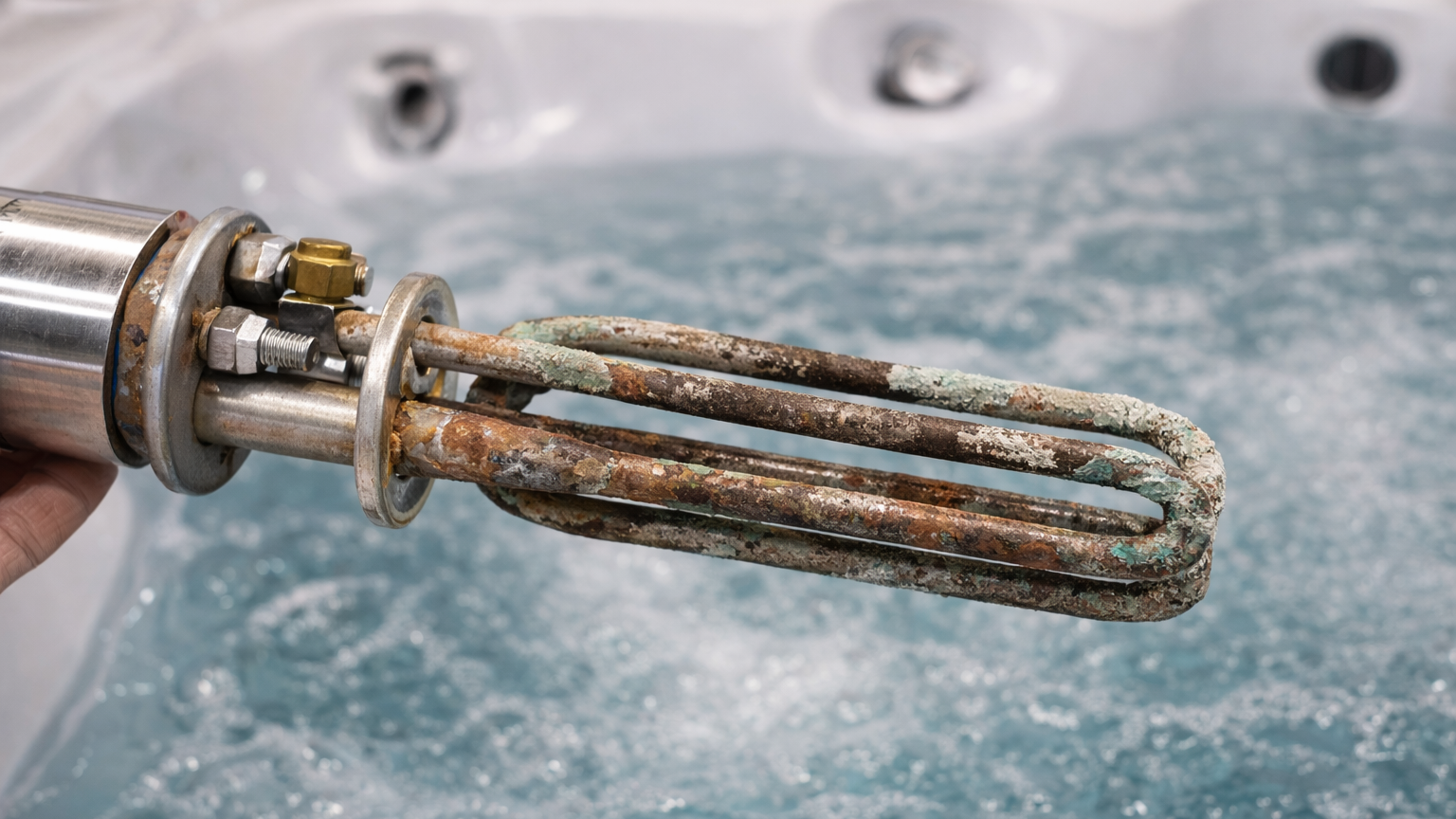
3. Visible Corrosion or Burn Marks
If you can safely access the heater assembly, inspect the element terminals.
Warning signs
- rust or scale buildup
- blackened terminals
- melted insulation on wires
- moisture around the heater tube
Corrosion often indicates long-term chemical imbalance and almost always shortens element life.
How to Test a Hot Tub Heating Element with a Multimeter
Testing is the best way to confirm failure before replacement.
Resistance (Ohms) Test
With power completely off:
- Disconnect both heater wires
- Set multimeter to resistance (ohms)
- Measure across the two terminals
Typical readings
- Most hot tub elements read 9–12 ohms (varies by wattage)
- Infinite resistance = broken element
- Zero or very low resistance = shorted element
If the reading is far outside normal range, the element is bad.
Ground Fault Test (Critical)
This test checks for internal leakage that trips GFCI breakers.
- Set multimeter to continuity or resistance
- Touch one probe to a heater terminal
- Touch the other probe to the metal heater tube
Expected result
- No continuity
- Infinite resistance
Any reading indicates the element is leaking current to ground and must be replaced.
If the Element Tests Good — What to Check Next
Many elements pass tests but still get blamed incorrectly.
Flow Problems
Low flow causes heaters to shut down for safety.
Check:
- dirty or collapsed filter
- weak circulation pump
- closed valves
- air trapped in plumbing
Always remove the filter and retest heating before condemning the element.
Temperature or High-Limit Sensors
A faulty sensor can shut the heater off prematurely.
Symptoms include:
- erratic temperature readings
- heater shutting off without breaker tripping
- recurring HL or OH errors
Sensor resistance should match manufacturer specs at room temperature.
Voltage Drop to the Heater
Elements require full voltage under load.
What to check
- Measure voltage at heater terminals while running
- A drop greater than ~10% indicates a wiring or relay issue
A good element won’t heat properly with low voltage.
Common Misdiagnoses That Waste Money
- Replacing the element when the filter is clogged
- Blaming the heater when a pressure switch is misadjusted
- Replacing the control board instead of testing voltage
- Ignoring ground fault testing
Heating elements fail — but not nearly as often as people think.
When Replacing the Heating Element Makes Sense
Replacement is the right move if:
- resistance readings are incorrect
- ground fault test fails
- breaker trips consistently during heating
- terminals are heavily corroded
- the spa is older and the element has high hours
At this point, replacement restores reliability and safety.
Choosing the Right Replacement Heating Element
When buying a replacement, always confirm:
- voltage (120V vs 240V)
- wattage rating
- length and mounting style
- compatibility with your heater housing
Installing the wrong element can damage the spa or trip breakers immediately.
When to Stop DIY and Call a Professional
Call a professional if:
- breaker trips after element replacement
- voltage readings are unstable
- heater relays show signs of overheating
- insulation resistance testing is needed
Electrical heater issues can be dangerous if misdiagnosed.
Related Articles
Written by Dan Harvickson, pool & spa repair technician