
Your hot tub cover used to be easy to lift.
Now it feels like it weighs twice as much.
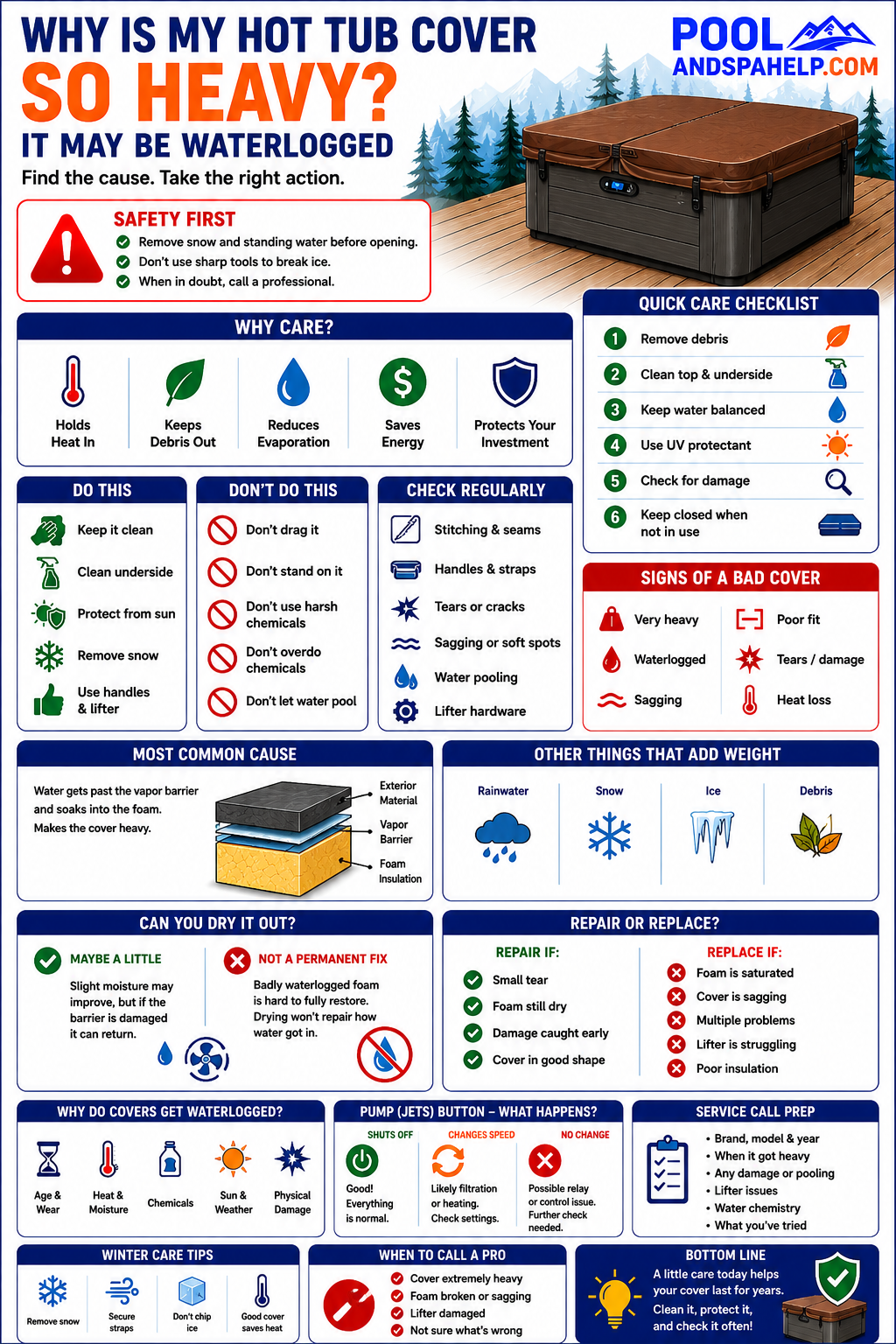
If a hot tub cover gradually becomes much heavier than it used to be, there’s a good chance moisture has made its way into the cover and the foam insulation has become waterlogged.
Unfortunately, once the foam absorbs a significant amount of water, there usually isn’t an easy permanent fix.
But before replacing the cover, it’s worth figuring out whether it really is waterlogged — and whether something else is adding all that weight.
Quick Answer: Why Is My Hot Tub Cover So Heavy?
A hot tub cover that has become increasingly heavy is usually caused by moisture getting through the protective vapor barrier around the foam insulation.
Once moisture reaches the foam core, the foam can gradually absorb it.
The result is a cover that:
- Feels much heavier
- Becomes difficult to open
- May begin sagging
- Doesn’t insulate as well
- Can put additional strain on the cover lifter
- May eventually need replacement
If the cover is only temporarily heavy after rain or snow, however, the problem may simply be water or snow sitting on top.
What’s Inside a Hot Tub Cover?
Understanding why covers become waterlogged is easier if you know how they’re constructed.
Most traditional hot tub covers contain rigid foam insulation cores.
Those foam cores are normally wrapped in a plastic vapor barrier designed to prevent moisture from reaching the foam.
Around that is the exterior cover material that you actually see.
So, in simplified form:
Exterior material → Vapor barrier → Foam insulation
The vapor barrier is extremely important.
A hot tub creates a warm, humid environment underneath the cover every day. If that barrier becomes damaged or deteriorates with age, moisture can eventually reach the foam.
The Most Common Cause: Waterlogged Foam
This is the first thing I’d suspect when someone tells me:
“My hot tub cover has gotten really heavy
Hot tub covers aren’t particularly light to begin with. But if you’ve owned the spa for a while, you know approximately what the cover normally feels like.
When it becomes noticeably heavier over months or years, something has changed.
Usually, that’s moisture inside the cover.
How Does Water Get Into the Foam?
The plastic vapor barrier surrounding the foam can eventually:
- Develop small holes
- Split
- Tear
- Separate at seams
- Become brittle
- Deteriorate from age and chemical exposure
Once moisture gets past that barrier, it can become trapped inside the cover.
The foam gradually absorbs more moisture, making the cover heavier.
Signs Your Hot Tub Cover Is Waterlogged
Weight is the most obvious clue, but there are others.
1. The Cover Is Much Harder to Lift
This is usually what people notice first.
If opening the cover has gradually become a workout, water intrusion should be high on your list of suspects.
2. One Side Is Heavier Than the Other
Hot tub covers commonly contain separate foam sections.
It’s possible for one foam core to become waterlogged before the other.
If one half suddenly feels considerably heavier, moisture may have entered that section.
3. The Cover Is Sagging
Water adds weight.
If the foam has also become damaged or weakened, the cover may start sagging toward the middle.
4. Water Pools on Top
A cover should normally be shaped so rainwater runs off.
If the cover develops a low spot and starts collecting water, the foam may be damaged, sagging, or deteriorated.
5. The Cover Doesn’t Seem to Hold Heat as Well
Dry foam is a good insulator.
Waterlogged insulation isn’t nearly as effective.
If the cover has become heavy and you’ve noticed the hot tub losing heat faster, those two symptoms may be related.
6. The Cover Lifter Struggles
A cover lifter designed for a normal cover suddenly has to move considerably more weight.
You may notice:
- More effort required
- Flexing
- Loose mounting hardware
- Bent components
- Difficulty keeping the cover supported
Don’t ignore this.
A badly waterlogged cover can eventually damage the lifter or its mounting points.
Heavy Doesn’t Always Mean Waterlogged
Before condemning the cover, check what’s actually making it heavy.
Rainwater
If the cover has a low spot, rainwater can collect on top.
Remove the standing water and see whether the cover returns to its normal weight.
If water repeatedly pools in the same area, however, investigate why the cover is sagging.
Snow
Snow gets heavy surprisingly quickly.
A significant accumulation can add a lot of weight to the cover.
Remove excessive snow with a soft broom or similar tool.
Avoid sharp shovels or tools that could puncture the cover.
Ice
Ice buildup can also add considerable weight.
Don’t aggressively chip ice off the cover.
It’s easy to damage the exterior material or puncture the vapor barrier underneath.
If possible, allow stubborn ice to melt rather than attacking it with a sharp object.
Can You Dry Out a Waterlogged Hot Tub Cover?
This is one of the first questions people ask.
And unfortunately, the answer is:
Sometimes you can remove some moisture, but a badly waterlogged cover usually isn’t permanently fixed by simply drying it.
If moisture entered because the vapor barrier is damaged, drying the foam doesn’t repair the reason the water got in.
The foam may simply become wet again.
What About Removing the Foam?
Some covers allow the foam inserts to be removed from the outer cover.
If you do this, be extremely careful.
The plastic vapor barrier surrounding the foam is important. Tearing or puncturing it can make the problem worse.
If the foam is only slightly damp and the barrier can genuinely be repaired, you might extend the cover’s life.
But if the foam is saturated, damaged, sagging, or the vapor barrier has deteriorated extensively, replacement usually makes more sense.
Can You Replace Just the Foam Inside a Hot Tub Cover?
Sometimes replacement foam inserts are available.
Whether that’s worthwhile depends on the condition of everything else.
Ask yourself:
- Is the exterior cover still in excellent condition?
- Are the seams intact?
- Are the handles good?
- Are the straps and locks still good?
- Is the hinge intact?
- Is the outer material still flexible?
- Is replacement foam actually available?
- How much does replacement foam cost compared with a complete cover?
If the cover is already old enough for the vapor barrier to fail, other parts may not be far behind.
In many cases, replacing the complete cover is the more practical solution.
Can You Repair the Vapor Barrier?
Small, accessible damage may sometimes be repairable with a suitable vapor-barrier repair material.
But there’s an important distinction:
Repairing a small tear before the foam becomes saturated is very different from trying to rescue a badly waterlogged cover.
If the foam has already absorbed a substantial amount of moisture, sealing the hole doesn’t magically remove the water that’s already inside.
That’s why early inspection matters.
Should You Keep Using a Waterlogged Hot Tub Cover?
A slightly damp cover isn’t necessarily an emergency.
A severely waterlogged one is another matter.
I’d start thinking seriously about replacement when the cover:
- Is extremely difficult to lift
- Is badly sagging
- Has broken foam
- Is damaging or overloading the cover lifter
- No longer fits properly
- Has extensive vapor-barrier damage
- Is clearly losing insulation performance
The issue isn’t just convenience.
Your hot tub cover is a major part of the spa’s insulation system.
Does a Waterlogged Cover Increase Heating Costs?
It can.
The foam inside the cover is there to slow heat transfer.
When that insulation becomes saturated with moisture, its insulating performance can deteriorate.
That means the hot tub may lose heat faster, particularly in cold or windy weather.
The heater then has to run more often to maintain the set temperature.
This becomes especially important in a cold climate.
A failing cover that seems like a minor annoyance in summer can become much more noticeable once temperatures drop below freezing.
A Heavy Cover Can Damage the Cover Lifter
This is something people don’t always consider.
Cover lifters are designed to handle a hot tub cover within a reasonable weight range.
As a cover becomes increasingly waterlogged, you’re asking the lifter to support substantially more weight than it originally did.
That can contribute to:
- Bent lifter arms
- Loose brackets
- Damaged mounting points
- Torn cover seams
- Broken handles
- Excessive stress on the spa cabinet
If your cover has become extremely heavy, don’t keep forcing the lifter indefinitely.
Fixing a cover problem is cheaper than turning it into a cover and lifter problem.
Why Do Hot Tub Covers Become Waterlogged?
Usually it’s a combination of age, moisture, heat, chemicals, and deterioration of the vapor barrier.
A hot tub cover lives in a harsh environment.
The underside is constantly exposed to:
- Warm moisture
- Condensation
- Sanitizer vapours
- Temperature changes
The exterior deals with:
- Sunlight
- Rain
- Snow
- Ice
- Wind
- Dirt and debris
Eventually, materials deteriorate.
Good cover care can help extend its life, but no conventional hot tub cover lasts forever.
How to Help Prevent a Hot Tub Cover From Becoming Waterlogged
You can’t guarantee that a cover will never absorb moisture, but you can reduce unnecessary damage.
Maintain Proper Water Chemistry
Don’t routinely run sanitizer levels excessively high.
Poorly balanced water and excessive chemical exposure can accelerate deterioration of materials underneath the cover.
Follow Instructions After Shocking the Spa
Some treatments require the hot tub to remain uncovered temporarily after chemicals are added.
Follow the chemical manufacturer’s instructions.
Don’t Damage the Vapor Barrier
If you remove the foam inserts, handle them carefully.
Even a small puncture can create a path for moisture.
Don’t Sit or Stand on the Cover
Excessive weight can crack the foam and damage internal materials.
Keep the Cover Clean and Inspect It
Occasionally look underneath the cover.
Catching a damaged seam or vapor barrier early is much better than discovering it after the foam has become saturated.
Quick Heavy-Cover Checklist
If your hot tub cover suddenly seems heavy, check these in order:
| What to Check | What It May Mean |
|---|---|
| Snow on top | Temporary added weight |
| Standing rainwater | Sagging or drainage problem |
| Ice buildup | Temporary added weight |
| One half much heavier | One foam core may be waterlogged |
| Entire cover gradually heavier | Moisture intrusion likely |
| Cover sagging | Foam may be damaged or saturated |
| Cover heavy + heat loss | Insulation may be deteriorating |
| Lifter struggling | Cover may be excessively heavy |
Repair or Replace?
Here’s a simple way to think about it.
| Cover Condition | What I’d Consider |
|---|---|
| Small tear, foam still dry | Repair may be worthwhile |
| Minor vapor-barrier damage caught early | Repair may be possible |
| Slight moisture, otherwise excellent cover | Inspect before deciding |
| One badly saturated foam core | Replacement insert if available and worthwhile |
| Both sides extremely heavy | Complete cover replacement |
| Sagging or broken foam | Replacement |
| Old cover with multiple problems | Replacement |
| Heavy cover causing lifter problems | Replacement should be strongly considered |
When It’s Probably Time for a New Cover
Eventually, repairing an old cover stops making financial sense.
I’d lean toward replacement when several symptoms appear together:
Heavy + sagging + deteriorated exterior + poor insulation = the cover has probably reached the end of its useful life.
Replacing it restores more than appearance.
A new properly fitting cover can make the spa:
- Easier to open
- Easier to close
- Better insulated
- Better protected from debris
- Less stressful on the cover lifter
Frequently Asked Questions
Why did my hot tub cover get so heavy?
If the cover has gradually become heavier over time, moisture has probably entered through a damaged or deteriorated vapor barrier and been absorbed by the foam insulation.
How do I know if my hot tub cover is waterlogged?
A dramatic increase in weight is the biggest clue. Sagging, water pooling, uneven weight between the two halves, and reduced insulation performance can also indicate waterlogged foam.
Can a waterlogged hot tub cover be dried out?
You may be able to remove some moisture from mildly affected foam, but badly saturated foam is difficult to restore permanently. If the vapor barrier is damaged, the moisture problem may return.
Can I replace only the foam in my hot tub cover?
Sometimes. Replacement inserts may be available, but compare the cost with replacing the complete cover — particularly if the exterior material, seams, handles, or straps are already deteriorating.
Why is only one side of my hot tub cover heavy?
The two foam cores are usually individually protected. One vapor barrier may have failed while the other remains intact.
Is a waterlogged hot tub cover dangerous?
The water itself isn’t usually the primary concern, but an extremely heavy cover can become difficult to handle and can put excessive stress on the cover lifter, mounting hardware, seams, and cabinet.
Will a waterlogged cover make my hot tub lose heat?
It can. Saturated insulation doesn’t perform like dry foam, so a badly waterlogged cover may allow the spa to lose heat faster.
The Bottom Line
If your hot tub cover has become much heavier than it used to be, don’t assume that’s just normal aging.
Check for snow, ice, or standing water first.
If none of those explains the weight, the foam inside the cover may be absorbing moisture through a damaged vapor barrier.
Minor damage caught early may sometimes be repairable.
But once a cover becomes badly waterlogged, heavy, sagging, and poorly insulated, replacement is usually the practical solution.
And don’t ignore a cover that’s becoming progressively heavier.
Besides making the hot tub harder to use, all that additional weight can eventually turn one worn-out cover into a worn-out cover and a broken cover lifter.
Related Articles:
Written by Dan Harvickson (Founder of Last Mountain Tech) Pool and Spa Specialist