
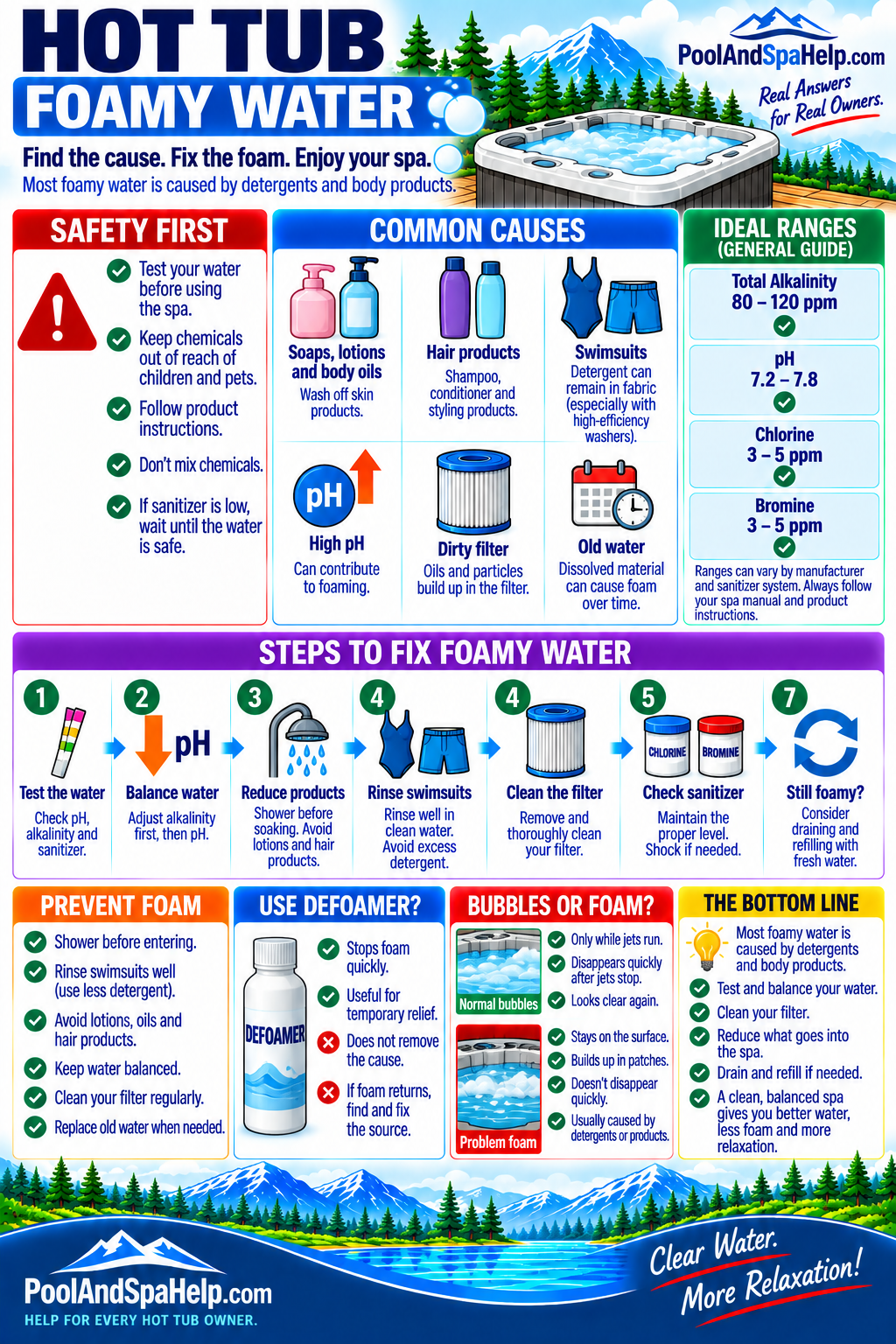
You turn on the hot tub jets and suddenly the surface looks like a bubble bath.
A small amount of temporary bubbling from powerful jets isn’t necessarily a problem. But thick foam that builds on the surface and sticks around after the jets are turned off usually means something has been introduced into the water or the water chemistry needs attention.
One of the most common causes is surprisingly simple: detergents and personal-care products getting into the hot tub.
Laundry detergent left in swimsuits, skin lotions, soaps, shampoos, conditioners, hair products, and similar contaminants can all contribute to foaming. Once they’re in the water, the jets vigorously aerate the water and can turn a relatively small amount of contamination into a layer of foam.
The good news is that foamy hot tub water is usually fairly easy to diagnose.
Quick Summary: Why Is My Hot Tub Foaming?
If your hot tub suddenly starts producing persistent foam, check these first:
| Check | What You’re Looking For | What to Do |
|---|---|---|
| Water chemistry | pH or alkalinity out of range | Test and balance the water |
| Swimsuits | Laundry detergent or fabric products | Rinse suits thoroughly without detergent |
| Lotions and body products | Lotions, oils, cosmetics, hair products | Shower before entering |
| Filter | Dirty or contaminated filter | Clean the filter thoroughly |
| Sanitizer | Low sanitizer or heavy contaminant load | Restore proper sanitizer level |
| Water age | Old water with accumulated dissolved material | Consider draining and refilling |
If the foam appeared shortly after several people used the spa, or after someone entered wearing a freshly washed swimsuit, contamination from detergents or personal-care products should be high on the list.
Safety Stop
Before trying to correct foamy water, make sure the water is properly sanitized.
Clear-looking water isn’t necessarily properly sanitized water, and neither is foamy water. If sanitizer levels are too low or you aren’t confident the water is safe, avoid using the hot tub until the water has been tested and corrected.
Always follow the directions on your specific chemical products. Don’t mix spa chemicals together, and don’t assume that adding extra chemicals will solve the problem faster.
Step 1: Test the Water
Start with a proper water test.
Check:
- pH
- Total alkalinity
- Sanitizer level
Foaming shouldn’t automatically be blamed on detergent without checking the chemistry first.
High pH can contribute to water problems and should be corrected before chasing other solutions. An alkalinity problem can also make pH difficult to control.
As a general guide, many hot tubs operate around:
- pH: 7.2–7.8
- Total alkalinity: approximately 80–120 ppm
Always use the ranges recommended for your spa and chemical system.
If alkalinity and pH both need adjustment, correct alkalinity first and then adjust pH.
For more information visit: Hot Tub Water Chemistry: A Simple Guide to Clear, Safe Water
Step 2: Think About What Has Entered the Hot Tub
If the water chemistry is reasonably balanced, start thinking about contamination.
This is where I would pay particular attention to detergents and personal-care products.
Hot tub water is a relatively small volume of water compared with a swimming pool. It doesn’t take much contamination to affect it.
Common sources include:
- Laundry detergent left in swimsuits
- Fabric softener
- Body lotion
- Sunscreen
- Shampoo and conditioner
- Hair styling products
- Body oils
- Soap
- Cosmetics
You may never actually see these products entering the water.
They simply wash off swimmers.
Then the jets do what jets are very good at doing: mixing a tremendous amount of air into the water.
If surfactants are present, that aeration can create foam.
Step 3: Don’t Overlook the Swimsuits
This is one of the first things I consider when persistent foam keeps returning.
A swimsuit can carry detergent into the hot tub even though it looks and feels completely clean.
Modern high-efficiency washing machines use much less water than older washing machines. Depending on the machine, cycle, detergent amount, and load, a swimsuit may retain detergent or other laundry products after washing.
Then somebody gets into a relatively small hot tub wearing that swimsuit.
The remaining detergent rinses into the spa.
Turn on the jets and:
Instant foam machine.
If foaming repeatedly appears after certain swimsuits are used, try thoroughly rinsing those suits in clean water before they go back into the hot tub.
Some frequent hot tub users choose to keep dedicated swimsuits for the spa and rinse them in clean water rather than routinely washing them with detergent.
You obviously still want clean swimwear—the goal is simply to minimize detergent residue entering the spa.
Step 4: Consider Lotions and Hair Products
Swimsuits aren’t the only way surfactants and oils enter the water.
Think about everything that may be on someone’s body:
Skin → lotion → hot tub
Hair → conditioner/styling products → hot tub
Swimsuit → detergent → hot tub
With several bathers, those small amounts can add up quickly.
A quick shower before using the hot tub can significantly reduce the amount of material introduced into the water.
This becomes particularly important when the hot tub gets heavy use.
Step 5: Check and Clean the Filter
Your filter is part of the cleanup process.
As contaminants accumulate in the water, some will eventually end up trapped in the filter.
Remove the filter and inspect it.
If it’s dirty, greasy, or overdue for cleaning, give it a proper cleaning according to the filter manufacturer’s recommendations.
Simply spraying a heavily contaminated filter with water may not remove oils and other material embedded in the filter media.
Also inspect the filter itself. An old, damaged, or heavily contaminated filter may need replacement rather than another cleaning.
Step 6: Check the Sanitizer
Test your chlorine or bromine level.
Heavy bather use and organic contamination can consume sanitizer surprisingly quickly.
If sanitizer is low, restore it according to the instructions for your particular sanitation system.
Depending on the condition of the water, shocking the hot tub may also be appropriate.
But don’t fall into the trap of blindly adding more and more chemicals.
Test first. Treat the problem you actually have.
Step 7: How Old Is the Water?
Sometimes you can correct the chemistry, clean the filter, shock the water, and still have persistent foam.
At that point, ask a simple question:
How old is the water?
Every time people use the hot tub, something gets left behind. Chemicals are added. Water evaporates while dissolved material remains. Fresh water gets added. More people use the spa.
Eventually the water can become increasingly difficult to manage.
If you’re constantly fighting foam and the water has been in the spa for a long time, draining and refilling may be easier and more effective than continuing to add chemicals.
Fresh water gives you a clean starting point.
After refilling:
- Start circulation.
- Test the fresh water.
- Adjust total alkalinity.
- Adjust pH.
- Establish the proper sanitizer level.
- Retest before using the spa.
What About Hot Tub Defoamer?
Commercial defoamers can make foam disappear quickly.
That can be useful when you need a temporary solution, but there’s an important distinction:
Removing the foam isn’t necessarily removing the cause of the foam.
If detergent, lotions, oils, old water, or another contaminant is causing the problem, defoamer may suppress the visible symptom without solving the underlying water-quality issue.
If you continually need defoamer, something else probably needs attention.
Use it as directed, but don’t let it replace troubleshooting.
Why Does the Foam Get Worse When I Turn On the Jets?
The jets introduce air and create turbulence.
Normally you’ll see bubbles while the jets are operating, and those bubbles should disappear relatively quickly.
When surfactants such as soaps and detergents are present, they change how the bubbles behave. Instead of immediately collapsing, the bubbles become more stable and begin accumulating on the surface.
That’s why water that doesn’t look particularly unusual with the pumps off can suddenly resemble a bubble bath when the jets come on.
Bubbles or Foam?
There’s an easy observation you can make.
Turn the jets off and watch the surface.
Normal jet bubbles: disappear relatively quickly.
Foam caused by contaminants: tends to remain on the surface, accumulate in patches, or collapse much more slowly.
It isn’t a laboratory test, but it’s a useful troubleshooting clue.
Most Common Fixes for Foamy Hot Tub Water
In many cases, the solution is some combination of:
- Balance the alkalinity and pH.
- Restore the proper sanitizer level.
- Clean the filter.
- Reduce lotions, oils, and hair products entering the water.
- Thoroughly rinse swimsuits.
- Shock the water when appropriate.
- Drain and refill if the water is old or heavily contaminated.
What I wouldn’t recommend is continually adding defoamer every time the jets are turned on.
If the foam keeps coming back, find out why.
How to Prevent Hot Tub Foam
Prevention mostly comes down to controlling what enters the water.
Showering before entering the spa helps remove lotions, cosmetics, sweat, oils, and hair products.
Swimsuits deserve special attention. If possible, thoroughly rinse hot-tub swimsuits in clean water and avoid excessive detergent or fabric products.
Also maintain the basics:
Keep the filter clean. Test the water regularly. Maintain the correct sanitizer level. Keep alkalinity and pH balanced. Replace old water when it becomes difficult to maintain.
Those habits prevent far more water problems than repeatedly treating symptoms after they appear.
When Should I Drain the Hot Tub?
A drain and refill becomes increasingly reasonable when:
- Foam returns immediately after treatment.
- The water is old.
- A large amount of detergent or another contaminant entered the spa.
- Water chemistry has become difficult to maintain.
- The water has several problems at the same time.
- You’re adding one chemical after another without making meaningful progress.
Sometimes fresh water is cheaper, faster, and easier than trying to rescue badly contaminated water.
Frequently Asked Questions
Why did my hot tub suddenly start foaming?
Think about what changed recently. New swimmers, freshly washed swimsuits, lotions, hair products, low sanitizer, chemistry changes, or a heavy weekend of hot tub use can all contribute.
If the chemistry tests normally, detergent and personal-care products are good places to investigate.
Can laundry detergent cause hot tub foam?
Yes. Detergent residue carried into the spa on swimsuits can contribute to persistent foaming, particularly once the jets begin aerating the water.
Can a high-efficiency washing machine contribute to the problem?
Potentially. High-efficiency machines use less water, and rinsing performance depends on the machine, cycle, load, and amount/type of detergent being used. If you suspect swimsuit residue, thoroughly rinsing the suit in clean water before hot tub use is an easy test.
Can high pH make a hot tub foam?
Water balance problems can contribute to poor water quality, so pH and alkalinity should always be checked when troubleshooting foam. Correct abnormal readings rather than assuming every foaming problem is caused by soap.
Should I use defoamer?
Defoamer can temporarily knock down foam, but it doesn’t necessarily remove whatever caused the foam. If you repeatedly need it, investigate the underlying cause.
Why does my hot tub only foam when the jets are running?
Jets introduce large amounts of air into the water. If surfactants such as detergent, soap, or personal-care products are present, that aeration makes the problem much more visible.
Should I shock a foamy hot tub?
It may be appropriate when sanitizer demand and organic contamination are part of the problem, but shock isn’t a universal cure for foam. Test the water first and follow the directions for your sanitation system and shock product.
When a hot tub starts foaming, don’t immediately reach for another bottle of chemicals.
Start with the basics:
Test the water → correct alkalinity and pH → check sanitizer → clean the filter → investigate detergents and personal-care products → consider the age of the water.
And don’t underestimate the swimsuit.
A perfectly clean-looking swimsuit can carry enough detergent residue into a relatively small volume of hot tub water to contribute to foaming—especially once powerful jets start mixing air into the water.
Fix what is getting into the hot tub, and you’ll usually have much better results than repeatedly trying to make the foam disappear.
Written by Dan Harvickson (Founder of Last Mountain) Pool and Spa Specialist