
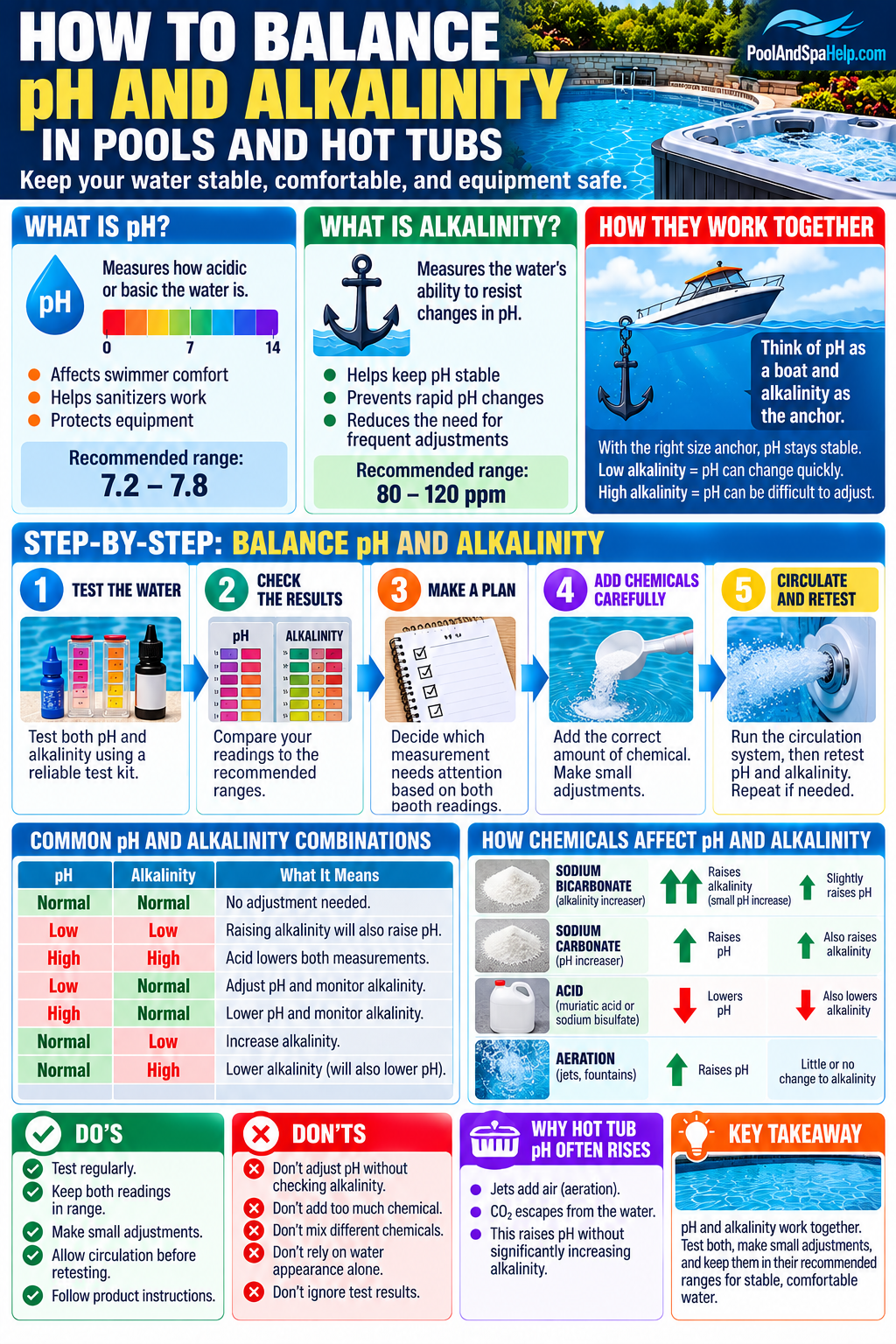
Maintaining proper pH and total alkalinity is an important part of keeping your pool or hot tub water comfortable, protecting equipment, and preventing water chemistry problems.
However, these two measurements are closely connected, and adjusting one can affect the other.
This is where many pool and hot tub owners become frustrated. They adjust their pH, only to discover that it has changed again the following day. Or they raise their alkalinity and suddenly find that their pH is too high.
The key to avoiding these problems is understanding how pH and alkalinity work together.
Balancing pH and alkalinity isn’t simply about getting two numbers into their recommended ranges. It’s about getting them to work together so your water chemistry remains stable.
In this guide, we’ll explain the relationship between pH and alkalinity, which measurement to address first, and how to bring both into balance without making unnecessary chemical adjustments.
Understanding pH and Total Alkalinity
Before adjusting your water chemistry, it’s important to understand what these two measurements actually represent.
Although they’re closely related, pH and total alkalinity measure different things.
What Is pH?
pH measures how acidic or basic your pool or hot tub water is.
The pH scale runs from 0 to 14, with 7 considered neutral.
- Below 7: Acidic
- At 7: Neutral
- Above 7: Basic (alkaline)
Most pools and hot tubs should maintain a pH between 7.2 and 7.8, although some manufacturers recommend a narrower range.
When pH is too low, the water becomes more acidic, potentially contributing to corrosion, equipment damage, and swimmer discomfort.
When pH is too high, the water becomes more basic, increasing the potential for scale formation and reducing the effectiveness of unstabilized chlorine.
What Is Total Alkalinity?
Total alkalinity measures the water’s ability to resist changes in pH.
Think of alkalinity as an anchor that helps keep pH stable.
When alkalinity is within an appropriate range, it helps prevent sudden changes in pH.
If alkalinity is too low, pH can become unstable and fluctuate more easily.
If alkalinity is too high, pH may become difficult to lower and may repeatedly rise, particularly in water with significant aeration.
For many pools and hot tubs, a commonly recommended total alkalinity range is 80–120 parts per million (ppm).
However, the ideal range can vary depending on the sanitizer system, equipment, and water conditions.
Some systems operate successfully with lower alkalinity targets.
How pH and Alkalinity Work Together
Imagine your pool or hot tub’s pH as a boat floating on the water.
Total alkalinity acts like an anchor.
With an appropriately sized anchor, the boat remains relatively stable.
If the anchor is too small, the boat can drift around easily.
If the anchor is excessively large, moving the boat becomes more difficult.
The same basic principle applies to pH and alkalinity.
Low alkalinity: pH has less resistance to change.
Appropriate alkalinity: pH is generally easier to maintain within its recommended range.
High alkalinity: pH may resist adjustment and can have a tendency to rise.
However, alkalinity doesn’t control pH by itself. Aeration, chemical additions, dissolved carbon dioxide, and other factors also influence pH.
This is particularly important in hot tubs, where jets introduce considerable aeration.
Recommended pH and Alkalinity Levels
Although pools and hot tubs follow the same basic chemistry principles, their ideal operating ranges may differ.
| Measurement | Swimming Pool | Hot Tub |
|---|---|---|
| pH | 7.2–7.8 | 7.2–7.8 |
| Total alkalinity | Commonly 80–120 ppm | Commonly 80–120 ppm |
| Preferred target | Depends on the system | Depends on the system |
These are general reference ranges. Always follow the recommendations for your specific pool or hot tub, sanitizer system, and equipment.
For example, some hot tubs experience persistent pH increases when alkalinity is maintained near the upper end of the traditional range.
In these situations, a manufacturer-approved lower alkalinity target may provide better pH stability.
Technician’s Tip: Don’t automatically assume that an alkalinity reading of 80 ppm is better or worse than 100 ppm. The goal is to maintain appropriate alkalinity while keeping pH stable.
Step 1: Test Both pH and Alkalinity
Before adding any chemicals, test both measurements.
Avoid adjusting pH based on its reading alone without checking alkalinity.
For example, if your pH is low and your alkalinity is also low, the approach may be different from a situation where pH is low but alkalinity is already high.
Choosing a Test Kit
A quality liquid reagent test kit is generally a good choice for measuring pH and total alkalinity.
Test strips can also be useful, although they may be less precise.
For reliable results:
- Run the circulation system to mix the water.
- Collect a sample away from return jets and chemical feeders.
- Follow the test kit’s instructions.
- Record both readings.
- Compare the results with your recommended operating ranges.
If the results seem unusual, repeat the test before making significant adjustments.
Old reagents, improperly stored test strips, and testing errors can produce misleading results.
Important: Also verify that sanitizer levels are safe. Acceptable pH and alkalinity readings do not guarantee properly sanitized water.
Step 2: Determine Which Measurement Needs Attention
Once you have both readings, the next step is deciding how to approach the adjustments.
The following table provides a general starting point.
| pH | Alkalinity | What to Consider |
|---|---|---|
| Normal | Normal | No adjustment necessary |
| Low | Low | Raising alkalinity may also raise pH |
| High | High | Acid lowers both measurements |
| Low | Normal | Adjust pH while monitoring alkalinity |
| High | Normal | Lower pH and monitor alkalinity |
| Normal | Low | Evaluate whether alkalinity needs increasing |
| Normal | High | Lowering alkalinity may also lower pH |
| Low | High | Requires careful management of both measurements |
| High | Low | Requires separate consideration of pH and alkalinity |
This table is a starting point rather than a complete chemical treatment procedure.
The correct adjustment depends on how far the readings are outside their recommended ranges.
Should You Always Adjust Alkalinity First?
You’ve probably heard that alkalinity should always be adjusted before pH.
That’s a useful general guideline, but it isn’t an absolute rule.
Alkalinity influences pH stability, so correcting an alkalinity problem can make subsequent pH adjustments easier.
However, there are situations where pH needs immediate attention.
For example, if pH is extremely low, allowing the water to remain acidic while attempting to correct other measurements may expose equipment to unnecessary risk.
Similarly, reducing high alkalinity involves deliberately lowering pH and then raising it again through aeration.
The best approach is to evaluate both readings together rather than following a fixed adjustment sequence.
Step 3: Understand How Chemical Adjustments Affect Both Measurements
One of the most important things to understand about balancing pH and alkalinity is that many chemicals affect both.
This is why adjusting one measurement can unexpectedly change the other.
Raising Alkalinity
Sodium bicarbonate, commonly sold as alkalinity increaser, is used to raise total alkalinity.
It generally increases alkalinity significantly while producing a smaller increase in pH.
This makes it useful when alkalinity is low, particularly when pH is also low or within its recommended range.
However, adding too much can push alkalinity above the desired target.
Raising pH
Sodium carbonate, commonly called soda ash or pH increaser, raises pH.
It also raises total alkalinity.
This is important because using soda ash to correct low pH can create an alkalinity problem if the alkalinity is already high.
Aeration can also raise pH by allowing dissolved carbon dioxide to escape from the water.
Unlike adding soda ash, aeration raises pH without significantly increasing total alkalinity.
Lowering pH
Acid is commonly used to lower pH.
Depending on the product, this may involve muriatic acid or sodium bisulfate.
However, adding acid also reduces total alkalinity.
This means repeated pH reductions can gradually lower alkalinity.
Lowering Alkalinity
Lowering total alkalinity generally involves adding acid.
The challenge is that acid reduces both alkalinity and pH.
To reduce alkalinity while maintaining an appropriate pH, the process often involves controlled acid additions followed by aeration.
Aeration raises pH without restoring the alkalinity that was removed.
This process may need to be repeated until both measurements are within suitable ranges.
Safety Stop — Pool and Spa Chemicals
Always follow the chemical manufacturer’s instructions for dosing, handling, circulation, and retesting.
Never mix pool chemicals together or combine chlorine products with acids.
Wear appropriate protective equipment, and keep swimmers out of the water until chemical levels are safe and the manufacturer’s re-entry requirements have been met.
For detailed correction procedures, see our separate guides on high and low alkalinity and high and low pH.
Step 4: Make Small, Measured Adjustments
Once you’ve determined which measurement needs correction, calculate the required chemical dose.
The amount depends on:
- Pool or hot tub water volume
- Current pH and alkalinity readings
- Desired target levels
- Chemical concentration
- Existing water chemistry
Never estimate chemical doses based solely on the appearance of the water.
Why Water Volume Matters
Consider the difference between a swimming pool containing 20,000 gallons and a hot tub containing 400 gallons.
The pool contains 50 times as much water.
A chemical dose that produces a small change in the swimming pool could cause a major change in the hot tub.
This is why accurate water volume is particularly important when adjusting hot tub chemistry.
Avoid Overshooting Your Target
When permitted by the product instructions, making a measured adjustment and retesting before adding more chemicals can help prevent overshooting.
You don’t necessarily need to reach the middle of the recommended range.
For example, if your pH is 7.5 and alkalinity is 90 ppm, and both measurements are appropriate for your system, there’s usually no reason to add chemicals simply to reach a different number.
Technician’s Tip: Water chemistry doesn’t need to be perfect. It needs to remain within appropriate operating ranges.
Step 5: Circulate the Water and Retest
After adding chemicals, allow the water to circulate according to the product manufacturer’s instructions.
Proper circulation distributes the chemicals throughout the pool or hot tub.
Once the required mixing time has passed, retest both pH and alkalinity.
Even if you only intended to change one measurement, the other may have changed as well.
For example:
You add alkalinity increaser to raise total alkalinity from 60 ppm to 90 ppm.
After circulation, your alkalinity reaches the desired range, but your pH has also increased.
Before adding another chemical, evaluate whether the new pH reading is still within its acceptable range.
If it is, no further adjustment may be necessary.
If additional corrections are needed, make them carefully and retest again.
The goal is to bring both measurements into appropriate ranges without repeatedly pushing one too high or too low.
Why Hot Tub pH Often Rises Even When Alkalinity Is Normal
Hot tubs present a slightly different challenge from swimming pools.
The primary reason is aeration.
When hot tub jets operate, they introduce air and create turbulence in the water.
This encourages dissolved carbon dioxide to escape.
As carbon dioxide leaves the water, pH tends to rise.
The important distinction is that pH can increase through aeration without a significant change in total alkalinity.
This means your alkalinity may remain relatively stable while your pH gradually increases.
Does This Mean Alkalinity Is Too High?
Not necessarily.
However, higher total alkalinity can contribute to faster or more persistent pH increases in heavily aerated water.
This is why some hot tubs maintain more stable pH at lower alkalinity levels than traditionally recommended.
The appropriate target depends on the hot tub’s construction, sanitizer system, and manufacturer recommendations.
If your hot tub repeatedly experiences rising pH, don’t automatically continue adding pH decreaser without investigating the relationship between aeration and alkalinity.
Repeated acid additions will also reduce alkalinity over time.
Why Pool pH and Alkalinity May Behave Differently
Swimming pools generally contain much larger volumes of water than hot tubs.
They also tend to operate at lower temperatures and often experience less aeration.
As a result, pH and alkalinity may change more gradually.
However, several factors can influence pool water chemistry.
These include:
- Water features and fountains
- Spillover spas
- Saltwater chlorine generators
- Chemical additions
- Rainwater and replacement water
- The alkalinity of the fill water
Pools with waterfalls, fountains, or spillover features may experience increased pH because of aeration.
Similarly, saltwater chlorine pools often experience upward pH drift, although the amount depends on the system and water chemistry.
The important point is that pH behavior depends on more than alkalinity alone.
Understanding how your particular pool operates can help you maintain more consistent water chemistry.
How to Keep pH and Alkalinity Stable
Once you’ve brought both measurements into their recommended ranges, the next goal is keeping them there.
Fortunately, maintaining stable water chemistry is usually easier than correcting a significant imbalance.
Test Regularly
Check pH frequently enough to identify changes before they become significant.
For swimming pools, testing several times per week during regular use is a practical starting point.
Hot tubs generally require more frequent pH testing, particularly during periods of heavy use.
Check alkalinity weekly or more often if readings are unstable.
Always follow any more frequent testing requirements specified by your sanitizer or equipment manufacturer.
Keep Track of Your Readings
Recording test results can help identify patterns.
For example, you may notice that your hot tub’s pH consistently increases after several days of use.
Or perhaps your pool’s alkalinity gradually decreases because of repeated acid additions.
Recognizing these patterns can help you make better adjustments.
Avoid Unnecessary Chemical Additions
If both measurements are within their recommended ranges and remain stable, avoid making adjustments simply to achieve an exact target.
Unnecessary chemical additions can create more problems than they solve.
Check Your Fill Water
The water used to fill or top up your pool or hot tub can affect pH and alkalinity.
Some municipal and well-water supplies contain relatively high alkalinity.
Others may have lower alkalinity or different pH characteristics.
If your water chemistry changes significantly after refilling, test your source water.
Understanding its chemistry can help explain why adjustments are necessary after filling.
Common Mistakes When Balancing pH and Alkalinity
1. Adjusting pH Without Testing Alkalinity
This can lead to repeated corrections when alkalinity is contributing to pH instability.
Always check both measurements before making significant adjustments.
2. Assuming High Alkalinity Always Means High pH
Although the two measurements are related, they aren’t the same thing.
It’s possible to have high alkalinity and relatively low pH.
The dissolved carbon dioxide content of the water plays an important role in this relationship.
3. Trying to Correct Both Measurements With One Chemical
Some chemicals affect both pH and alkalinity, but they don’t necessarily change them by the same amount.
One chemical addition may improve one measurement while pushing the other outside its desired range.
4. Adding More Chemicals Before Retesting
Making several adjustments without allowing sufficient circulation can lead to overdosing.
Follow the manufacturer’s mixing and retesting instructions.
5. Chasing Exact Numbers
A pH of 7.4 isn’t automatically better than 7.6.
Likewise, an alkalinity reading of 100 ppm isn’t necessarily better than 90 ppm.
The correct target depends on your particular system and overall water chemistry.
6. Ignoring Aeration
Hot tub jets, waterfalls, fountains, and spillover features can raise pH through carbon dioxide loss.
Repeatedly adding acid without understanding this process can gradually reduce alkalinity.
Frequently Asked Questions
Can pH Be Normal When Alkalinity Is Too High?
Yes.
pH and alkalinity measure different properties of the water.
You can have acceptable pH with alkalinity above the recommended range.
However, high alkalinity may contribute to pH rising over time, particularly in aerated water.
Does Raising Alkalinity Also Raise pH?
Usually, yes.
Sodium bicarbonate generally raises total alkalinity while causing a smaller increase in pH.
The amount of pH change depends on the existing water chemistry.
Can I Raise pH Without Raising Alkalinity?
Yes.
Aeration can raise pH by allowing dissolved carbon dioxide to escape.
This process does not significantly increase total alkalinity.
Does Lowering pH Reduce Alkalinity?
Yes.
Adding acid to lower pH also reduces total alkalinity.
The amount of change depends on the acid dose and existing water chemistry.
Why Does My Hot Tub pH Keep Rising?
Aeration from hot tub jets is a common cause.
As dissolved carbon dioxide escapes, pH increases.
Higher alkalinity can contribute to more persistent pH increases under these conditions.
Should I Adjust Alkalinity Every Time I Adjust pH?
No.
You should test both measurements, but that doesn’t mean both require adjustment.
If alkalinity is within an appropriate range and remains stable, there may be no reason to change it.
Is 80 ppm Alkalinity Too Low for a Hot Tub?
Not necessarily.
An alkalinity reading of 80 ppm may be suitable for many hot tubs.
Some systems may operate successfully at lower levels, while others require higher targets.
Follow the hot tub and sanitizer manufacturers’ recommendations.
Final Thoughts
Balancing pH and total alkalinity becomes much easier when you understand how the two measurements work together.
Total alkalinity helps stabilize pH, but it doesn’t prevent pH from changing.
Aeration, chemical additions, and other factors can still influence water chemistry.
The most important things to remember are:
- Test pH and alkalinity together.
- Understand that adjusting one may affect the other.
- Don’t assume alkalinity must always be adjusted first.
- Make measured chemical adjustments based on water volume.
- Allow adequate circulation before retesting.
- Avoid chasing exact numbers when both measurements are within appropriate ranges.
- Pay attention to aeration, particularly in hot tubs.
The goal isn’t to constantly adjust your water chemistry. It’s to find the balance that keeps your pH stable while maintaining appropriate alkalinity.
If one of your measurements is consistently outside its recommended range, see our dedicated troubleshooting guides:
Related Articles:
- Hot Tub Water Chemistry: A Simple Guide to Clear, Safe Water
- Hot Tub Water Smells Musty? What to Check and How to Fix It
Written by Dan Harvickson (Founder of Last Mountain Tech) Pool and Spa Specialist