
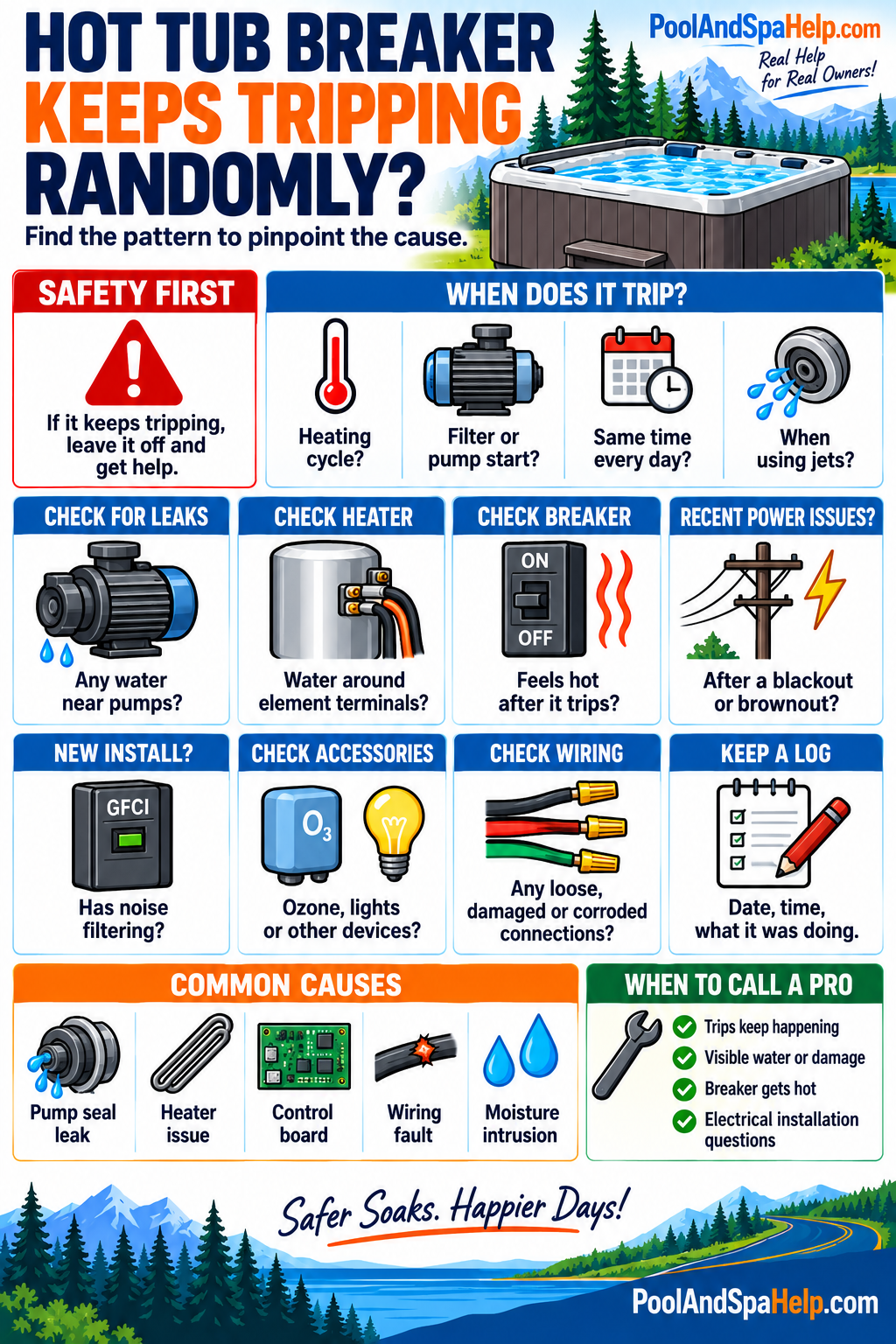
Your hot tub runs perfectly for hours—or even days.
Then suddenly:
Click.
The breaker trips.
You reset it and everything works normally again.
Maybe it runs for another day. Maybe a week.
Then it happens again.
Intermittent hot tub breaker trips can be some of the most difficult electrical problems to diagnose because the problem may not be present when you’re looking for it.
A component that tests perfectly today may only cause a trip when it heats up, gets wet, starts during a particular cycle, or operates under a specific set of conditions.
That’s why one of the most useful diagnostic tools for an intermittent breaker trip isn’t necessarily a multimeter.
It’s information.
The more you know about what the hot tub was doing immediately before the breaker tripped, the better chance you have of narrowing down the cause.
Safety First
A GFCI breaker is an important electrical safety device.
If it keeps tripping, don’t simply assume the breaker is being overly sensitive.
It may be detecting a genuine electrical fault.
Hot tubs combine high-voltage electricity and water, so electrical diagnosis should be performed by someone qualified to work safely on the equipment.
Never bypass a GFCI or replace it with a non-GFCI breaker to stop nuisance tripping.
Turn off power and call a qualified technician or electrician if you find:
- Water around electrical connections
- Burned or melted wiring
- Damaged electrical components
- Signs of arcing
- A burning smell
- A breaker that becomes unusually hot
- Repeated trips that are becoming more frequent
Start Here
If your hot tub breaker trips only occasionally:
- Write down when it trips.
- Note what the hot tub was doing at the time.
- Look for water around electrical equipment.
- Inspect pumps for signs of shaft-seal leakage.
- Check around heater element terminals for moisture.
- Note whether the breaker feels unusually hot after a trip.
- Think about recent blackouts, brownouts, or power disturbances.
- If it’s a newer installation, verify that the GFCI/breaker setup is appropriate for the spa, including any manufacturer requirements related to electrical noise filtering.
- Look for patterns rather than repeatedly resetting the breaker.
Technician Tip: With an intermittent trip, the information provided by the hot tub owner can be extremely valuable. Knowing that it usually trips during heating, filtration, a jet cycle, or shortly after a power interruption can dramatically narrow down what needs to be investigated.
From My Experience: Intermittent trips can be extremely frustrating to diagnose. I’ve had hot tubs behave perfectly throughout an entire service call, only to have the homeowner call me 5–10 minutes after I left to say the breaker tripped again. That’s why I ask owners to record when the trip happens and what the spa was doing at the time. Sometimes that pattern provides the clue you simply can’t reproduce during a service call.
First Question: Is It Really Random?
It may appear random because nobody happens to be watching the hot tub when the breaker trips.
But hot tubs perform many operations automatically.
While you’re inside the house, the spa may:
- Start a filtration cycle
- Turn on a circulation pump
- Start the heater
- Run a purge cycle
- Activate another programmed function
If the breaker consistently trips when one particular component starts, the problem isn’t really random.
You just haven’t identified the pattern yet.
Become a Detective: Keep a Trip Log
If the spa only trips occasionally, start keeping notes.
Each time it happens, record:
- Date
- Approximate time
- Water temperature
- Weather conditions
- Whether anyone was using the spa
- Whether the jets were running
- Whether the spa was heating
- Whether a filtration cycle may have started
- Whether there had recently been a blackout or brownout
- Whether it was raining or particularly humid
- Whether the spa had recently been refilled or serviced
You don’t need perfect information.
Even a rough pattern can be extremely helpful.
For example:
“It seems to trip every morning.”
That may correspond with a scheduled filtration cycle.
Or:
“It only seems to happen when the water needs to heat.”
Now the heating circuit deserves much more attention.
Does It Trip When the Heater Turns On?
The heater is one of the first components worth investigating if the timing of the trips corresponds with heating.
A heater element can develop an insulation fault that allows current to leak to ground.
Sometimes the problem may be intermittent.
The element may behave differently:
- When cold
- When hot
- After operating for a while
- When moisture is present
Also inspect around the heater element terminals.
Look for:
- Moisture
- Corrosion
- Burn marks
- Damaged terminals
- Evidence of previous overheating
Water near heater electrical terminals is a serious concern.
Shut the power off if you find it.
Does It Trip During a Filtration Cycle?
This is another useful clue.
Depending on the hot tub design, a filtration cycle may activate:
- A circulation pump
- A jet pump
- The heater
- Ozone equipment
- Other accessories
If the breaker repeatedly trips around the beginning of filtration, determine which components are being energized during that cycle.
One of them may be causing the fault.
The owner’s control settings and filtration schedule can be extremely useful here.
If the filtration cycle starts at approximately the same time every day and the breaker mysteriously trips around that time, you may have found your first real clue.
Does It Trip When a Particular Pump Runs?
Pumps deserve careful inspection.
A pump can create an intermittent electrical problem because of:
- Moisture entering the motor
- Damaged wiring
- Motor winding problems
- Internal electrical faults
- A failing capacitor or other electrical component
- Water leaking from the wet end toward the motor
Pay particular attention to the pump shaft seal.
A small shaft-seal leak may allow water to travel toward the motor or electrical components.
The leak may be small enough that there isn’t a large puddle in the equipment compartment.
Look for:
- Water between the wet end and motor
- Mineral deposits
- Rust
- Corrosion
- Dampness underneath the pump
- Evidence of water traveling toward electrical components
If the breaker tends to trip when one particular pump operates, that pump becomes a strong suspect.
Look for Small Water Leaks
This is one of my important checks when diagnosing intermittent GFCI trips.
You don’t necessarily need a dramatic plumbing leak to create an electrical problem.
A very small drip landing in the wrong place can be enough.
Inspect carefully around:
- Pump shaft seals
- Pump unions
- Heater unions
- Heater element terminals
- Plumbing directly above electrical equipment
- Control boxes
- Electrical connectors
Look for evidence of past water, not just an active leak.
That includes:
- Mineral deposits
- Rust
- Corrosion
- Water stains
- Damp insulation
- Discoloration
A drip may only occur when a pump runs or when the plumbing heats and expands.
By the time you inspect the spa, everything may be dry again.
Does Weather Affect the Problem?
Write down the weather when the breaker trips.
If trips seem more common after:
- Heavy rain
- Snowmelt
- High humidity
- Rapid temperature changes
look for possible moisture intrusion.
Inspect the equipment compartment, electrical enclosures, conduit, and surrounding installation for evidence of water.
Correlation doesn’t automatically prove the cause, but repeated weather-related trips are worth investigating.
Does It Happen After a Blackout or Brownout?
This is another question I like to ask.
Did the breaker trip:
- During a power outage?
- When power came back on?
- After a brownout?
- During repeated utility interruptions?
When power returns, multiple spa components may restart or the control system may go through its startup sequence.
If the problem consistently follows utility disturbances, tell the technician or electrician.
That pattern is useful information and may change what they investigate.
It may also point toward an installation, breaker, power-quality, or equipment issue rather than a simple plumbing-related fault.
Is This a New Hot Tub or New Electrical Installation?
If the intermittent tripping began after:
- Installing a new spa
- Replacing the GFCI breaker
- Replacing the spa pack
- Changing the electrical service
- Moving the hot tub
don’t immediately assume a component inside the spa has failed.
Have the installation verified against the hot tub manufacturer’s electrical requirements.
That includes:
- Correct breaker type and rating
- Correct wiring
- Proper neutral and ground arrangement
- Correct GFCI installation
- Tight electrical connections
- Manufacturer-specified breaker compatibility
Some spa manufacturers or control systems may specify GFCI/breaker arrangements with noise-filtering or interference-resistant characteristics.
If a newer installation has experienced nuisance tripping from the beginning, this is worth checking with the spa and control-system documentation.
Does the Breaker Feel Hot?
After a trip, without opening or touching energized electrical connections, note whether the exterior of the breaker appears unusually warm or hot.
Breakers can generate some heat during normal operation, particularly under significant load.
But a breaker that becomes unusually hot deserves investigation.
Possible causes can include:
- Loose electrical connections
- Breaker problems
- Improper installation
- Excessive load
- Panel connection issues
This is electrician territory.
Do not remove panel covers or tighten energized connections unless you’re qualified to do so.
Check Electrical Connections
Intermittent electrical faults can also result from connection problems.
With the power safely disconnected, a qualified person can inspect for:
- Loose terminals
- Discolored wiring
- Melted insulation
- Burn marks
- Corrosion
- Damaged connectors
- Evidence of overheating
Heating and cooling cycles can sometimes make a marginal connection behave inconsistently.
A connection may appear fine during one inspection and cause trouble later under load.
Don’t Forget Accessories
The main pump and heater aren’t the only electrical devices in many hot tubs.
Depending on the spa, you may also have:
- Circulation pump
- Ozonator
- Blower
- Stereo equipment
- Lighting
- Salt system
- UV equipment
- Additional jet pumps
If the breaker only trips occasionally, consider whether an accessory operates intermittently.
An ozonator, for example, may operate during filtration rather than continuously.
That can make the trip appear random when it’s actually associated with a scheduled function.
Has Anything Recently Been Repaired?
If intermittent tripping started shortly after service work, mention that.
Ask:
- Was a pump recently replaced?
- Was the heater replaced?
- Was plumbing repaired?
- Was the control pack changed?
- Were electrical connections disturbed?
- Was the spa recently drained and refilled?
A recent repair doesn’t mean the technician necessarily did something wrong.
But it provides a useful timeline.
Something that changed immediately before the problem started deserves attention.
What If It Trips Only When People Are Using the Hot Tub?
If the spa runs normally while unattended but trips during use, determine what changes when people get in.
Usually that’s when someone activates:
- Jet pumps
- Blower
- Lights
- Water features
- Other accessories
Try to identify whether one specific function consistently precedes the trip.
Don’t repeatedly reproduce a known electrical fault just for testing.
Once you’ve established a pattern, stop and have the suspect circuit investigated.
What If It Trips Only Once Every Few Weeks?
Unfortunately, these are some of the hardest problems to diagnose.
If everything works perfectly during a service call, there may be very little for the technician to observe.
That’s why your notes become so important.
Instead of telling the technician:
“It trips randomly.”
you may eventually be able to say:
“It has tripped four times. Three happened early in the morning, and each time the spa should have been in its filtration cycle.”
That’s a much better starting point.
Should You Just Replace the Breaker?
Not automatically.
GFCI breakers can fail, but the breaker is also the device telling you that something may be wrong.
Replacing it without diagnosing the spa can hide the real problem temporarily—or accomplish nothing at all.
Before blaming the breaker, investigate:
- Heater
- Pumps
- Moisture
- Wiring
- Accessories
- Electrical installation
- Connection problems
If the breaker itself is suspected, it should be evaluated by a qualified electrician.
Don’t Keep Resetting It Forever
An occasional trip can be tempting to ignore.
Reset.
Everything works.
Forget about it.
Two weeks later:
Reset again.
But if the breaker continues tripping, there’s a reason.
Even if the spa operates normally between trips, the underlying problem may be getting worse.
This is especially important if:
- Trips are becoming more frequent
- Water is present around electrical equipment
- The breaker is unusually hot
- You smell something burning
- Wiring shows heat damage
- A particular component consistently causes the trip
At that point, stop using the spa until the problem is diagnosed.
A Useful Diagnostic Sequence
For an intermittent GFCI trip, I generally think about the problem in this order:
1. Gather Information
When does it trip?
What was the spa doing?
2. Look for Water
Especially around pump shaft seals, heater terminals, and electrical components.
3. Find the Cycle
Heating?
Filtration?
Jet use?
Accessory operation?
4. Identify What Turns On
Which components operate during that cycle?
5. Look for Environmental Patterns
Rain?
Humidity?
Power outage?
Brownout?
6. Consider Recent Changes
New spa?
New breaker?
Recent repair?
Electrical work?
7. Test the Suspect Components
Once you’ve established a pattern, electrical testing can be focused on the components most likely to be responsible.
That’s much more effective than randomly replacing parts.
When to Call a Hot Tub Technician
Consider having the spa professionally diagnosed if:
- The breaker repeatedly trips.
- The problem is becoming more frequent.
- You find water near electrical components.
- The heater appears to trigger the trip.
- A particular pump appears responsible.
- The spa trips during automatic cycles.
- There are signs of corrosion or overheating.
- The cause can’t be narrowed down.
For installation, breaker, panel, or supply-wiring problems, you may also need a qualified electrician.
Preparing for a Service Call
With intermittent breaker trips, this may be one of the most valuable things you can do.
Before the technician arrives, write down:
- Date and time of each trip
- What the hot tub was doing
- Whether it was heating
- Whether filtration was running
- Which pumps were operating
- Whether anyone was using the spa
- Recent weather
- Recent blackouts or brownouts
- Any small leaks you’ve noticed
- Whether the breaker felt unusually hot
- Any recent repairs or electrical work
If your control system displays error messages or stores diagnostic information, take a photo before resetting anything.
The more information you provide, the less the technician has to rely on reproducing a problem that may only happen once every several days.
Frequently Asked Questions
Why does my hot tub breaker trip randomly?
It may not actually be random. A heater, pump, circulation system, accessory, moisture problem, wiring fault, breaker issue, or scheduled operating cycle may only create the fault under certain conditions.
Why does my hot tub run normally after I reset the breaker?
Intermittent faults may only occur when a particular component operates or certain conditions are present. Resetting the breaker doesn’t necessarily mean the underlying problem has disappeared.
Can a small water leak trip a hot tub GFCI?
Yes. Even a small amount of water reaching electrical equipment can create a ground fault. Pump shaft seals and areas around heater electrical connections are worth inspecting carefully.
Can the heater cause intermittent breaker trips?
Yes. A heater element or its electrical connections can develop faults that may only appear under certain operating conditions.
Can a pump cause random GFCI trips?
Yes. Motor faults, moisture, damaged wiring, or water leaking toward the motor can potentially cause intermittent trips.
Can a power outage cause my hot tub breaker to trip?
A trip associated with an outage, brownout, or restoration of utility power is useful diagnostic information. If it repeatedly happens after power disturbances, have the spa and electrical installation investigated rather than assuming the timing is coincidental.
Should I replace the GFCI breaker if it keeps nuisance tripping?
Not without diagnosing the cause. The breaker itself can be faulty, but it may also be correctly responding to an electrical fault elsewhere in the spa.
A hot tub breaker that trips intermittently can be extremely difficult to diagnose because everything may work perfectly while you’re looking at it.
That’s why the owner’s observations matter so much.
Don’t just record that the breaker tripped.
Try to determine:
What happened immediately before it tripped?
Heating started?
Filtration started?
A particular pump turned on?
Someone activated the jets?
It rained?
Power came back after an outage?
Then look for physical evidence—especially small water leaks around pump shaft seals and heater electrical terminals.
The trip may initially seem completely random.
But after collecting enough information, you may discover that it isn’t random at all.
Find the pattern, and you may find the fault.
Related Articles:
- Why Your Hot Tub Keeps Tripping the Breaker
- How To Tell If A Hot Tubs Heating Element Is Bad
- Hot Tub Has No Power? What to Check
Written by Dan Harvickson (Founder of Last Mountain Tech) Pool and Spa Specialist