
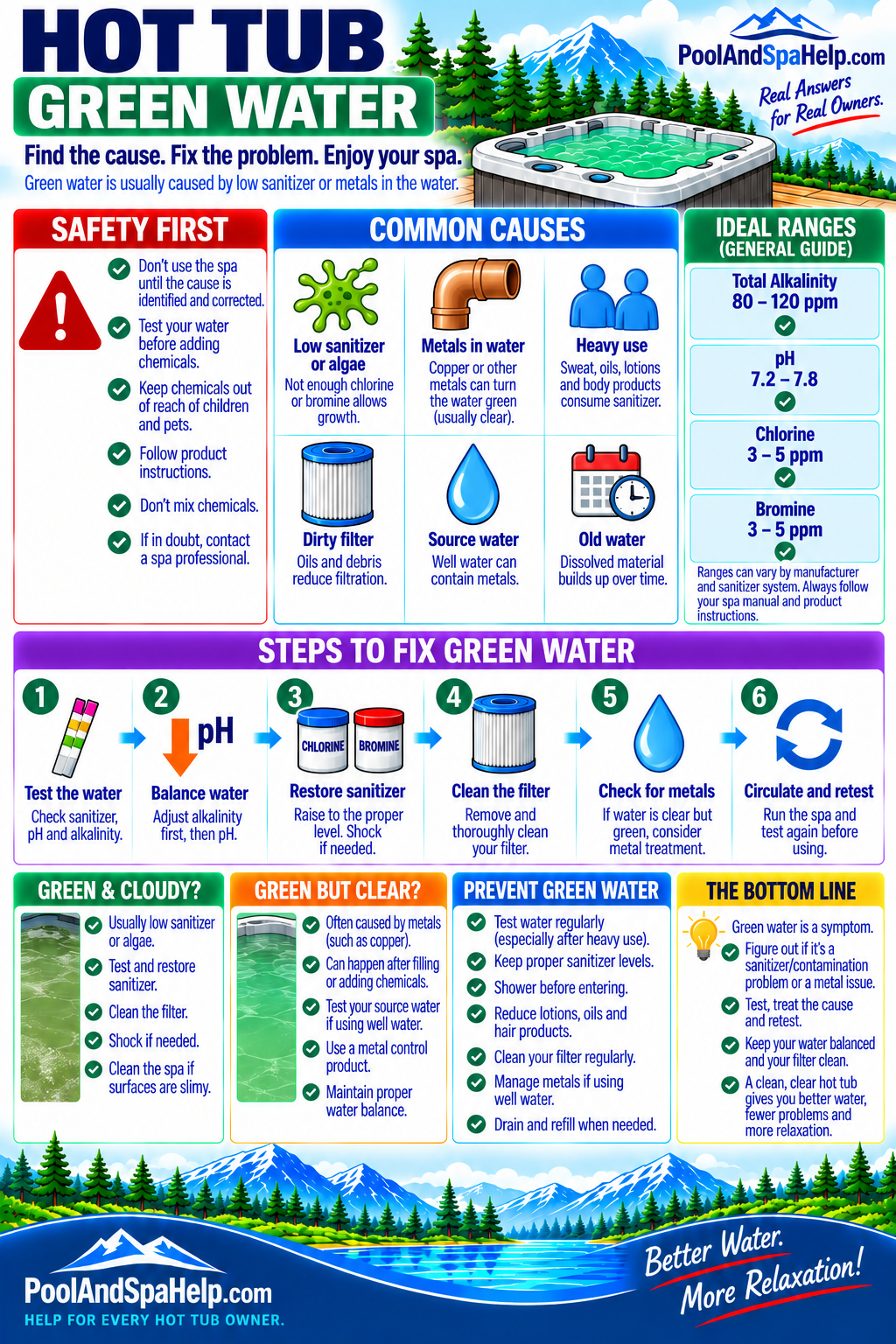
You open the hot tub cover and discover that the water has turned green.
The first reaction is usually:
Algae.
And sometimes that’s correct—but not always.
Green hot tub water can be caused by low sanitizer and organic growth, but dissolved metals such as copper or iron can also give the water a green tint. In some cases, the difference is fairly easy to spot.
A useful first question is:
Is the green water cloudy, or is it still clear?
Cloudy or dull green water makes a sanitizer or contamination problem more likely.
Clear water with a green tint can point toward metals in the water, particularly if the color appeared after filling the spa or adding chemicals.
Before adding anything else, test the water and figure out which problem you’re actually dealing with.
Quick Summary: Why Is My Hot Tub Water Green?
| What You See | Possible Cause | What to Do |
|---|---|---|
| Green and cloudy water | Low sanitizer, contamination, organic growth | Test sanitizer and water balance |
| Green and slimy water | Possible algae or biological growth | Stop using spa and sanitize |
| Clear green-tinted water | Copper or other dissolved metals | Test/treat for metals |
| Green after adding chemicals | Metals reacting or oxidizing | Investigate source water and metals |
| Green after heavy use | Sanitizer depleted by bather load | Test and restore sanitizer |
| Green with dirty filter | Poor filtration/contamination | Clean filter and restore water chemistry |
Don’t assume every green hot tub needs the same treatment.
For more information on Basic hot tub water chemistry visit: Hot Tub Water Chemistry: A Simple Guide to Clear, Safe Water
Safety Stop
Don’t use the hot tub simply because the water is still transparent.
Green water is telling you something has changed.
If sanitizer is low, the water is cloudy or slimy, or you don’t know why it turned green, keep bathers out until you’ve tested and corrected the problem.
Always follow the directions for your specific sanitizer and chemical products.
Never mix spa chemicals together. Add chemicals separately and allow the water to circulate as directed.
Step 1: Is the Water Clear or Cloudy?
Before touching the chemicals, look closely at the water.
This simple observation can give you an important troubleshooting clue.
Green and cloudy
If the water is green and cloudy, especially if the surfaces feel slippery or slimy, start by investigating:
- Low chlorine or bromine
- Heavy bather load
- Organic contamination
- Poor filtration
- Inadequate circulation
- Algae or other biological growth
Green but clear
If the water is surprisingly clear but has a green, blue-green, or unusual tint, consider metals in the water.
Copper is particularly well known for producing blue-green or green discoloration.
The distinction isn’t absolute, but it’s an excellent place to start.
Step 2: Test the Water
Now test:
- Sanitizer
- pH
- Total alkalinity
Don’t start adding chemicals based only on the color.
As a general guide, many hot tubs operate around:
- pH: 7.2–7.8
- Total alkalinity: approximately 80–120 ppm
Sanitizer targets depend on the system and products you’re using, so follow the directions for your particular spa and sanitizer.
If alkalinity and pH both need adjustment, generally correct alkalinity first and then pH.
Your test results can tell you which troubleshooting path makes the most sense.
Step 3: Check the Sanitizer Level
If chlorine or bromine is very low—or reads essentially zero—you’ve found an important clue.
Sanitizer is continuously being consumed as it deals with contaminants introduced by bathers and the environment.
A hot tub that was properly sanitized yesterday isn’t guaranteed to have an adequate sanitizer level today.
Sanitizer demand can increase because of:
- Heavy hot tub use
- Sweat and body oils
- Lotions and cosmetics
- Organic contamination
- Leaves and other debris
- Long periods without water testing
- Problems with the sanitation system
If the sanitizer has been depleted, restore the proper level according to your product instructions.
Depending on the condition of the water, shocking the spa may also be appropriate.
Step 4: Inspect the Water and Spa Surfaces
Run your hand along an accessible surface at the waterline.
Does it feel normal?
Or does it feel unusually slippery or slimy?
Green water combined with slimy surfaces is much more concerning than a transparent green tint.
Also look for:
- Film along the waterline
- Unusual odour
- Debris
- Discoloration
- Cloudiness
- Material accumulating around the filter
If the water is green, cloudy, and the surfaces feel slimy, I wouldn’t treat this as a minor cosmetic problem.
The spa needs to be properly cleaned and sanitized before being used again.
Step 5: Check the Filter
A dirty filter doesn’t necessarily cause green water by itself, but poor filtration makes recovering from a water-quality problem much more difficult.
Remove the filter and inspect it.
If it’s dirty, clean it thoroughly according to the filter manufacturer’s recommendations.
If it’s heavily contaminated, damaged, or simply at the end of its useful life, replacement may make more sense.
Also make sure the hot tub is actually circulating properly.
You can have perfectly good water chemistry and a perfectly good filter, but neither helps much if water isn’t moving through the filtration system as intended.
Step 6: Shock the Hot Tub When Appropriate
If testing and inspection point toward an organic contamination or sanitizer problem, shocking the water may be part of the recovery process.
Shock helps oxidize contaminants and can assist the sanitizer in restoring water quality.
But remember:
Shock isn’t a substitute for testing.
The correct shock product and amount depend on your sanitation system and the product you’re using.
Follow the label.
After treatment, allow the spa to circulate and retest the water before using it.
Step 7: What If the Water Is Green but Crystal Clear?
Now we take a different troubleshooting path.
If you can clearly see the bottom of the hot tub and the water simply has a transparent green or blue-green tint, don’t automatically assume algae.
You may be looking at dissolved metals.
Copper is one possibility. Iron and other minerals can also produce unusual water colours under certain conditions.
Metals may already be present in the source water, especially with some well-water supplies.
They can also potentially enter the water from equipment or plumbing components under corrosive water conditions.
When the chemistry changes or an oxidizer is added, dissolved metals can become much more noticeable.
That’s why someone can fill a spa with apparently clear water, add chemicals, and then wonder:
Why did my brand-new water turn green?
Step 8: Did the Water Turn Green Immediately After Filling?
Timing matters.
If the water was green before you added anything, investigate the source water.
If it looked normal after filling but changed colour soon after adding sanitizer or shock, dissolved metals become more suspicious.
The chemical didn’t necessarily “create” the metal.
It may have changed or oxidized metal already present in the water, making the colour visible.
If you’re using well water or know your source water contains metals, consider testing the source water itself.
A spa or pool retailer may also be able to perform a more detailed water test than basic home test strips.
Step 9: Treating Metals in Hot Tub Water
If testing suggests metals rather than biological contamination, adding more and more sanitizer isn’t the solution.
A product designed to sequester or control metals may be appropriate.
These products help keep dissolved metals from causing staining and discoloration.
Follow the product directions carefully because metal-control products vary.
Also maintain proper water balance.
Water that is allowed to become excessively corrosive can potentially contribute to metal entering the water from components in the circulation system.
If the metal concentration is particularly high, partially or completely replacing the water with a better source may ultimately be necessary.
Step 10: When Is It Better to Drain and Refill?
Not every water problem deserves an afternoon of chemical experimentation.
Consider draining and refilling when:
- The water is old.
- The water is badly contaminated.
- Green water keeps returning.
- Multiple chemistry problems exist at the same time.
- The water is extremely difficult to balance.
- A large amount of contamination entered the spa.
- Treatment is becoming more expensive or complicated than replacing the water.
If you refill, don’t simply fill the spa and immediately start throwing chemicals into it.
Use the same basic sequence:
Circulate → Test → Adjust alkalinity → Adjust pH → Establish sanitizer → Retest
That gives the fresh water a much better start.
Why Did My Hot Tub Turn Green Overnight?
A sudden colour change doesn’t necessarily mean the problem developed overnight.
For example, sanitizer may have gradually been consumed until there was no longer enough residual to control the water properly.
Alternatively, metals may already have been dissolved in apparently clear water and become visible after a chemistry change or oxidation.
Ask yourself what happened immediately before the colour appeared.
Did you:
- Have several people in the hot tub?
- Forget to test sanitizer?
- Refill the spa?
- Add shock?
- Add chlorine or bromine?
- Change the pH?
- Use a different water source?
That timeline can be extremely useful.
Green Water After Shocking the Hot Tub
This one can be confusing.
You shock the hot tub expecting clearer water and instead it turns green.
If the water remains relatively clear but develops a green or blue-green tint immediately after treatment, metals should be considered.
The oxidizer may have reacted with dissolved metals already present in the water.
Don’t immediately respond by dumping in another large dose of shock.
Test the water and determine what you’re treating first.
Can Algae Grow in a Hot Tub?
Yes, although properly maintained hot tubs are generally not friendly environments for algae because of sanitizer, filtration, covered operation, and high water temperatures.
But sanitizer can be depleted.
A spa that has been neglected, left with inadequate sanitizer, poorly circulated, or exposed to contamination can develop biological growth.
That’s another reason I wouldn’t diagnose green water based solely on colour.
Green + cloudy/slimy + low sanitizer tells a very different story from green + crystal clear + normal sanitizer after a fresh fill.
How to Prevent Green Hot Tub Water
Most green-water problems can be made much less likely with routine maintenance.
Test the water regularly, especially after heavy use.
Maintain the proper sanitizer residual.
Keep alkalinity and pH within the appropriate range.
Clean the filter regularly and make sure the spa has adequate circulation.
If your source water contains metals, consider managing them from the beginning rather than waiting for discoloration or staining to appear.
And don’t judge sanitation by appearance alone.
Clear water can still have inadequate sanitizer.
When to Call for Help
Consider having the water professionally tested or contacting a spa professional when:
- The water repeatedly turns green after treatment.
- You suspect high metal levels but aren’t sure which metal is present.
- Staining is appearing on the spa shell or components.
- The sanitizer level won’t remain stable.
- pH continually moves out of range.
- You suspect a circulation or filtration problem.
- You can’t restore safe water despite proper treatment.
Bring a fresh water sample if you’re having the water professionally tested.
Knowing whether the spa uses chlorine or bromine and what products you’ve recently added can also make diagnosis easier.
Frequently Asked Questions
Why is my hot tub water green?
Common possibilities include inadequate sanitizer, organic contamination, poor filtration, biological growth, or dissolved metals such as copper.
The appearance of the water helps narrow it down.
Does green hot tub water always mean algae?
No.
Clear green or blue-green water can be associated with dissolved metals. Cloudy or slimy green water combined with low sanitizer makes biological contamination more suspicious.
Why did my hot tub turn green after I added chlorine or shock?
An oxidizer can make dissolved metals in the water more visible. If the water remains clear but develops a green tint shortly after treatment, investigate metals before repeatedly adding more sanitizer.
Can well water turn a hot tub green?
It can. Well water may contain iron, copper, manganese, and other minerals depending on the source.
If discoloration regularly occurs after filling from the same water source, have the source water tested.
Should I shock green hot tub water?
If low sanitizer and organic contamination are causing the problem, shocking may be appropriate. If dissolved metals are responsible, however, repeatedly adding shock won’t correct the underlying metal problem.
Test first.
Can I use my hot tub if the water is green but clear?
I wouldn’t assume that clear green water is safe simply because you can see through it.
Test the sanitizer and water chemistry and determine why the water changed colour before using the spa.
Should I drain green hot tub water?
Sometimes.
If the water is old, severely contaminated, difficult to balance, or contains a problematic concentration of metals, draining and refilling may be the simplest solution.
If your hot tub water turns green, look at the water before reaching for another chemical bottle.
The most useful first distinction is:
Green + cloudy or slimy: investigate sanitizer, contamination, filtration, and possible biological growth.
Green + clear: investigate dissolved metals, especially if the colour appeared after filling, shocking, or adjusting the chemistry.
Then work systematically:
Inspect → Test → Check sanitizer → Check filtration → Identify contamination or metals → Treat the actual cause → Retest
Green water is a symptom.
Figuring out why it’s green is what tells you how to fix it.
Written by Dan Harvickson (Founder of Last Mountain Tech) Pool and Spa Specialist