
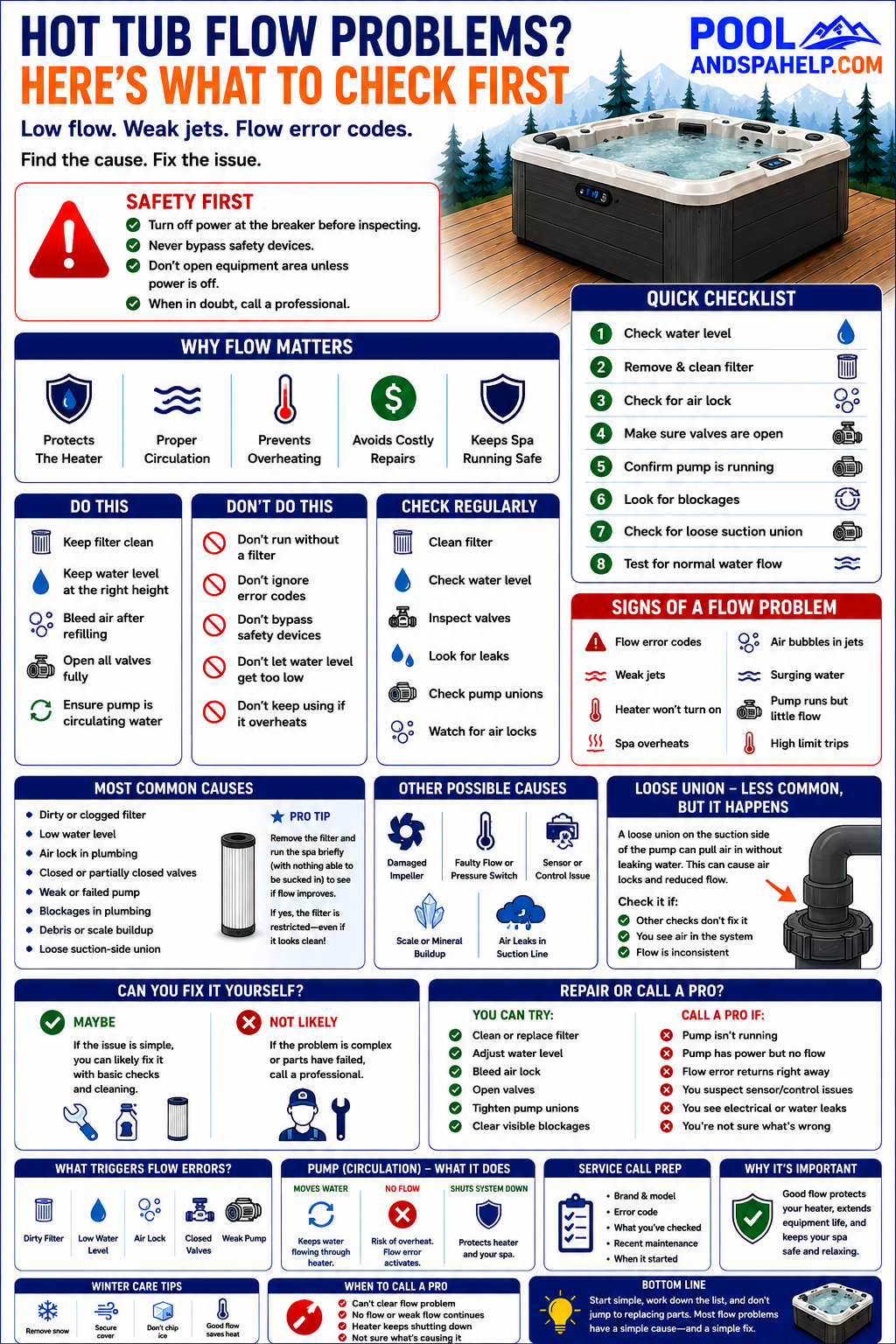
Your hot tub says FLO, FL, LF, or another flow-related error.
Maybe the heater won’t turn on.
Maybe the jets seem weaker than usual.
Or perhaps the spa keeps shutting the heater down even though everything appears to be running normally.
Whatever the symptom, the basic problem is often the same:
Your hot tub isn’t moving enough water through the heating system—or the controls think it isn’t.
The good news is that many hot tub flow problems are caused by something relatively simple, especially a dirty or restricted filter.
Before replacing pumps, sensors, or other parts, start with the basics.
Quick Summary
If your hot tub has a flow problem:
- Check the water level.
- Remove the filter and test the spa without it.
- Make sure all valves are fully open.
- Confirm the circulation or jet pump is actually moving water.
- If the spa was recently refilled, check for an air lock.
- Look for anything else restricting water flow.
- If the basic checks don’t solve it, the pump, flow/pressure switch, sensors, or controls may need further diagnosis.
The filter is one of the first things I would check—even if it looks clean.
Safety Stop
Hot tubs combine water and high-voltage electricity, so know where DIY troubleshooting should stop.
Turn off power at the breaker before opening the equipment compartment or inspecting plumbing connections.
Do not bypass a flow switch, pressure switch, high-limit device, GFCI, or other safety control to keep the spa operating.
If you find burned wiring, melted connections, water around electrical components, or anything you’re uncomfortable working around, leave the power off and call a qualified technician.
What Does a Hot Tub Flow Error Actually Mean?
A flow error doesn’t necessarily mean the flow switch itself has failed.
The spa’s control system needs adequate water movement through the heater. Depending on the system, it may use a pressure switch, flow switch, temperature sensors, or other logic to determine whether it’s safe to energize the heater.
If adequate flow isn’t detected, the system may shut the heater down to protect it from overheating.
That’s why a flow-related error can be caused by several different things:
- Dirty or restricted filters
- Low water level
- Air trapped in the plumbing
- Closed or partially closed valves
- Weak or failed circulation pump
- Jet pump problems
- Plumbing restrictions
- Scale or debris
- Faulty pressure or flow switch
- Sensor or control problems
The trick is figuring out why the water isn’t moving properly before replacing anything.
Check This First: Remove the Filter
This is where I would start.
A hot tub filter can become restricted enough to reduce water flow through the heater even when it looks perfectly clean.
Turn the spa off, remove the filter, make sure nothing can be pulled into the open filter intake, and restart the spa according to the manufacturer’s instructions.
Then see whether the flow problem disappears.
If the problem goes away without the filter:
The filter is probably restricted.
Clean it thoroughly or replace it if cleaning doesn’t restore proper flow.
If the problem remains:
Leave the filter out temporarily while continuing with the basic flow checks.
Technician’s note: I’ve been on plenty of service calls where the filter looked clean but was restricted enough to cause a flow or high-limit problem. Removing the filter is one of the quickest ways I use to rule it in or out.
Check the Water Level
Next, make sure there’s enough water in the spa.
If the water level is too low, the pump may pull air into the system instead of maintaining a solid supply of water.
Check the manufacturer’s recommended fill level, but generally the water should be comfortably above the filter intake and any suction openings that need to remain submerged.
If the water is low:
- Turn off the spa.
- Add water to the proper level.
- Restore power.
- Check whether normal circulation returns.
If the pump sounds unusually noisy or you see large amounts of air coming from the jets, you may already have air trapped in the system.
Was the Hot Tub Recently Drained and Refilled?
If the flow problem started immediately after refilling the spa, suspect an air lock.
Air can become trapped inside the pump or plumbing while the spa is empty.
When you turn the pump on, the impeller may spin without being able to establish proper water flow.
Common signs include:
- Pump running but little or no water movement
- Surging water from the jets
- Large amounts of air from the jets
- Pump sounding different than normal
- Flow errors appearing immediately after refilling
Try This First
Turn the pump on and off a few times according to the manufacturer’s instructions.
Some air locks will clear themselves.
If they don’t, the pump may need to be manually bled.
Turn off power to the spa before attempting to bleed air from the plumbing or pump, and follow the manufacturer’s procedure for your particular system.
Are All the Valves Open?
This sounds obvious, but it’s worth checking—especially if someone has recently serviced the spa.
Many hot tubs have slice valves or gate valves on either side of the pump or heater.
If one has been left closed or partially closed, water flow can be severely restricted.
Make sure the plumbing valves are fully open.
Also inspect them carefully. Occasionally, the handle can appear to be in the correct position even though the internal portion of an older valve has failed or separated.
Is the Pump Actually Moving Water?
Hearing a pump motor running doesn’t necessarily mean it’s circulating enough water.
Look for actual water movement.
Depending on the spa, you may see:
- Water moving from the circulation outlet
- Gentle movement at the surface
- Normal jet pressure
- Water returning through the heater system
If the motor runs but there’s little or no circulation, possibilities include:
- Air lock
- Blocked plumbing
- Damaged impeller
- Weak pump
- Debris inside the wet end
- Closed valve
If the pump doesn’t run at all, you’re dealing with a different branch of the diagnosis.
Decision Tree: What Is Your Hot Tub Doing?
Flow Error + Spa Was Just Refilled
Start with:
Air lock → water level → filter → pump circulation
A refill-related flow problem is often caused by trapped air.
Flow Error + Weak Jets
Start with:
Filter → water level → valves → pump → plumbing restriction
If removing the filter dramatically improves jet pressure, you’ve probably found the problem.
Flow Error + Circulation Pump Isn’t Running
Check whether the circulation pump has power and whether it’s actually operating.
A failed or weak circulation pump can prevent adequate water movement through the heater.
If you’re uncomfortable performing electrical testing, this is a good point to call a technician.
Flow Error + Pump Runs Normally
If water movement appears normal but the spa still reports a flow problem, diagnosis may need to move toward:
Pressure/flow switch → sensors → wiring → control system
Don’t automatically replace the switch just because the error says “flow.”
The control may simply be reporting the condition it sees.
Flow Error + High-Limit or Overheating Error
Pay particularly close attention to water circulation.
Restricted flow through the heater can allow the water inside the heater assembly to get much hotter than the rest of the spa.
Start with:
Filter → water level → circulation pump → valves → plumbing restrictions
A Less-Common Flow Problem I’ve Seen
From my experience: One less-common cause of hot tub flow problems that I’ve encountered is a loose union on the suction side of the pump.
If the union loosens slightly, the pump can pull air into the plumbing while it’s running. That can reduce water flow and sometimes contribute to an air lock.
What makes this problem particularly easy to miss is that the union doesn’t necessarily have to leak water.
I’ve seen pump unions that were tight enough that no water visibly dripped out but loose enough for the pump to draw air into the system while running.
This isn’t one of the first things I would suspect.
But if you’ve ruled out the filter, water level, valves, and the usual air-lock causes—and you’re still seeing air entering the system—the suction-side pump connection is worth checking.
Other Less-Common Causes
If the basic checks haven’t solved the problem, there are several possibilities deeper in the system.
Scale or Debris
Mineral buildup or debris can restrict plumbing or heater passages.
This is more likely on spas that have experienced significant scale buildup or poor water chemistry.
Damaged Pump Impeller
The motor may run normally while a damaged or obstructed impeller moves very little water.
Weak Circulation Pump
A circulation pump doesn’t necessarily have to be completely dead to cause problems.
A weak pump may still run but fail to produce enough flow through the heater.
Pressure or Flow Switch Problem
A pressure or flow switch can fail or become improperly adjusted.
But I wouldn’t make this my first assumption.
Rule out actual water-flow problems first.
Sensor or Control Problem
Some systems determine adequate flow indirectly using temperature sensors or other control logic.
A sensor or control fault can therefore sometimes produce symptoms that look like a circulation problem.
Most Common Fixes
In order, I’d concentrate on:
1. Clean or replace the filter
Don’t rely on appearance alone.
2. Correct the water level
Make sure the pump isn’t drawing air.
3. Clear an air lock
Especially after draining and refilling.
4. Open any closed valves
Check them after service work.
5. Restore proper pump operation
A weak, airlocked, obstructed, or failed pump can’t maintain heater flow.
6. Find plumbing restrictions or air leaks
Move here after you’ve eliminated the common causes.
7. Diagnose the flow switch, sensors, or controls
These should generally come later in the troubleshooting process.
When to Stop Troubleshooting and Call for Service
It’s time to bring in a technician if:
- The pump isn’t running
- The pump has power but isn’t moving water
- Flow errors immediately return after the basic checks
- The spa repeatedly overheats
- You suspect a failed sensor or control board
- You find burned or damaged wiring
- Water is leaking near electrical components
- The problem requires electrical testing
- You’re simply not sure what you’re looking at
A flow problem is often simple, but continuing to operate a spa without proper circulation can damage the heater or other equipment.
What to Tell the Technician
Before calling for service, make a few notes.
Try to provide:
- Spa brand and model
- Exact error code or message
- Whether the spa was recently drained
- Whether the filter has been removed and tested
- Whether the circulation pump is running
- Whether the jets are strong or weak
- Whether you’re seeing air bubbles
- Whether the problem is constant or intermittent
- Any recent repairs or maintenance
That information can significantly narrow down the diagnosis before the technician even arrives.
Why Hot Tubs Need Good Water Flow
Your heater isn’t designed to heat stagnant water.
Water must continuously carry heat away from the heater and distribute it throughout the spa.
When flow becomes restricted, the small amount of water inside the heater can heat very quickly.
That’s why hot tubs have flow, pressure, temperature, and high-limit protection systems.
They’re not there just to produce annoying error codes.
They’re there to prevent overheating and equipment damage.
Frequently Asked Questions
Can a dirty hot tub filter cause a flow error?
Absolutely. A restricted filter is one of the first things to check. Don’t assume it’s good simply because it looks clean.
Can I run my hot tub without the filter?
Removing the filter can be useful as a short diagnostic test, but the spa shouldn’t normally be operated without proper filtration. Make sure nothing can be pulled into the open filter intake while testing.
Why did my flow error start after I changed the water?
An air lock is a strong possibility. Air can become trapped in the pump or plumbing while the spa is drained and prevent the pump from establishing proper circulation after refilling.
Can a bad pump cause a flow error?
Yes. A failed, weak, obstructed, or airlocked pump may not move enough water through the heater.
Does a flow error mean my flow switch is bad?
No. The switch may simply be correctly reporting inadequate water flow. Check the actual circulation system before assuming the switch needs replacement.
Can a hot tub have a flow problem even if the jets work?
Yes. Some spas use a separate circulation pump for the heating and filtration system. Strong therapy jets don’t necessarily prove that adequate water is flowing through the heater.
Can a loose pump union cause a flow problem without leaking?
It can. On the suction side of a running pump, a slightly loose connection may draw air inward without producing an obvious water leak. It’s less common than filter or air-lock problems, but it can happen.
Bottom Line
When a hot tub has a flow problem, start simple.
Check the water level.
Remove the filter.
Make sure the valves are open.
Confirm that the pump is actually circulating water.
And if the spa was recently refilled, don’t overlook an air lock.
Only after you’ve eliminated those common causes would I start looking seriously at switches, sensors, controls, or less-common plumbing problems.
A flow error is the spa telling you that something doesn’t look right.
Related Articles:
- Hot Tub Pump Has No Power
- Pool Pump Hums But Wont Start
- Hot Tub Pump Keeps Running? Here’s What to Check First
Written by Dan Harvickson (Founder of Last Mountain Tech) Pool and Spa Specialist