
Water that won’t reach the set temperature is one of the most common hot tub problems. The good news is that many heating issues are caused by simple problems like dirty filters, low water flow, or incorrect settings—not necessarily a failed heater.
Quick Summary
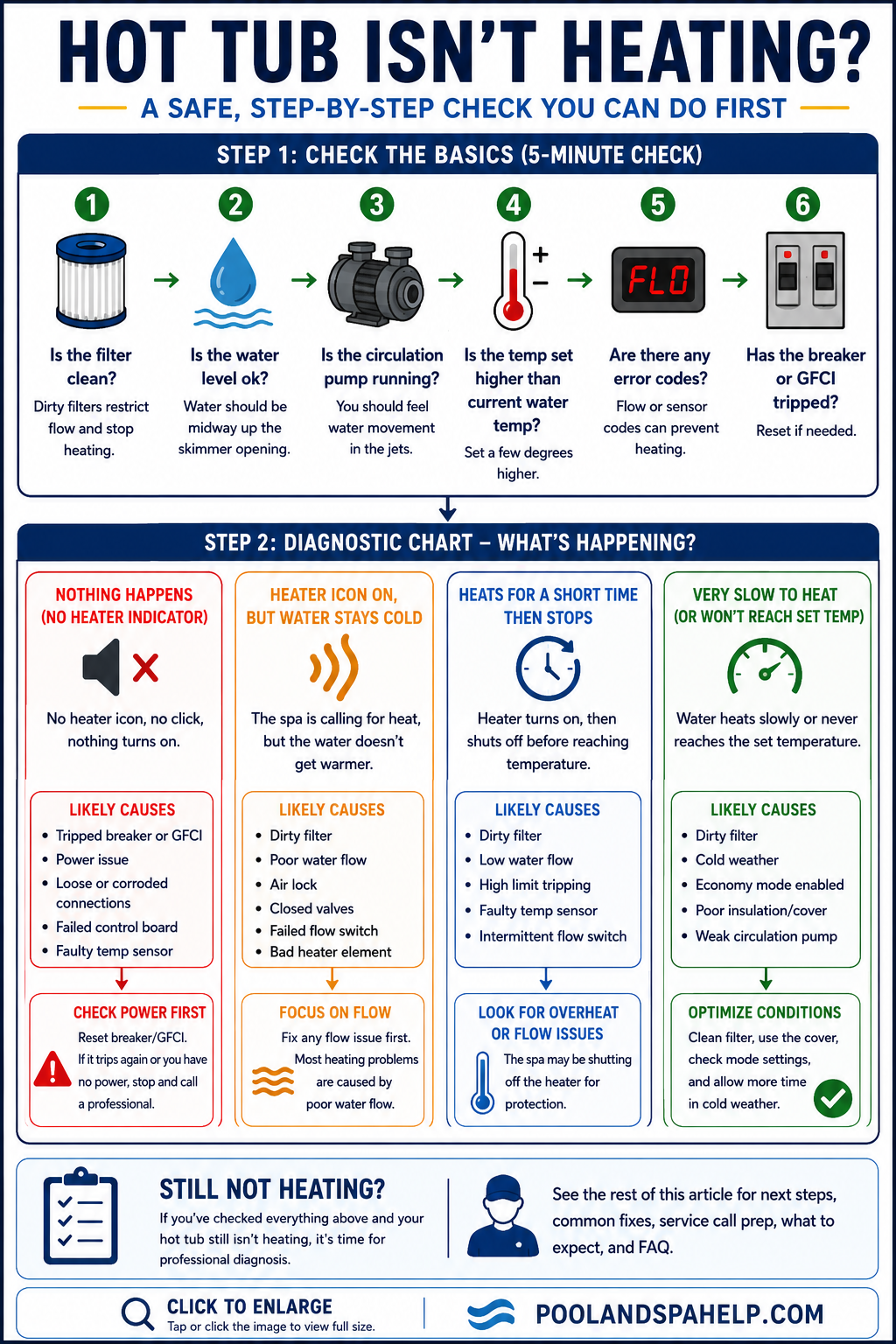
Before assuming your heater has failed, start with the basics. Check that the filter is clean, the water level is correct, the circulation pump is running, the temperature is set above the current water temperature, there are no error codes, and the breaker or GFCI hasn’t tripped.
Next, identify what your spa is doing. If nothing happens when it should be heating, start by checking the power supply. If the heater indicator is on but the water stays cold, focus on water flow problems such as a dirty filter, air lock, or failed flow switch. If the spa heats briefly and then stops, look for overheating or flow-related issues. If it’s heating very slowly, consider factors like dirty filters, cold weather, Economy mode, or a weak circulation pump.
If you’ve completed these checks and your hot tub still isn’t heating, the problem may require professional diagnosis. The remainder of this guide explains the most common fixes, how to prepare for a service call, what to expect during the repair process, and why the problem occurs.
Safety Stop
Stop troubleshooting and contact a qualified technician immediately if you notice any of the following:
- Burning smell
- Melted or damaged wiring
- Smoke
- Water leaking onto electrical components
- The breaker trips immediately after being reset
- You are uncomfortable performing any of the checks below
Check These First (2 Minutes)
Before assuming something expensive has failed, verify these simple items:
✓ Is the spa actually calling for heat? (Set the temperature a few degrees above the current water temperature.)
✓ Is the water level high enough?
✓ Is the filter dirty or overdue for cleaning?
✓ Is the circulation pump running?
✓ Are any error codes displayed?
✓ Has the breaker or GFCI tripped?
Many heating problems are solved before moving beyond this point.
Decision Tree
Step 1 – Is an Error Code Displayed?
Yes
Start with the error code. Many heating problems are actually caused by flow or sensor faults.
Examples include:
- FLO
- LF
- DR
- DRY
- OH
- SN
- HL
Repairing the underlying issue often restores heating.
No
Continue to Step 2.
Step 2 – Is Water Moving Properly?
Poor water flow is one of the biggest reasons heaters shut off.
Check for:
- Dirty filter
- Closed slice valves
- Air lock
- Low water level
- Blocked suction fitting
- Weak circulation pump
If water flow is poor, correct that first before suspecting the heater.
Step 3 – Is the Spa in Economy or Sleep Mode?
Some hot tubs only heat during programmed filter cycles.
If your spa is in Economy or Sleep mode, it may appear not to heat even though it’s operating normally.
Switch back to Standard mode and allow several hours for the water temperature to recover.
Step 4 – Does the Heater Indicator Turn On?
Many control panels display a heating icon or indicator light.
- Heating light ON but water stays cold → Possible heater, flow, or circulation issue.
- Heating light never comes on → Possible sensor, thermostat, programming, or control problem.
Step 5 – Is the Breaker Staying On?
If the heater starts briefly before the breaker trips, stop troubleshooting.
This usually requires electrical testing and professional diagnosis.
Most Common Fixes (What I Usually See)
After years of working on hot tubs, these are the most common causes of a spa that won’t heat:
- Dirty filter restricting water flow.
- Circulation pump not moving enough water.
- Air trapped in the plumbing after a refill.
- Economy mode accidentally enabled.
- Failed pressure or flow switch.
- Heater element failure.
- Temperature sensor problem.
- Control board failure.
Although many owners immediately suspect the heater, it’s often a flow-related issue instead.
When To Call A Technician
If you’ve completed the checks above and your spa still isn’t heating, the next steps usually require specialized tools and electrical testing.
A qualified technician may need to:
- Verify power reaching the heater
- Test heater resistance
- Check pressure or flow switch operation
- Test temperature sensors
- Inspect the control board
- Confirm proper circulation
At this point, professional diagnosis is usually the fastest and safest option.
Service Call Prep
Before calling for service, have the following information ready:
- Spa manufacturer and model
- Approximate age of the spa
- Current water temperature
- Desired temperature setting
- Any error codes displayed
- Whether the circulation pump is running
- Whether the breaker has tripped
- What you’ve already checked
Providing this information helps the technician arrive better prepared and may reduce diagnostic time.
What to Expect During the Service Call
A technician will typically begin by confirming the symptoms before performing a series of tests.
In most cases they will:
- Verify water flow through the heater
- Check the filter and circulation system
- Inspect sensors and pressure or flow switches
- Measure voltage supplied to the heater
- Test the heater element
- Inspect the control board if other components test normally
The goal is to eliminate the most common causes before recommending expensive parts.
Why This Happens
Your hot tub heater is designed with several safety devices that prevent it from operating under unsafe conditions.
If the spa detects poor water flow, overheating, incorrect sensor readings, or electrical faults, it may disable the heater to protect both the equipment and the user.
For that reason, a heater that isn’t heating isn’t always caused by a bad heater. In many cases, another component has prevented the heater from turning on until the underlying problem is corrected.
Understanding that relationship helps explain why technicians often check the circulation system and sensors before replacing the heater itself.
Frequently Asked Questions
Can a dirty filter stop a hot tub from heating?
Yes. A clogged filter can restrict water flow enough to prevent the heater from operating.
Why is my hot tub heating so slowly?
Cold weather, dirty filters, poor circulation, or operating in Economy mode can all slow the heating process.
Should I replace the heater first?
Usually not. It’s important to rule out water flow problems, sensors, and circulation issues before replacing expensive components.
Is it safe to keep using the spa if it isn’t heating?
If the spa operates normally aside from the lack of heat, it generally isn’t an emergency. However, discontinue use if you notice burning smells, damaged wiring, smoke, or repeatedly tripping breakers.
Continue Troubleshooting:
- Hot Tub Flow Issues? (FLO, FL1, FL2, LF) Causes & Fixes
- Hot Tub High Limit
- Heater Turns On Then Shuts Off
- Hot Tub Not Heating Past 80 Degrees
- Watkins Protection Mode Explained (Hot Spring, Limelight, Hot Spot & Caldera Spas)
Learn More:
- How To Tell If A Hot Tubs Heating Element Is Bad
- Hot Tub Pressure Switch
- Hot Tub Error Codes – Meanings, Causes, and Troubleshooting
- What Temperature Should You Keep Your Hot Tub When You’re Not Using It?
Still Not Sure What’s Wrong?
If you’ve gone through the steps in this guide and you’re still unsure what to do next, I offer personalized email consultations.
I’ll review your symptoms, photos (if needed), and the information you’ve gathered to help you determine the most likely cause and the best next step—whether that’s a simple DIY fix or calling a professional.
👉 Learn more about my Pool & Spa Consultation Service
Written by Dan Harvickson (Founder of Last Mountain Tech) Pool and Spa Technician