
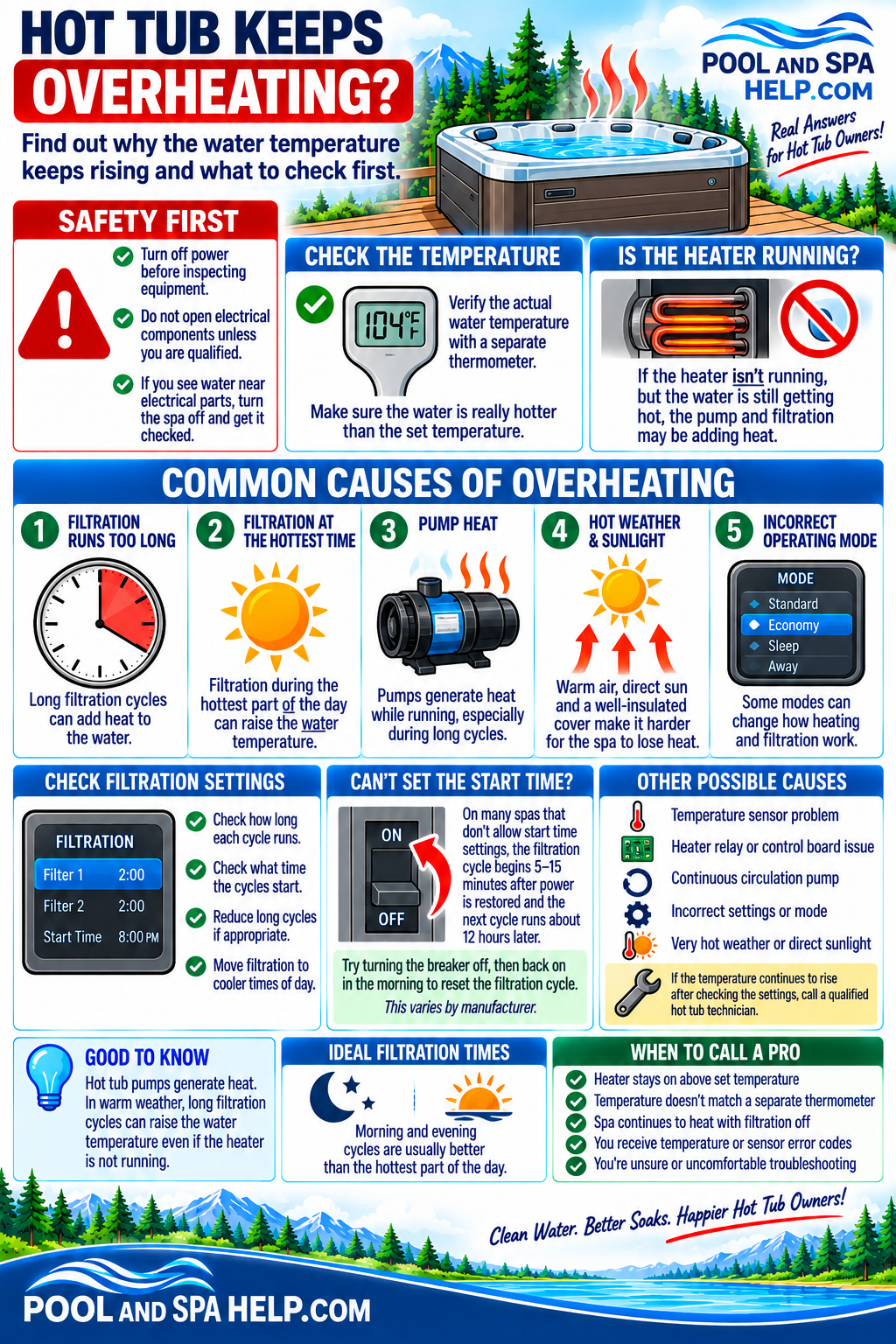
If your hot tub is set to 100°F but the water keeps climbing to 102°F, 104°F, or even higher, it doesn’t necessarily mean the heater is stuck on.
One of the most common causes I see is much simpler:
The filtration cycle is running too long — or it’s running during the hottest part of the day.
Hot tub pumps generate heat while they run. In warm weather, that heat can gradually transfer into the water. Combine a long filtration cycle with a well-insulated cabinet, a closed cover, and hot outdoor temperatures, and the spa may actually heat itself without the heater running.
Before assuming there’s a bad circuit board, temperature sensor, or heater relay, check the filtration settings.
Quick Summary
If your hot tub keeps getting hotter than its set temperature:
- Verify the actual water temperature.
- Check whether the heater is actually running.
- Check how long the filtration cycles are set to run.
- Check what time of day filtration occurs.
- Reduce excessively long filtration cycles if appropriate.
- Move filtration away from the hottest part of the day.
- If the spa doesn’t let you set the filtration start time, resetting power may allow you to change when the cycles occur.
- If the temperature continues climbing with the pump and heater off, investigate sensors, controls, or other mechanical problems.
Start with the filtration schedule. It may save you from troubleshooting a heating system that isn’t actually malfunctioning.
Safety Stop
Hot tub electrical systems combine high voltage and water.
Homeowners can safely check control-panel settings, filtration schedules, displayed temperatures, and other normal operating controls.
However, do not open electrical control boxes or test live heater circuits unless you’re qualified to work around high-voltage equipment.
Turn off power at the breaker before inspecting accessible equipment for obvious damage or water leaks.
If you smell burning, see melted wiring, find water around electrical components, or suspect that the heater is remaining energized when it shouldn’t be, shut the spa off and have it inspected.
Check First: Is the Hot Tub Actually Too Hot?
Before troubleshooting anything, verify that the water really is hotter than the spa says it should be.
A separate pool or hot tub thermometer can help.
For example, if the control panel displays 104°F but a separate thermometer shows 100°F, you may have a temperature-sensing problem rather than actual overheating.
If both readings show that the water really is hotter than the set temperature, continue troubleshooting.
Hot Tub Overheating Decision Tree
Is the actual water temperature above the set temperature?
No → The temperature reading may be inaccurate. Investigate the temperature sensor or control system.
Yes → Continue.
Has the circulation or filtration pump been running for a long time?
Yes → Check the filtration settings first.
No → Continue.
Is filtration occurring during the hottest part of the day?
Yes → Move the filtration cycle to a cooler part of the day if possible.
No → Continue.
Does the spa not allow you to select the filtration start time?
Yes → A power reset may allow you to shift the filtration schedule. See the procedure below.
No → Adjust the filtration schedule through the controls.
Does the temperature continue rising when filtration should be off?
Yes → A heater, sensor, relay, control-board, or other equipment problem becomes more likely.
Most Common Cause: Filtration Is Adding Heat
Hot tub pumps don’t just move water.
They also generate heat.
Some of the heat produced by the pump motor and moving water eventually makes its way into the spa water. Normally, this isn’t enough to cause a problem.
But several factors can change that.
A hot tub may gradually overheat when you combine:
- Long filtration cycles
- Continuous circulation
- Hot outdoor temperatures
- Direct sunlight
- A well-insulated cabinet
- A well-insulated cover
- Filtration during the hottest part of the afternoon
The heater may never turn on, yet the water temperature continues climbing.
This is why one of my first checks on an overheating spa is the filtration schedule.
Check the Filtration Duration
Go into the spa’s filtration settings and find out how long each filtration cycle runs.
The exact controls vary considerably between manufacturers.
Some spas may filter for a couple of hours at a time. Others allow much longer cycles or continuous filtration. Some use a dedicated low-wattage circulation pump rather than the main jet pump.
If the main pump is running for several hours at a time, particularly in hot weather, it can contribute a surprising amount of heat.
Before changing anything, write down the existing settings.
Then consult the owner’s manual to determine the manufacturer’s recommended filtration settings for your spa and usage.
If filtration is set much longer than necessary, reducing the duration may solve the overheating problem.
Don’t Simply Turn Filtration Off
Filtration serves an important purpose.
Water needs to circulate through the filter, chemicals need to be distributed, and some spas use circulation for other functions.
The goal isn’t to eliminate filtration.
It’s to determine whether the spa is filtering considerably longer than necessary and unintentionally adding heat.
Check When the Filtration Cycle Runs
The filtration duration isn’t the only thing that matters.
Timing matters too.
Imagine a hot tub beginning a long filtration cycle at 1:00 p.m. on a hot summer day.
The cabinet is already warm.
The cover is trapping heat.
The surrounding air is hot.
Then the pump begins adding even more heat.
Moving that same filtration cycle to the early morning or evening may significantly reduce the problem.
If your controls allow you to select the filtration start time, try scheduling filtration during cooler periods of the day.
Can’t Set the Filtration Start Time? Try This
Some hot tubs allow you to select the filtration duration but don’t allow you to directly choose when the filtration cycle starts.
On many of these systems, the filtration schedule is established when the spa is powered up.
Typically, the first filtration cycle begins approximately 5–15 minutes after power is restored, with another filtration cycle approximately 12 hours later.
That gives you a useful trick.
To shift the filtration schedule:
Choose a time in the morning when you’d like filtration to occur.
Turn the hot tub breaker off.
Wait briefly.
Turn the breaker back on.
Watch the spa afterward and confirm when the filtration cycle actually begins.
For example, if you reset the spa at approximately 7:00 a.m., a system using this type of scheduling may begin filtration shortly afterward and run its second cycle approximately 12 hours later — putting filtration in the morning and evening instead of the hottest part of the afternoon.
Important: This behavior varies by control system.
Not every hot tub establishes its filtration schedule this way, so confirm the actual operation of your spa after resetting it and consult the owner’s manual when available.
Is the Heater Actually Running?
This is an important diagnostic distinction.
If the water temperature is climbing, check the control panel for a heating indicator.
Depending on the spa, you may also be able to observe whether the heater is being called for through the normal display.
If the water is above the set temperature and the heater isn’t being called for, but the pump has been running for hours, filtration-related heat becomes much more likely.
If the spa is clearly calling for heat when the water is already well above the set temperature, you may be dealing with a sensor or control problem.
If the heater appears to remain energized when it shouldn’t, shut the spa down and have it inspected.
Other Reasons a Hot Tub May Overheat
If changing the filtration schedule doesn’t solve the problem, start looking at other possibilities.
Temperature Sensor Problem
The control system relies on a temperature sensor to determine when heating is required.
If the sensor is inaccurate, poorly positioned, damaged, or failing, the control board may receive incorrect temperature information.
One clue is a significant difference between the temperature shown on the display and a reliable separate thermometer.
Heater Relay or Control Problem
The circuit board controls when power is supplied to the heater.
A failed relay or control-board problem can potentially allow the heater to remain energized when it shouldn’t.
This is different from heat generated by filtration.
If you suspect that the heater itself is remaining on after the set temperature has been exceeded, turn the spa off and have the electrical system inspected.
Incorrect Operating Mode
Some hot tubs have several heating and filtration modes.
Depending on the manufacturer, these may be called:
- Standard
- Ready
- Rest
- Economy
- Sleep
- Away
The terminology and operation vary significantly.
Check that the spa hasn’t accidentally been placed into a mode that changes its normal heating or filtration behavior.
Continuous Circulation
Some spas use a dedicated circulation pump designed to operate for very long periods or continuously.
These smaller pumps generally add less heat than a large jet pump, but ambient temperature, insulation, equipment design, and circulation can still influence water temperature.
Don’t assume that every overheating problem is caused by filtration simply because a pump is running.
The type of pump matters.
Hot Weather and Direct Sun
Sometimes the environment itself makes cooling difficult.
A covered hot tub sitting in direct summer sun may already be close to or above the desired water temperature without any help from the heater.
Add pump operation and the temperature may continue climbing.
During very hot weather, shifting filtration to cooler hours can become particularly useful.
What If the Hot Tub Is Still Too Hot After Changing Filtration?
Give the spa enough time to respond to the new filtration schedule and monitor the temperature.
If the overheating stops, you’ve probably identified the cause.
If the temperature continues climbing, note what the equipment is doing when it happens.
Ask:
Is the pump running?
Is the heating indicator on?
Does the displayed temperature match the actual water temperature?
Does overheating happen only on hot days?
Does it happen even when filtration isn’t running?
Those observations can narrow the problem considerably.
When to Book Service
Consider having the spa inspected if:
- The heater appears to stay on above the set temperature.
- The displayed temperature is significantly different from the actual water temperature.
- The spa continues heating when the filtration pump isn’t running.
- Changing filtration duration and timing doesn’t help.
- You receive temperature or sensor error codes.
- The spa repeatedly reaches an unsafe temperature.
- You smell burning or notice damaged electrical components.
- You’re uncomfortable diagnosing electrical equipment.
A technician can determine whether the problem is caused by the temperature sensor, heater circuit, relay, control board, or another component.
Service Call Prep
Before calling for service, write down:
- The temperature setting
- The highest temperature you’ve observed
- The actual water temperature from a separate thermometer
- Filtration duration
- Filtration start times
- Whether the pump was running when the temperature increased
- Whether the heating indicator was on
- Outdoor temperature and weather conditions
- Any error codes
- Whether resetting or changing filtration affected the problem
This information can make diagnosis much faster.
What to Expect
An overheating hot tub doesn’t automatically mean an expensive repair.
If the problem occurs mainly during warm weather and the heater isn’t actually running, the filtration schedule should be one of the first things checked.
A settings change may be all that’s required.
If the heater continues operating above the set temperature or the controls aren’t accurately detecting water temperature, further diagnosis will be necessary.
Why Filtration Can Make a Hot Tub Too Hot
A hot tub is designed to retain heat extremely well.
That’s normally a good thing.
But during hot weather, it can work against you.
The cabinet insulation holds heat around the plumbing and equipment. The cover reduces heat loss from the water. Meanwhile, the filtration pump produces additional heat while it operates.
If the spa can’t lose heat as quickly as the equipment is adding it, the water temperature gradually rises.
That’s why the combination of long filtration cycles + hot weather + good insulation can make a perfectly functional hot tub appear to have a heating problem.
Frequently Asked Questions
Why is my hot tub hotter than the temperature I set?
The heater isn’t necessarily causing it. Long filtration cycles, hot outdoor temperatures, direct sunlight, pump heat, or a control problem can all push the water above the set temperature.
Start by checking when and how long the filtration pump runs.
Can a hot tub pump actually heat the water?
Yes. Pumps generate heat while operating, and some of that heat can transfer into the water and equipment area.
During cool weather it may barely be noticeable. During hot weather, long pump run times can contribute to overheating.
Why does my hot tub overheat only in summer?
The spa has a much harder time releasing heat when the surrounding air is already hot. A closed insulated cover, warm cabinet and long filtration cycles can cause the temperature to creep upward even without much — or any — heater operation.
Should I change my filtration cycle in summer?
Possibly.
If the spa is overheating and filtration runs for long periods or during the hottest part of the day, moving the cycles to the morning and evening or reducing excessive filtration time may help.
Always maintain adequate filtration for your spa and usage.
Why can’t I change the filtration start time?
Some control systems don’t provide a direct start-time setting.
On many systems, the filtration schedule is established shortly after the spa is powered up. Resetting power at the desired time may therefore shift the filtration cycles.
This isn’t universal, so confirm how your particular control system operates.
Why is my hot tub overheating even though the heater light is off?
Pump operation, hot weather and retained cabinet heat can raise the water temperature without the heater operating.
If the filtration pump has been running for a long time, check the filtration schedule before assuming the heater has failed.
Related Articles:
- Hot Tub High Limit
- Hot Tub Pump Keeps Running? Here’s What to Check First
- How a Hot Tub Heating System Works (And Why It Sometimes Stops Heating)
When a hot tub keeps getting hotter than its set temperature, don’t start by replacing parts.
Check how long the pump is running and when it’s running.
Sometimes the spa isn’t malfunctioning at all.
It’s simply doing too much filtration at the wrong time of day.