
If you’ve ever wondered what actually happens after you turn your hot tub temperature up, you’re not alone.
Most people imagine there’s a simple switch that turns the heater on.
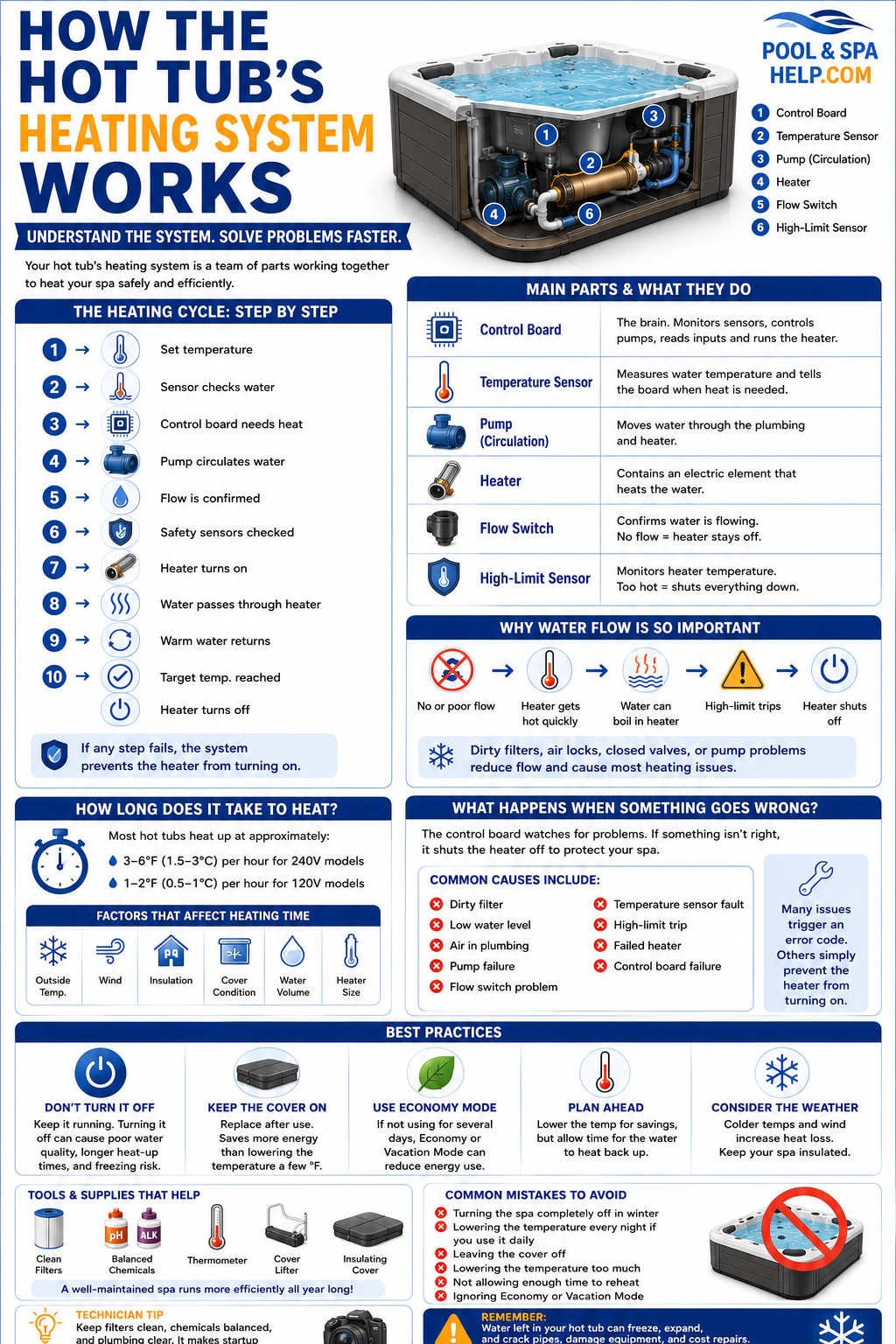
In reality, your hot tub’s heating system is a team of components working together. Before the heater is allowed to turn on, the control system checks several safety devices to make sure water is flowing properly and that the spa can be heated safely.
Understanding how this process works makes it much easier to understand why your hot tub isn’t heating—or why it’s displaying an error code.
The Basic Heating Cycle
Think of your hot tub as a chain of events.
Every link in the chain has to work correctly before the water can heat.
A simplified version looks like this:
You set the desired temperature
        ↓
Water temperature sensor checks the water
        ↓
Control board decides heat is needed
        ↓
Pump starts circulating water
        ↓
Flow is confirmed
        ↓
Safety sensors are checked
        ↓
Heater turns on
        ↓
Water passes through the heater
        ↓
Warm water returns to the spa
        ↓
Target temperature reached
        ↓
Heater turns off
If any step fails, the control system usually prevents the heater from turning on.
The Main Parts of a Hot Tub Heating System
Control Board
The control board is the brain of the hot tub.
It monitors temperatures, controls pumps, reads sensors, and decides when the heater should operate.
Modern control boards constantly monitor dozens of inputs to protect both the equipment and the user.
Temperature Sensor
The temperature sensor measures the water temperature.
When the water drops below your set temperature, it tells the control board that heat is required.
Once the desired temperature is reached, the heater is switched off.
Circulation Pump or Jet Pump
Before the heater can operate, water must be moving.
Depending on the spa, this is done by either:
- A dedicated circulation pump
- The low speed of Pump 1
Without water flow, the heater could quickly overheat.
Heater
The heater contains an electric heating element.
As water flows through the stainless steel heater tube, the element transfers heat into the moving water before it returns to the spa.
The heater itself doesn’t “push” heat into the spa.
It simply heats the water that’s already circulating.
Flow Switch or Pressure Switch
Many spas use a flow switch or pressure switch.
Their job is simple:
Confirm that water is actually moving.
If there’s little or no flow because of:
- Dirty filters
- Air locks
- Failed pumps
- Closed valves
the heater will usually remain off.
High-Limit Sensor
This is one of the most important safety devices.
Instead of measuring the entire spa temperature, it monitors the heater itself.
If the heater begins getting too hot, the high-limit sensor shuts everything down before damage occurs.
Why Water Flow Is So Important
Many heating problems aren’t actually heater problems.
The heater depends on moving water to carry heat away.
If water stops moving:
- The heater gets hot very quickly.
- Water inside the heater can boil.
- The high-limit sensor trips.
- The control board shuts the heater off.
This is why dirty filters are one of the most common causes of heating issues.
Why Your Hot Tub Doesn’t Heat Immediately
Many people expect instant heat after increasing the temperature setting.
Instead, the spa warms gradually.
A typical hot tub heater is 4-5.5 kW.
That usually increases water temperature by roughly:
- 2-6°F (1-3°C) per hour
The exact rate depends on:
- Outside temperature
- Wind
- Spa insulation
- Cover condition
- Water volume
- Heater size
What Happens When Something Goes Wrong?
The control board constantly watches for problems.
If something doesn’t look right, it usually shuts the heater off to prevent damage.
Common reasons include:
- Dirty filter
- Low water level
- Air trapped in the plumbing
- Pump failure
- Flow switch problem
- Faulty temperature sensor
- High-limit sensor trip
- Failed heater
- Control board failure
Many of these issues will trigger an error code, while others simply prevent the heater from operating.
Why Heating Problems Can Have Many Different Symptoms
Not every heating problem looks the same.
For example:
The heater never turns on
- Could be a sensor, relay, thermostat setting, or control board issue.
The pump runs but the water stays cold
- Could be the heater element, flow switch, or safety circuit.
The spa heats very slowly
- Dirty filters, poor insulation, cold weather, or a partially failing heater.
The spa overheats
- Often caused by restricted water flow or a stuck relay.
Although all four symptoms involve heating, they usually have different causes.
Frequently Asked Questions
Does the heater stay on all the time?
No. The control board cycles the heater on and off to maintain the selected temperature.
Can the heater work if the pump isn’t running?
No.
Almost every modern hot tub requires water circulation before the heater is allowed to operate.
Why does my hot tub stop heating after changing the filter?
A clogged filter is common—but a newly installed filter that’s too restrictive, installed incorrectly, or an air lock introduced during maintenance can also reduce flow enough to prevent heating.
How long should it take to heat a cold hot tub?
Most hot tubs warm at approximately 2-6°F (1-3°C) per hour, depending on the heater size and outdoor conditions.
Related Articles
Troubleshooting
- Heater Turns On Then Shuts Off
- Hot Tub Not Heating Past 80 Degrees
- Hot Tub Isn’t Heating? Here’s What to Check Before Calling for Service
- Hot Tub High Limit
- Watkins Protection Mode Explained (Hot Spring, Limelight, Hot Spot & Caldera Spas)
Learn More
- Hot Tub Error Codes – Meanings, Causes, and Troubleshooting
- What Temperature Should You Keep Your Hot Tub When You’re Not Using It?
- How To Tell If A Hot Tubs Heating Element Is Bad
- Hot Tub Pressure Switch
- Hot Tub Losing Temperature During Use? Here’s What to Check First
- Hot Tub Water Keeps Overheating? What to Check First
Written by Dan Harvickson (Founder of Last Mountain Tech) Pool and Spa Specialist