
You notice water around the bottom of your hot tub.
Or maybe the water level seems to be dropping faster than it should.
Before assuming you have a cracked shell or a major plumbing problem, start with the areas where hot tub leaks are most likely to occur.
Most hot tubs contain dozens of plumbing connections, seals, unions, pumps, and fittings—and fortunately, many leaks can be narrowed down without tearing the entire spa apart.
The key is figuring out where the water is coming from and when it leaks.
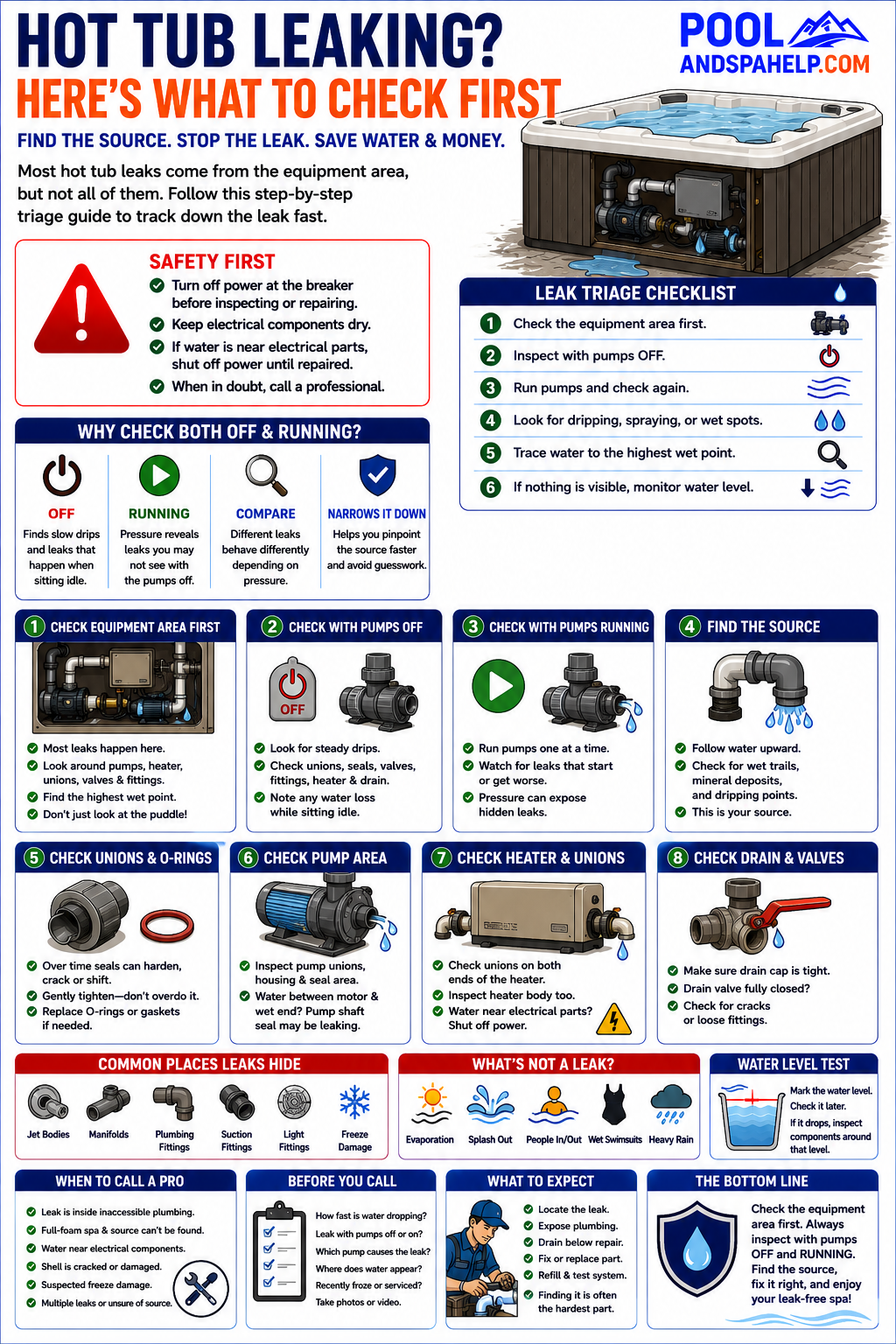
Quick Triage: Start Here
If your hot tub is leaking:
- Check the equipment area first.
- Look around the pumps, heater, unions, valves, and plumbing connections.
- Check for water while the pumps are off.
- Run the pumps and check the same areas again.
- Look for dripping, spraying, wet fittings, or water trails.
- If nothing is visible, determine whether the leak continues when the hot tub is sitting unused.
These few checks can tell you a surprising amount about where the problem may be.
Safety First
Hot tubs combine water and electricity, so use caution when investigating a leak.
Turn off power at the breaker before:
- Reaching into wet equipment areas
- Touching electrical components
- Tightening or removing plumbing near electrical equipment
- Disassembling pumps or heaters
If water is leaking directly onto electrical connections, pumps, control boxes, or other electrical components, shut the hot tub off at the breaker until the problem can be repaired.
Never work on energized equipment while standing in water.
Check the Equipment Area First
The first place I usually check when diagnosing a hot tub leak is the equipment compartment.
There is a simple reason for this: a large percentage of the potential leak points are concentrated in a relatively small area.
Depending on the hot tub, the equipment area may contain:
- Pumps
- Pump unions
- Heater unions
- Heater assemblies
- Gate or slice valves
- Check valves
- Drain fittings
- Plumbing manifolds
- Numerous glued fittings and connections
With so many connections packed together, this is one of the most likely places for a leak to develop.
Remove the equipment access panel and look carefully for moisture.
Don’t just look for water on the floor. Try to find where the water starts.
Water can run along pipes, hoses, equipment, and the bottom of the cabinet before finally appearing somewhere completely different.
A flashlight can make small leaks much easier to spot.
Check With the Pumps Off AND Running
This is one of the most useful things you can do when troubleshooting a hot tub leak.
Check the hot tub while the pumps are off, then check it again while they’re running.
A leak may behave very differently depending on whether the plumbing is under pressure.
Leaks With the Pumps Off
If you see a steady drip while the hot tub is sitting idle, look closely at:
- Pump seals
- Unions
- Heater connections
- Drain fittings
- Plumbing joints
- Valves
- Low-pressure plumbing connections
If the hot tub continues losing water even when it hasn’t been running, that can also help narrow down the possible location.
Leaks That Appear or Get Worse With the Pumps Running
Turn on each pump individually if your hot tub allows it.
Watch the equipment and plumbing as the pump starts.
You may suddenly see:
- Water spraying from a fitting
- A union begin dripping
- A plumbing connection start leaking
- Water appearing around a pump
- A leak that becomes significantly faster
Pressure created by the pump can make a small leak much easier to find.
Technician Tip: I always like to inspect a suspected leak both ways. I’ve seen leaks that are barely noticeable with the pump off become obvious as soon as the pump starts.
Hot Tub Leak Decision Tree
Is Water Visible in the Equipment Area?
YES → Find the Highest Wet Point
Follow the water upward rather than simply looking at where it collects.
Check:
- Pump unions
- Pump seals
- Heater unions
- Heater assembly
- Valves
- Plumbing fittings
- Drain plumbing
Once you’ve identified the component that’s actually leaking, you can determine whether it needs tightening, a new gasket or O-ring, or a repair.
NO → Check the Rest of the Cabinet
If the equipment area is dry, inspect any accessible sides of the hot tub.
Look for:
- Wet insulation
- Water trails
- Damp cabinet areas
- Dripping plumbing
- Water collecting underneath one particular section
The wettest area can sometimes point you toward the source.
Does It Leak Only When the Pump Runs?
YES
This often points toward something affected by increased water pressure or flow.
Possible causes include:
- Loose plumbing fittings
- Cracked fittings
- Leaking unions
- Pump-related leaks
- Jet plumbing
- Manifolds
- Pressurized plumbing connections
Run pumps individually when possible. If the leak appears only when one particular pump operates, you’ve just narrowed your search considerably.
NO
If the hot tub loses water while sitting with the pumps off, look for components that remain exposed to the water in the tub.
Possible areas include:
- Suction plumbing
- Lower plumbing connections
- Pump or heater connections
- Drain plumbing
- Jet bodies below the waterline
- Shell penetrations
Check the Pump Area
Hot tub pumps are a common place to find water.
Inspect around:
- The front of the pump
- Pump unions
- Pump housing
- Pump seal area
- Plumbing entering and leaving the pump
If water appears between the pump’s wet end and motor, the pump shaft seal may be leaking.
If the water is coming from a large threaded connection attached to the pump, the problem may instead be a union gasket or O-ring.
Don’t automatically assume the pump itself needs replacement just because there is water underneath it.
Find the actual source first.
Check the Heater and Heater Unions
The heater assembly usually has plumbing connections on both ends.
Inspect the unions for:
- Dripping
- Mineral deposits
- Water stains
- Damaged O-rings or gaskets
- Loose connections
Also inspect the heater assembly itself.
If water is leaking from the heater rather than the plumbing connections, the heater may require repair or replacement.
If water is reaching electrical connections, turn the spa off at the breaker.
Check Unions, Gaskets and O-Rings
Large plumbing unions are designed so components such as pumps and heaters can be removed for service.
The seal is normally created by a gasket or O-ring inside the connection.
Over time, these seals can:
- Flatten
- Harden
- Crack
- Shift out of position
- Become damaged during servicing
Sometimes the union itself simply becomes slightly loose.
If you find a leaking union, don’t immediately crank it tighter. Excessive force can damage the union or plumbing.
If gentle tightening doesn’t stop the leak, shut the power off, isolate or drain the necessary plumbing, and inspect the gasket or O-ring.
Look for White or Crusty Deposits
A slow leak isn’t always dripping when you happen to inspect it.
Look for white, chalky, or crusty deposits around:
- Unions
- Pump housings
- Heater connections
- Plumbing joints
- Valves
Minerals left behind as water evaporates can reveal a small or intermittent leak.
This is especially useful when the leak is too slow to produce an obvious puddle.
Check the Drain
Don’t overlook the hot tub drain.
Make sure:
- The drain cap is tight
- The drain valve is completely closed
- The fitting isn’t cracked
- Plumbing behind the drain isn’t leaking
A slow drain leak can gradually lower the water level without producing an obvious spray or large puddle.
What If the Equipment Area Is Dry?
This is where leak diagnosis becomes more difficult.
If you can’t find anything around the equipment, the leak may be farther inside the cabinet.
Possible causes include:
- Jet body leaks
- Plumbing connections
- Cracked fittings
- Manifold leaks
- Freeze damage
- Light fittings
- Suction fittings
- Shell penetrations
Some hot tubs use full-foam insulation, which can make tracing these leaks considerably more difficult because water may travel through the foam before becoming visible.
Don’t immediately start removing large amounts of insulation.
First try to determine which general area of the spa is getting wet.
Watch the Water Level
If you can’t locate the leak visually, monitor the water level.
Mark the current water level with a piece of tape or another removable marker.
Then check it periodically.
If the water level drops and eventually stops at approximately the same height each time, inspect components and plumbing located around that level.
For example, a leak that stops just below a particular jet may indicate a problem associated with plumbing or fittings at that height.
This isn’t foolproof because plumbing can travel vertically inside the cabinet, but it can provide an important clue.
Don’t Confuse Normal Water Loss With a Leak
Not every dropping water level means your hot tub is leaking.
Water can be lost through:
- Evaporation
- Splashing
- People getting in and out
- Water carried away on swimsuits
- An uncovered hot tub
But if you’re repeatedly adding a significant amount of water or finding water around the cabinet, it’s worth investigating.
Most Common Hot Tub Leak Areas
When troubleshooting, I would generally inspect these areas early:
Pump Unions
Loose unions or damaged seals can cause anything from a slow drip to a substantial leak.
Pump Seals
A failed shaft seal can allow water to leak between the wet end and motor.
Heater Unions
Like pump unions, heater connections rely on seals that can deteriorate.
Plumbing Fittings
A cracked or damaged fitting can leak continuously or primarily when the pumps are running.
Jet Bodies
The seal between a jet body and the hot tub shell can eventually fail.
Drain Plumbing
Drain fittings and valves can develop slow leaks that aren’t immediately obvious.
Freeze-Damaged Plumbing
If water freezes inside the plumbing, fittings, manifolds, pumps, and other components can crack.
Multiple leaks are possible after significant freeze damage.
When to Call a Hot Tub Technician
Consider booking service if:
- The leak is inside inaccessible plumbing
- The hot tub uses full-foam insulation and the source can’t be found
- Water is leaking around electrical components
- The shell appears damaged
- Plumbing must be cut apart for repair
- You suspect freeze damage
- Multiple areas appear to be leaking
- You can’t determine where the water is coming from
Finding the leak before the technician arrives can still save diagnostic time.
Preparing for a Service Call
Before contacting a technician, try to note:
- How quickly the water level drops
- Whether it leaks with the pumps off
- Whether it leaks faster with the pumps running
- Which pump makes the leak appear
- Where water appears underneath the hot tub
- Whether the spa recently froze
- Whether any plumbing or equipment was recently serviced
Photos or a short video of an active leak can also be extremely helpful.
What to Expect During a Leak Repair
A simple equipment-area leak may only require:
- Tightening a connection
- Replacing an O-ring
- Replacing a gasket
- Replacing a pump seal
- Repairing a fitting
Leaks deeper inside the cabinet can require more work.
The technician may need to:
- Locate the wet area.
- Remove cabinet panels or insulation.
- Expose the leaking plumbing.
- Drain the water below the repair.
- Cut out and replace damaged plumbing.
- Refill and pressure-test the system.
The difficult part of many hot tub leak repairs isn’t actually fixing the leak.
It’s finding it.
Why Hot Tubs Develop Leaks
Hot tub plumbing is exposed to heat, chemicals, vibration, water pressure, and temperature changes for years.
Eventually seals can harden, fittings can loosen, and components can deteriorate.
Common contributing factors include:
- Aging O-rings and gaskets
- Pump vibration
- Temperature changes
- Improper water chemistry
- Previous repairs
- Plumbing stress
- Freeze damage
A small leak should be repaired rather than ignored. Water can damage insulation, cabinet materials, equipment, and electrical components—and small leaks rarely repair themselves.
Frequently Asked Questions
Where do hot tubs usually leak?
The equipment compartment is a good place to start because it contains many potential leak points, including pumps, unions, heaters, valves, and plumbing connections.
Why does my hot tub only leak when the jets are on?
The increased pressure created when a pump runs can expose leaks in plumbing fittings, unions, manifolds, jet plumbing, or other pressurized components.
Can a hot tub leak only when it’s turned off?
Yes. Some leaks may be more noticeable while the spa is sitting idle, depending on the location of the leak and how water pressure changes when the pumps operate.
Can I use leak sealer in my hot tub?
Leak-sealing products may sometimes slow very small leaks, but they aren’t a substitute for locating and repairing a failed gasket, cracked fitting, damaged pump seal, or other mechanical problem.
Whenever practical, find and repair the actual source.
Can a hot tub leak underneath without being visible inside the cabinet?
Yes. Water can travel along plumbing, insulation, or the spa base before becoming visible. The location of the puddle isn’t necessarily the location of the leak.
Should I turn my hot tub off if it’s leaking?
If water is reaching electrical equipment or electrical connections, shut the hot tub off at the breaker.
For other leaks, whether the spa should remain operating depends on the severity and location of the leak. A rapidly falling water level can eventually cause pumps or heaters to operate without adequate water flow, so don’t leave a significant leak unattended.
The Bottom Line
If your hot tub is leaking, start in the equipment compartment.
It’s where I usually begin because pumps, heaters, unions, valves, and numerous plumbing fittings are concentrated in this area.
Then perform one particularly important test:
Look for the leak with the pumps off—and look again with them running.
The difference between those two conditions can immediately narrow down the problem.
If the equipment area is dry, start working outward through the cabinet and use wet insulation, water trails, pump operation, and the dropping water level as clues.
Don’t start replacing parts simply because they’re wet.
Follow the water and find the actual source first.
Related Articles:
- How To Tell If A Pool Pump Seal Is Leaking
- Water Around Hot Tub But No Leak? Here’s What to Check
- How to Find a Leak in a Full-Foam Hot Tub
- Hot Tub Losing Water but No Leak? What to Check First
Written by Dan Harvickson (Founder of Last Mountain Tech) Pool and Spa Specialist