
Quick Summary
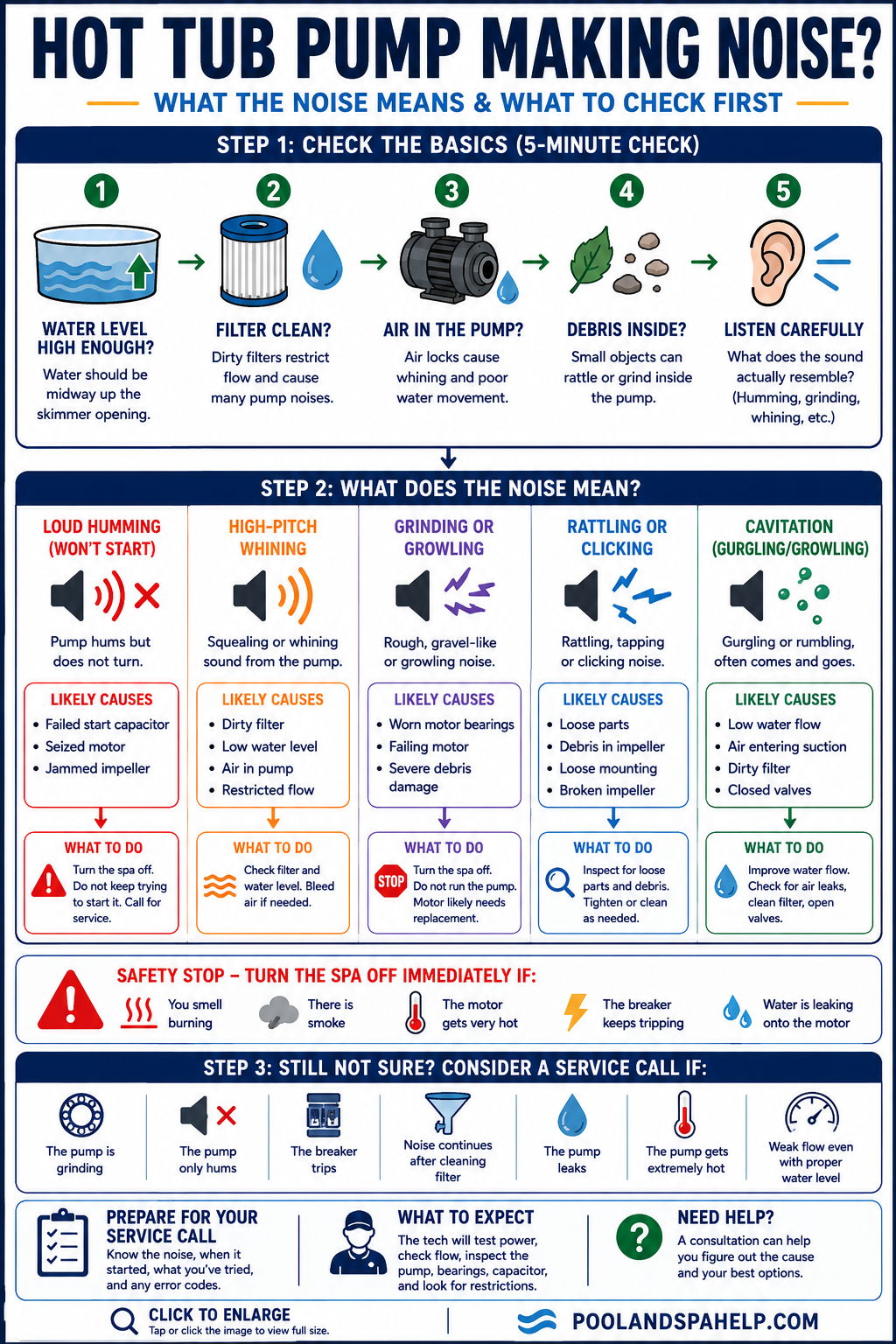
A noisy hot tub pump doesn’t always mean it needs to be replaced. Start by checking the water level, cleaning the filter, and making sure there isn’t air trapped in the pump or debris in the impeller. The type of noise is often the biggest clue—a humming pump may have trouble starting, whining usually points to a flow problem or air lock, grinding often means worn motor bearings, and rattling may be caused by loose parts or debris. If the pump is overheating, leaking, or making loud grinding noises, turn the spa off and arrange for service to prevent further damage.
Hot Tub Pump Making Noise?
If your hot tub pump suddenly starts making unusual noises, don’t panic.
Many noisy pumps are caused by simple problems like trapped air, a dirty filter, or debris in the impeller. Other noises can indicate worn bearings or a failing motor that will eventually require replacement.
The type of noise often provides the biggest clue.
⚠️ Safety Stop
Turn the spa off immediately if:
- You smell burning electrical insulation.
- The pump is smoking.
- The motor becomes extremely hot.
- The breaker keeps tripping.
- Water is leaking onto the motor.
Running a damaged pump longer can destroy the motor or damage the pump seal.
Check These First
Before assuming the pump has failed, check these common causes.
1. Is the water level high enough?
Low water allows air to enter the plumbing.
Symptoms include:
- Gurgling
- Growling
- Intermittent whining
- Bubbles coming from the jets
Top off the water if necessary.
2. Remove and inspect the filter
A dirty filter is probably the most common cause of pump noise.
Restricted flow makes the pump work harder and may create:
- Whining
- Cavitation
- Growling
- Reduced jet pressure
Run the spa briefly without the filter (only for testing).
If the noise disappears, clean or replace the filter.
3. Is there air trapped in the pump?
Air locks commonly occur after:
- Refilling the spa
- Draining the spa
- Replacing a pump
- Plumbing repairs
Symptoms include:
- Loud whining
- Pump sounds dry
- Little or no water movement
Bleeding the pump may solve the problem.
4. Look for obvious debris
Small objects can sometimes enter the wet end. (Safety note: Turn power off to the spa if you decide to check inside the wet end as the pump may start without warning)
Possible debris includes:
- Small stones
- Pieces of plastic
- Broken filter media
- Leaves
- Scale buildup
Debris often causes rattling or scraping sounds.
5. Listen carefully
The exact sound matters.
Try to determine whether it’s:
- Humming
- Grinding
- Screeching
- Clicking
- Buzzing
- Rattling
- Growling
Each sound points toward different problems.
Decision Tree
Is the pump humming but not turning?
↓
Most likely:
- Failed start capacitor
- Seized motor bearings
- Jammed impeller (⚠️ Safety note: Turn power off to the spa if you decide to check he impelleras the pump may start without warning)
Turn the spa off and arrange service.
Is the pump whining or squealing?
↓
Check:
- Dirty filter
- Low water level
- Air trapped in plumbing
- Restricted suction
Is the pump grinding?
↓
Grinding almost always indicates worn motor bearings.
The motor usually needs replacement or rebuilding.
Do not continue running it.
Is the pump rattling?
↓
Inspect for:
- Loose pump mounting bolts
- Loose plumbing
- Broken impeller (⚠️Safety note: Turn power off to the spa if you decide to check the impeller as the pump may start without warning)
- Debris inside the wet end (⚠️Safety note: Turn power off to the spa if you decide to check inside the wet end as the pump may start without warning)
Does the noise come and go?
Possible causes include:
- Air entering the suction line
- Intermittent cavitation
- Control system cycling
- Low water level
Most Common Fixes (What I Usually See)
After years of servicing hot tubs, these are the causes I encountered most often.
Dirty filters
This is easily the most common cause of noisy pumps.
Cleaning or replacing the filter often restores normal operation.
Air lock after refilling
Very common after draining the spa.
The pump sounds much worse than it actually is.
Worn motor bearings
Older pumps often develop a grinding or roaring sound weeks or months before complete failure. This is usually caused by a leaking shaft seal on your pump, therefore, it’s important to catch a leaking shaft seal and having it replaced before more damage happens.
Pump running dry
If water isn’t reaching the pump, internal components can become damaged quickly.
Small debris in the impeller
Occasionally a tiny object becomes lodged inside the wet end, producing a clicking or rattling sound.
When To Call A Technician
Consider calling a technician if:
- The pump is grinding.
- The motor only hums.
- The breaker trips repeatedly.
- The noise continues after cleaning the filter.
- The pump leaks.
- The pump becomes extremely hot.
- Water flow is weak despite normal water level.
Service Call Prep
Before your appointment, make note of:
- Hot Tub Brand
- Age of hot tub
- If able to find, pump brand and hp rating
- Does the hot tub run on 110v or 220v?
- The exact type of noise.
- When it started.
- Whether the spa was recently drained.
- Whether the filter has been cleaned.
- Any error codes displayed.
- Whether all jet pumps are affected or only one.
This information helps speed up diagnosis.
What to Expect During a Service Call
A technician will usually:
- Listen to the pump while operating.
- Check water flow.
- Test pump amperage.
- Inspect the capacitor.
- Examine bearings.
- Check for suction restrictions.
- Inspect the impeller.
- Verify the control system is supplying proper voltage.
Most diagnoses take less than an hour.
Why This Happens
Hot tub pumps operate for hours every day in a warm, humid environment.
Over time:
- Bearings wear out.
- Pump seals age.
- Debris enters the impeller.
- Filters become clogged.
- Air leaks develop.
- Capacitors weaken.
Many noisy pumps are simply showing signs of normal wear after years of operation.
Frequently Asked Questions
Is it safe to use a noisy hot tub pump?
It depends on the noise. A dirty filter may only produce a mild whining sound, while grinding bearings or a seized motor should be addressed immediately.
Can a dirty filter make the pump noisy?
Yes. Restricted water flow is one of the most common reasons a pump begins whining or cavitating.
Why does my pump hum but not start?
This often indicates a failed start capacitor, seized bearings, or a jammed impeller.
Can air make a pump noisy?
Absolutely. Air trapped inside the pump can create whining, growling, or gurgling sounds while reducing water flow.
Will a noisy pump eventually fail?
If the noise is caused by worn bearings or internal motor damage, the pump will usually continue getting louder until it stops working.
Still Not Sure What’s Wrong?
If you’ve gone through the steps in this guide and you’re still unsure what to do next, I offer personalized email consultations.
I’ll review your symptoms, photos (if needed), and the information you’ve gathered to help you determine the most likely cause and the best next step—whether that’s a simple DIY fix or calling a professional.
👉 Learn more about my Pool & Spa Consultation Service
Continue Troubleshooting
- Hot Tub Pump Has No Power
- Hot Tub Pump Has No Power
- Hot Tub’s Pump Isn’t Starting? 10 Common Causes and How to Fix Them.
- Hot Tub Flow Issues? (FLO, FL1, FL2, LF) Causes & Fixes
Learn More:
Written by Dan Harvickson (Founder of Last Mountain Tech) pool and spa specialist