
You reset the hot tub breaker.
Everything starts normally…
Then click — the breaker trips again.
Or maybe it trips the instant you turn it on. Maybe the pumps run normally until the heater starts. Maybe the spa operates for 10 or 20 minutes before suddenly shutting down.
When the breaker trips is one of the biggest clues to what’s causing the problem.
A hot tub that repeatedly trips its breaker should never be ignored. The breaker or GFCI may be reacting to an electrical fault, water intrusion, a failing component, or excessive current draw.
Instead of repeatedly resetting it, use the symptoms to narrow down the problem.
Safety First
Hot tubs combine high-voltage electricity and water, so electrical troubleshooting needs to be treated seriously.
Before opening the equipment compartment:
- Turn OFF power at the spa breaker.
- Never work on energized high-voltage components unless you’re qualified to do so.
- Keep the equipment compartment dry.
- Don’t bypass the GFCI or breaker.
- Don’t install a larger breaker to stop it from tripping.
- Don’t repeatedly reset a breaker that immediately trips again.
If you see burned wiring, melted insulation, water around electrical components, or smell something burning, leave the breaker OFF and have the spa inspected.
From my experience: When an established hot tub suddenly starts tripping the breaker, the heater element is one of the most common causes I’ve encountered. An element can develop an electrical fault that allows current to leak to ground, causing the GFCI breaker to trip. I’ve also seen water get past a failed heater-element seal or O-ring and reach the electrical connections, producing the same symptom.
On a brand-new installation, I look at the wiring. One surprisingly common mistake I’ve encountered — even on installations completed by licensed electricians — is an incorrectly connected neutral. On a typical 120/240V hot tub protected by a GFCI breaker, the spa’s load neutral must be connected to the appropriate neutral terminal on the GFCI breaker itself, not directly to the panel’s neutral bar. If it’s connected incorrectly, the GFCI can trip immediately even though there’s nothing wrong with the hot tub itself. Because this involves line-voltage wiring, the installation should be checked and corrected by a qualified electrician.
Check This First
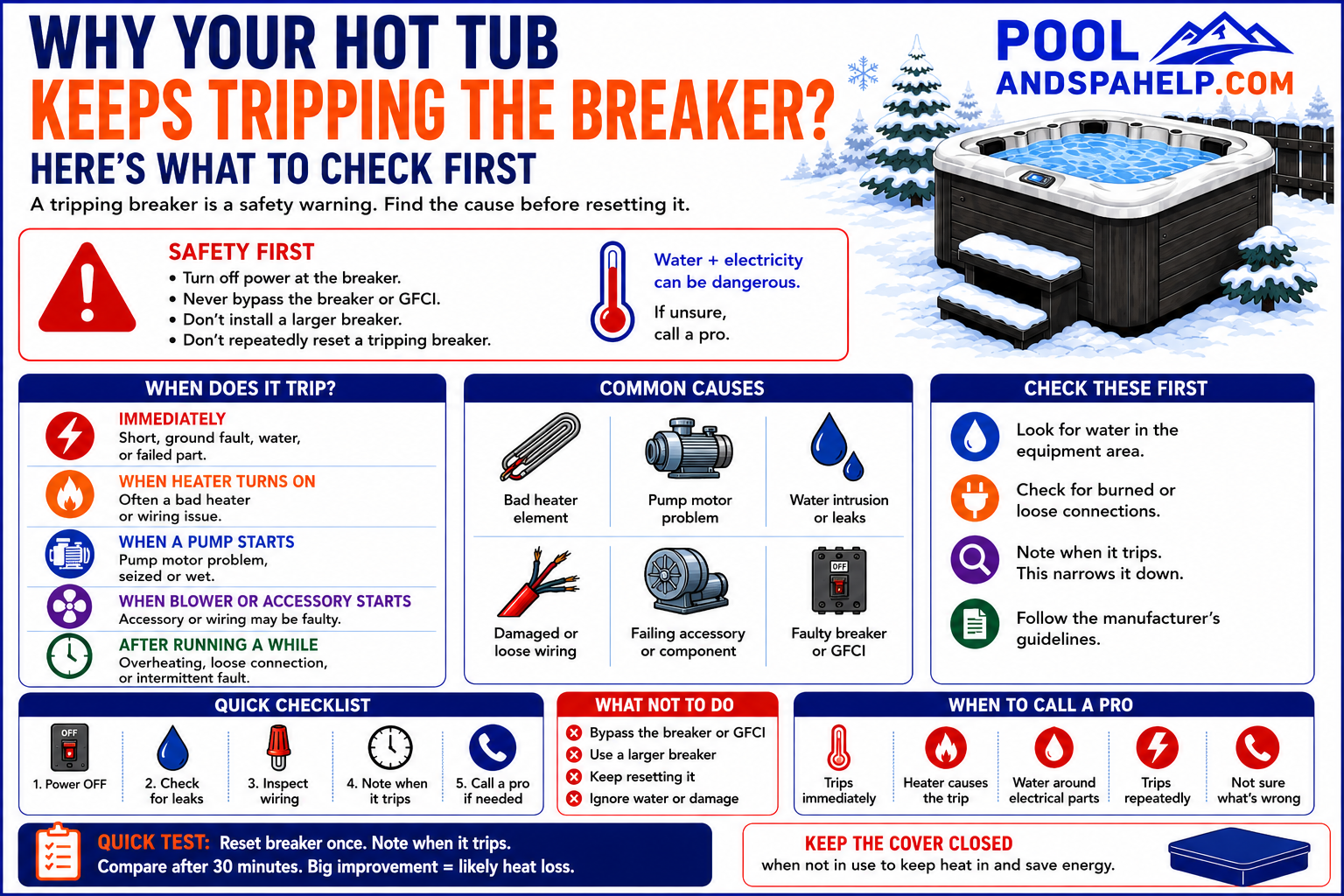
Before taking anything apart, reset the breaker once and pay attention to exactly when it trips.
Does it trip:
- Immediately?
- When a pump starts?
- When the heater turns on?
- When the blower or another accessory starts?
- After the spa has been running for several minutes?
- Only occasionally?
That timing can dramatically narrow down the problem.
Quick Diagnosis: When Does the Breaker Trip?
Breaker Trips Immediately
If the breaker trips immediately when you reset it, stop resetting it.
Possible causes include:
- Shorted component
- Ground fault
- Water inside electrical equipment
- Damaged wiring
- Failed GFCI
- Fault inside the spa control system
An immediate trip usually points toward an electrical fault rather than normal operating load.
If the breaker won’t remain on at all, professional electrical diagnosis is usually the safest next step.
Breaker Trips When the Heater Turns On
This is one of the most useful clues.
If the spa operates normally until the heater is energized, the heater circuit becomes the primary suspect.
A failing heating element can develop a small electrical path between the element and the surrounding water or heater tube.
The heater may even continue producing heat while developing a ground fault.
Possible causes include:
- Failing heater element
- Moisture around heater connections
- Damaged heater wiring
- Loose or overheated terminals
- Fault in the heater circuit
A technician can electrically test the heater to determine whether the element has failed.
Breaker Trips When a Pump Starts
If the breaker trips when a particular pump turns on, focus on that pump and its circuit.
Possible causes include:
- Failing pump motor
- Seized motor
- Damaged motor windings
- Water leaking into the motor
- Damaged wiring
- Excessive current draw
Listen carefully when the pump attempts to start.
If you hear humming immediately before the breaker trips, the motor may be struggling to start or may be mechanically seized.
Breaker Trips When the Blower or Accessory Starts
Don’t overlook accessories.
Depending on the spa, the breaker may trip when activating:
- Air blower
- Ozonator
- Circulation pump
- Stereo equipment
- Lighting
- Auxiliary pumps
If the spa operates normally until one specific accessory is turned on, that component or its wiring becomes a strong suspect.
Breaker Trips After Running for a While
A delayed trip can be harder to diagnose.
Possible causes include:
- Motor overheating
- Loose electrical connection
- Heater problem
- Breaker overheating
- Excessive current draw
- Intermittent water intrusion
- Component failing as it warms up
Pay attention to what the spa is doing immediately before the trip.
For example, if the spa runs for 15 minutes and trips shortly after the heater turns on, the heater circuit may still be responsible.
If it happens after a pump has been running for a while, the pump may be overheating or drawing excessive current.
Is It the Breaker or the GFCI?
Hot tubs are normally protected by a GFCI.
Depending on the installation, the GFCI protection may be incorporated into the spa breaker or another part of the electrical system.
These devices protect against different types of electrical problems.
A standard breaker primarily protects the circuit against excessive current.
A GFCI monitors for electrical current taking an unintended path — particularly important around water.
That means a spa can trip even though it doesn’t appear to be drawing excessive current.
A small ground fault from a heater, pump, wiring problem, or moisture intrusion can be enough to trip the GFCI.
Never bypass GFCI protection to keep the hot tub running.
Look for Water in the Equipment Compartment
With power OFF, inspect the equipment area.
Look around:
- Pumps
- Heater
- Plumbing unions
- Control box
- Wiring
- Equipment floor
A leaking pump seal, loose union, plumbing connection, or other leak can allow water to reach electrical components.
Sometimes the actual problem isn’t the leaking component itself.
It’s where the water goes afterward.
If water has reached electrical wiring, motors, connectors, or the control system, leave the spa powered off until the problem has been corrected.
Check for Burned or Damaged Wiring
With power disconnected, visually inspect accessible wiring.
Look for:
- Melted insulation
- Darkened terminals
- Burned connectors
- Loose connections
- Corrosion
- Damaged wires
- Signs of overheating
Loose electrical connections create resistance.
Resistance creates heat.
Over time, that can damage terminals, wiring, relays, or circuit boards.
If you find burned or melted electrical components, don’t simply tighten the connection and turn the spa back on.
The damaged components should be properly inspected and repaired.
The Heater Is a Common Suspect
When a hot tub repeatedly trips its GFCI, the heater is one of the first components technicians often investigate.
Heating elements live in a harsh environment.
They’re repeatedly heated and cooled while surrounded by water.
Eventually, the insulation inside an element can deteriorate.
Once electrical current begins leaking from the element to ground, the GFCI can trip.
A technician can test the heater electrically rather than simply replacing it based on suspicion.
This is important because a breaker that trips isn’t automatically proof that the heater is bad.
Don’t Forget the Pumps
Spa pumps can also cause breaker trips.
A pump motor may:
- Draw excessive amperage
- Develop an internal electrical fault
- Become mechanically seized
- Overheat
- Get wet from a leaking pump seal or plumbing connection
The timing of the trip is useful here.
If Pump 1 starts normally but the breaker trips every time Pump 2 is activated, Pump 2 deserves much more attention than the heater.
Could the Breaker Itself Be Bad?
Yes.
Breakers and GFCIs can fail.
They can become weak, damaged, or unreliable with age.
But the breaker should not be the first component replaced simply because it keeps tripping.
The breaker may be doing exactly what it’s supposed to do.
Before condemning it, the spa and electrical circuit should be checked for an actual fault.
Replacing a protective device without identifying the cause can leave the original problem unresolved.
What About a Breaker That Feels Warm?
Some warmth under load can occur, but a breaker that becomes unusually hot deserves attention.
Possible causes include:
- Loose connection
- Excessive current draw
- Damaged breaker
- Incorrect wiring
- Electrical panel problem
If the breaker, wiring, or panel appears overheated, stop using the spa and have the electrical system inspected.
Most Common Causes of a Hot Tub Tripping the Breaker
The most common possibilities include:
Failing Heater Element
Especially likely if the breaker trips when the heater turns on.
Pump Motor Problem
More likely if the breaker trips when a particular pump starts or after the motor has been running.
Water Intrusion
Leaks or condensation can allow moisture to reach electrical components.
Damaged or Loose Wiring
Burned terminals, damaged insulation, and loose connections can create serious electrical problems.
Failing Accessory
An ozonator, blower, circulation pump, light, or other accessory can develop a ground fault.
Faulty GFCI or Breaker
Possible, but it should be diagnosed rather than assumed.
What NOT to Do
A tripping breaker is a safety warning.
Don’t:
- Keep resetting it repeatedly.
- Replace it with a higher-amperage breaker.
- Bypass the GFCI.
- Disconnect grounding wires.
- Assume the heater is bad without testing it.
- Continue operating the spa if wiring is overheating.
- Ignore water inside the equipment compartment.
The goal isn’t to find a way to stop the breaker from tripping.
The goal is to find out why it is tripping.
When to Book Service
Electrical problems are one area where professional diagnosis is often worthwhile.
Book service if:
- The breaker trips immediately.
- The breaker won’t reset.
- The heater appears to cause the trip.
- A pump causes the breaker to trip.
- You see burned or melted wiring.
- Water has reached electrical components.
- The breaker or wiring becomes unusually hot.
- The problem is intermittent and difficult to reproduce.
- You aren’t comfortable working around high-voltage spa equipment.
A technician can isolate individual components and electrically test them to determine which circuit is actually causing the fault.
Service Call Prep
Before contacting a technician, gather a few details.
Try to determine:
- Spa make and model
- Approximate age
- Breaker size
- Whether it trips immediately or after running
- Whether it trips when the heater starts
- Whether a particular pump causes it
- Whether the spa recently developed a leak
- Whether any electrical work was recently performed
- Whether the problem started after heavy rain, flooding, or servicing
Also note any error codes shown on the topside control.
The more precisely you can describe when the breaker trips, the easier it may be to diagnose.
What to Expect During Diagnosis
A technician will usually try to isolate the circuit causing the trip rather than replacing components at random.
Depending on the spa and symptoms, diagnosis may include checking:
- Heater element
- Pump motors
- Circulation pump
- Blower
- Ozonator
- Wiring
- Control system
- GFCI/breaker
- Electrical connections
Electrical measurements can then confirm whether a component is shorted, leaking current to ground, or drawing excessive amperage.
This is much more reliable than replacing the heater simply because heaters commonly fail.
Why This Happens
Hot tubs are unusually demanding electrical environments.
They combine:
- Water
- High voltage
- High-current heaters
- Multiple motors
- Heat
- Humidity
- Vibration
- Outdoor weather
Components also cycle on and off thousands of times throughout the life of the spa.
Eventually, seals leak, heating elements deteriorate, motor insulation breaks down, terminals loosen, and electrical components age.
That’s exactly why the spa has breaker and GFCI protection.
When that protection begins tripping, treat it as a symptom that needs to be diagnosed — not an inconvenience that needs to be defeated.
Frequently Asked Questions
Why does my hot tub breaker trip when the heater comes on?
A failing heating element is one possibility, especially if the spa operates normally until heating begins.
Heater wiring, connections, and controls can also cause the problem.
The heater should be electrically tested before replacement.
Why does my hot tub run for a while and then trip the breaker?
A component may be failing after it warms up.
Pump motors, heaters, loose connections, and even the breaker itself can behave differently as temperature increases.
Watch what equipment is operating immediately before the trip.
Can a bad pump trip a hot tub breaker?
Yes.
A failing, seized, wet, or overloaded pump motor can trip the breaker.
If the breaker consistently trips when one particular pump starts, that pump and its circuit should be inspected.
Can water cause a hot tub GFCI to trip?
Yes.
Water entering electrical components or connections can create a ground fault and trip the GFCI.
Always investigate leaks inside the equipment compartment.
Can I just replace the breaker?
Not without diagnosing the problem first.
A failed breaker is possible, but the breaker may be correctly responding to a fault somewhere in the spa.
Should I keep resetting the breaker to figure out what’s wrong?
No.
One reset can help establish when the trip occurs, but a breaker that immediately or repeatedly trips should not be continuously reset.
Related Hot Tub Troubleshooting
If the breaker stays on but the spa still isn’t operating normally, these related guides can help narrow down the problem:
- Hot Tub Not Heating? Here’s What to Check First
- Hot Tub Pump Has Power But Won’t Start
- Hot Tub High Limit Keeps Tripping
- How a Hot Tub Heating System Works
- Hot Tub GFCI Troubleshooting
The important clue is always what happens immediately before the problem occurs.
Once you know that, you can stop guessing and start narrowing down the circuit responsible.
Still Not Sure What’s Tripping the Breaker?
If you’ve narrowed the problem down but aren’t sure which component has failed, don’t start replacing parts based on guesses.
A heater, pump, accessory, wiring fault, water intrusion, or the breaker itself can produce similar symptoms.
The safest next step is to identify exactly when the breaker trips and which components are operating at that moment.
That information can turn “my hot tub keeps tripping the breaker” into a much more specific — and much easier to diagnose — problem.
Related Articles:
- Hot Tub Breaker Keeps Tripping Randomly? How to Find an Intermittent GFCI Trip
- Hot Tub Has No Power? What to Check
- How To Tell If A Hot Tubs Heating Element Is Bad
- Hot Tub’s Pump Isn’t Starting? 10 Common Causes and How to Fix Them.
- Balboa Hot Tub Error Codes Explained: HL, LF, dr, dry, OH, SnA, SnB & More
Written by Dan Harvickson (Founder of Last Mountain Tech) Pool and Spa Specialist