
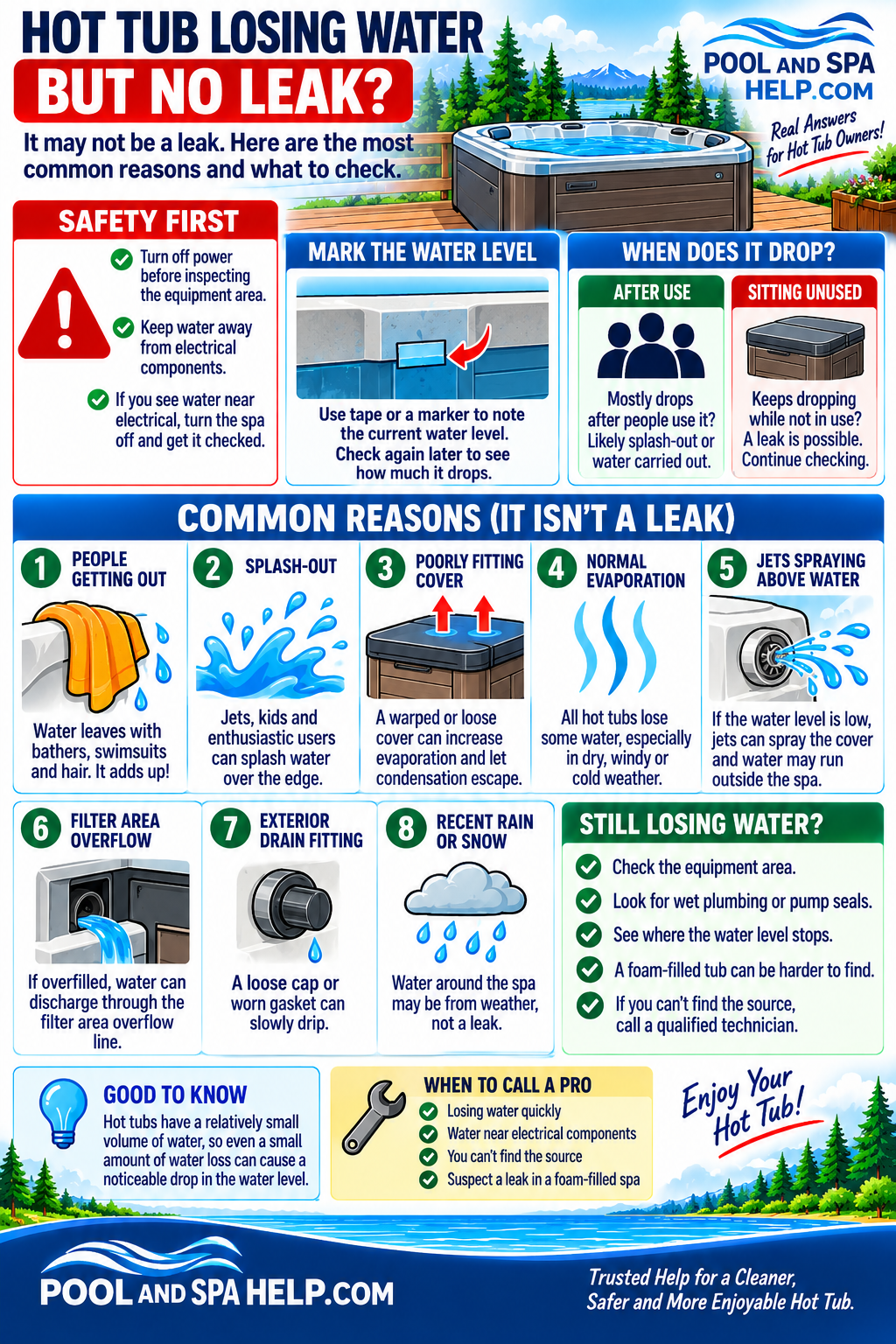
If your hot tub water level keeps dropping but you can’t find a leak, don’t assume there’s a hidden plumbing problem just yet.
Hot tubs can lose a surprising amount of water without having a mechanical leak. People getting in and out of the spa, splashing, evaporation, and even a poorly fitting cover can all gradually lower the water level.
The first question isn’t necessarily “Where is the leak?”
It’s “When is the water disappearing?”
That can help you determine whether the water is actually leaking from the spa or simply being lost during normal operation and use.
Quick Summary
If your hot tub is losing water but you can’t find a leak:
- Mark the current water level.
- Think about how often the spa has been used.
- Check for water being carried out when people exit.
- Inspect the cover for gaps or poor fit.
- Look for excessive condensation or water escaping around the cover.
- Check whether low water is allowing jets to spray above the waterline.
- Check around the cabinet, drain fitting, and equipment area.
- Monitor the water level while the spa is not being used.
If the water level continues dropping significantly while the hot tub is sitting unused, you may have a leak that simply isn’t obvious yet.
Safety Stop
Before removing access panels or inspecting the equipment area, shut off power to the hot tub at the breaker if you may come into contact with electrical components.
Water and electricity are a dangerous combination.
If you find water around the control box, pumps, heater terminals, wiring, or other electrical equipment, turn the spa off and have the problem inspected before continuing to use it.
Check First: Is the Hot Tub Actually Leaking?
Before searching through foam and plumbing, determine whether the spa loses water when nobody is using it.
Use a piece of tape, washable marker, or another temporary reference to mark the water level.
Leave the spa unused for a period of time and check the level again.
A small amount of evaporation can be normal, particularly in dry, windy, or cold conditions. However, a noticeable continuing drop while the spa is sitting unused deserves further investigation.
If most of the water loss happens after people use the spa, the problem may not be a leak at all.
Hot Tub Water-Loss Decision Tree
Does the water level mainly drop after people use the hot tub?
Yes → Check splash-out and water carried out by bathers.
No → Continue.
Is the cover loose, warped, damaged, or not sitting flat?
Yes → Check for increased evaporation and condensation escaping from beneath the cover.
No → Continue.
Are any jets spraying above the waterline?
Yes → Correct the water level and check the jet direction. Water may be spraying against the underside of the cover and running outside the cabinet.
No → Continue.
Is there water around the outside of the spa?
Yes → Check the cover, exterior drain fitting, filter-area overflow, equipment compartment, and recent rain before assuming the shell or plumbing is leaking.
No → Continue.
Does the water level continue dropping while the hot tub sits unused?
Yes → Start treating the problem as a possible hidden leak.
No → Normal use, splash-out, evaporation, or cover-related water loss is more likely.
Most Common Reasons a Hot Tub Loses Water Without an Obvious Leak
1. Water Carried Out by People
This is one of the simplest explanations, but it’s easy to underestimate.
Every time someone gets out of a hot tub, water leaves with them.
Swimsuits absorb water. Hair holds water. Water runs off your body onto the steps, deck, patio, or ground.
With several people entering and exiting the spa repeatedly, the amount can add up.
This is especially noticeable with smaller hot tubs because losing the same volume of water causes a larger change in the water level.
What to look for
Pay attention to whether the water level seems normal before using the spa but noticeably lower afterward.
If so, you may simply be seeing normal bather water loss.
2. Splash-Out
Jets, kids, crowded spas, and enthusiastic hot tub users can move quite a bit of water over the edge.
Sometimes the evidence disappears before you notice it. Water on a warm deck may evaporate, soak into wood, drain away, or disappear into the ground.
If the water level only seems to drop significantly after the hot tub has been used, splash-out should be high on the list.
3. A Poorly Fitting Hot Tub Cover
A properly fitting cover helps trap heat and reduce evaporation.
If the cover is warped, damaged, sagging, incorrectly positioned, or simply doesn’t fit the spa properly, warm moist air can escape.
That can increase evaporation.
A cover that doesn’t sit flat can also allow condensation from underneath the cover to run toward the outside of the spa instead of dripping back into the tub.
You may see water around the hot tub and assume the spa itself is leaking when the water is actually coming from the cover.
Inspect the cover from all sides and make sure it sits reasonably flat against the top of the spa.
4. Normal Evaporation
All hot tubs lose some water through evaporation.
How much depends on conditions such as:
- Water temperature
- Air temperature
- Humidity
- Wind
- How often the cover is removed
- How long the spa is used
- How well the cover seals
Water loss can become much more noticeable during cold or dry weather because of the temperature difference between the hot water and surrounding air.
A spa that spends a lot of time uncovered will naturally require more frequent topping up.
The important clue is the rate of water loss.
A gradual decline over time can be normal. A water level that drops noticeably every day while the covered spa isn’t being used deserves investigation.
5. Jets Spraying Above the Waterline
This one can be surprisingly deceptive.
If the water level becomes low enough, some jets may begin spraying partially above the surface instead of completely underwater.
The spray can hit the underside of the hot tub cover.
From there, the water may run toward the edge, down the outside of the shell, or into the cabinet.
You may never actually see water spraying out of the spa.
Check the water level while the pumps are running and watch the direction of the jets.
If a jet is breaking the surface and spraying the cover, refill the spa to its proper operating level and adjust the jet direction if necessary.
6. Water Coming From the Filter Area
Some hot tubs have an overflow or drain arrangement around the filter compartment that can discharge water outside the cabinet.
If the spa is overfilled, people enter the tub, or water is displaced into the filter area, some of that water may exit through the overflow.
Later, you find water near the bottom of the spa and assume something inside is leaking.
Check where any filter-area overflow or drain line exits before beginning more invasive leak troubleshooting.
7. The Exterior Drain Fitting Is Dripping
The spa’s drain fitting is another easy place to overlook.
A loose cap, damaged gasket, cracked fitting, or drain that isn’t completely closed can create a slow drip.
Because the drain is normally near the bottom of the cabinet, the water can look like it’s coming from somewhere inside the hot tub.
Inspect the exterior drain and the ground immediately around it.
Even a slow drip can add up to significant water loss over several days.
8. Rainwater or Water Around the Spa
Finding water beside the hot tub doesn’t automatically mean that water came from inside it.
Rain can run down the cover and cabinet. Snow can melt around the spa. Condensation can collect beneath the cover and run down the sides.
Before chasing a leak, consider recent weather and dry the area around the spa.
Then see whether the water returns.
A Simple Test: Mark the Water Level
One of the easiest ways to separate normal-use water loss from a possible leak is to monitor the spa while nobody uses it.
Bring the water to its normal operating level and mark the level.
Keep the cover on and avoid using the hot tub for a reasonable test period.
Then check the mark again.
If the water level remains relatively stable, but drops after the spa is used, look closely at:
- Splash-out
- Water carried out by bathers
- Cover fit
- Jet spray
- Filter-area overflow
If the level continues falling while the covered spa is sitting unused, a leak becomes more likely.
What If the Water Keeps Dropping?
If you’ve ruled out normal water loss and the level continues to fall, it’s time to start looking for an actual leak.
Begin in the equipment compartment.
Check around:
- Pump seals
- Pump unions
- Heater connections
- Plumbing fittings
- Valves
- Drain plumbing
- Hose connections
Check the equipment area both while the pumps are running and while they’re off. Some leaks only appear under pressure, while others may be more noticeable when the pump is stopped.
If you still can’t find anything, shut the spa down and monitor where the water level eventually stops.
The stopping point can provide an important clue.
If the water consistently stops just below a particular jet or fitting, inspect components at that level more closely.
On foam-filled hot tubs, remember that the wettest area isn’t always directly beside the leak. Water can travel through the foam before appearing somewhere else.
For a complete leak diagnosis, see Hot Tub Leaking? How to Find Where the Water Is Coming From.
When to Book Service
Consider calling a hot tub technician if:
- The water level drops rapidly while the spa isn’t being used.
- Water is entering the equipment compartment.
- Water is near electrical components.
- The spa continues losing water below the normal operating level.
- You suspect a leak inside a foam-filled cabinet.
- The leak appears to be underneath the spa.
- You can’t determine where the water is going.
A technician may need to isolate plumbing sections or trace moisture through the insulation to locate the source.
Service Call Prep
Before contacting a technician, note:
- Approximately how much water the spa loses per day
- Whether it loses water while covered and unused
- Whether the loss becomes worse while the pumps are running
- Where the water level eventually stops
- Whether you’ve found moisture around the equipment
- Whether the problem started suddenly or gradually
- Any recent repairs, draining, refilling, or freezing conditions
These details can make leak diagnosis considerably easier.
Why This Happens
A hot tub contains a relatively small volume of water compared with a swimming pool, so relatively modest water loss can create a noticeable change in level.
The spa also operates with warm water, strong jets, moving bathers, and a large temperature difference between the water and surrounding air.
That makes some water loss unavoidable.
The key is determining whether the amount you’re losing makes sense for how the spa is being used.
If the water mostly disappears when people are using the hot tub, there’s a good chance it isn’t disappearing through the plumbing.
If it keeps disappearing when nobody is touching the spa, it’s time to look harder for a leak.
Frequently Asked Questions
How much water loss is normal for a hot tub?
There isn’t one normal amount because evaporation varies with temperature, humidity, wind, cover condition, and spa use.
Instead of relying on a specific measurement, watch the pattern. Slow water loss over time can be normal. Significant daily loss from a covered, unused spa is much more suspicious.
Can people getting out of a hot tub really lower the water level?
Yes. Water clings to bodies, swimsuits, and hair every time someone exits. With several bathers or frequent use, the amount can become noticeable.
Can a bad hot tub cover cause water loss?
Yes. A poorly fitting or damaged cover can allow more evaporation. Condensation can also run outside the spa rather than returning to the water.
Why is there water around my hot tub if it isn’t leaking?
Possible sources include cover condensation, rain, snowmelt, splash-out, the exterior drain fitting, a filter-area overflow, or jets spraying against the underside of the cover.
Why does my hot tub lose water only when the jets are running?
Check for jets spraying above the waterline and inspect the equipment compartment. A plumbing leak on the pressure side can also become more noticeable while the pumps are operating.
Should I use leak sealer in my hot tub?
Don’t add leak sealer simply because the water level is dropping. First determine whether you actually have a leak and, if possible, locate its source. Some problems are better repaired directly rather than masked with a sealant.
Related Articles:
- Hot Tub Leaking? Here’s What to Check First
- How to Find a Leak in a Full-Foam Hot Tub
- Water Around Hot Tub But No Leak? Here’s What to Check
Written by Dan Harvickson (Founder of Last Mountain Tech) Pool and Spa Specialist