
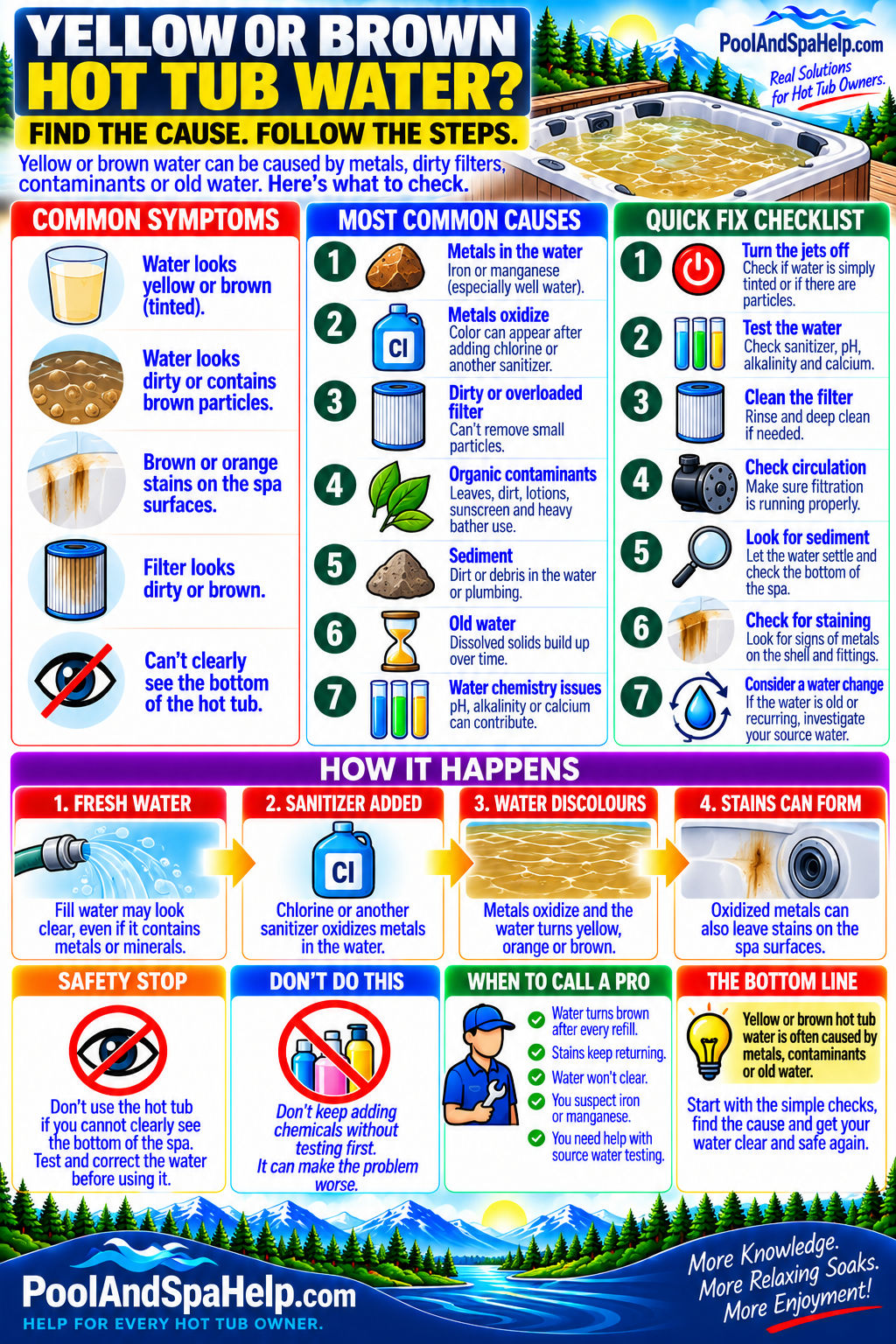
Yellow or brown hot tub water can be alarming, especially when the water looked perfectly clear when you first filled the spa.
But the color itself can provide an important troubleshooting clue.
Yellow, tea-colored, orange, or brown water is often associated with metals such as iron or manganese, particularly when the discoloration appears shortly after adding chlorine or another oxidizer. But metals aren’t the only possibility.
Dirty filters, contaminated water, organic material, sediment, old water, and plumbing debris can also discolor hot tub water.
Before adding more chemicals, take a closer look at when the discoloration started and what the water actually looks like.
Quick Check: Is the Water Clear but Tinted, or Actually Dirty?
Look down into the hot tub with the pumps turned off.
Clear water with a yellow or brown tint
If you can easily see through the water but it has a yellow, orange, tea-colored, or brown tint, metals in the water are one possibility.
Iron is a common culprit.
This is especially worth considering if:
- You recently filled the hot tub.
- You use well water.
- The water changed color after adding sanitizer.
- You see orange or brown staining around the spa.
Cloudy brown or dirty-looking water
If the water contains visible particles or looks muddy rather than simply tinted, check for:
- Dirty filters
- Sediment
- Organic contamination
- Debris entering the spa
- Plumbing contamination
- Poor filtration
That distinction can help narrow down the problem quickly.
Safety Stop
Don’t use the hot tub if you cannot clearly see the bottom.
Severely discolored or cloudy water can make it difficult to see someone beneath the surface and may indicate that the water hasn’t been properly sanitized.
Also avoid using the spa if you don’t know what contaminated the water.
Test and correct the water before getting back in.
What Causes Yellow or Brown Hot Tub Water?
Several problems can produce similar-looking water.
Common causes include:
- Iron or manganese in the source water
- Metals oxidizing after sanitizer is added
- Dirty or contaminated filters
- Sediment in the water
- Organic contamination
- Old hot tub water
- Debris or contamination inside the plumbing
- Water chemistry problems
The timing of the discoloration is one of your best diagnostic clues.
Step 1: Did the Water Change Color After You Filled the Hot Tub?
If you’ve just refilled the hot tub and the water has a yellow or brown tint, start by considering your source water.
Well water is particularly worth investigating because it may contain dissolved minerals and metals.
The water coming from the hose may even appear clear.
That doesn’t necessarily mean it will stay that way.
Once the water enters the hot tub and the chemistry changes, dissolved material can become much more noticeable.
If the problem happens every time you refill the spa, your source water moves much higher on the suspect list.
Step 2: Did It Turn Brown After Adding Chlorine?
This is an important clue.
Suppose you fill the hot tub and the water initially looks fine.
Then you add chlorine or another oxidizing sanitizer and suddenly the water develops a yellow, orange, or brown tint.
That can indicate metals in the water being oxidized.
Iron is a common example.
Once oxidized, iron can discolor the water and may eventually stain hot tub surfaces.
If this happens repeatedly after filling, consider having the source water tested for metals rather than continually treating the symptom.
Step 3: Check the Filter
Remove the filter and inspect it.
A filter can tell you quite a bit about what’s happening in the water.
Look for:
- Brown or orange discoloration
- Fine sediment
- Dirt between the pleats
- Oily buildup
- Scale
- Unusual debris
Rinse the filter thoroughly.
If it is heavily contaminated, use an appropriate filter-cleaning product according to its instructions.
A filter that is damaged, deteriorated, or impossible to clean may need replacement.
If the water contains suspended material, the filter may also need to be cleaned more than once while you’re clearing the problem.
Step 4: Test the Water Chemistry
Don’t start randomly adding chemicals because the water looks brown.
Test it first.
Check:
- Sanitizer
- pH
- Total alkalinity
- Calcium hardness
Follow the recommended ranges for your particular hot tub and water-care system.
Water chemistry matters not only for sanitation but also because it can affect how minerals behave in the water.
If you’re dealing with suspected metals, knowing the current pH is particularly useful before deciding what treatment is appropriate.
Step 5: Look for Staining
Inspect the shell, fittings, waterline, filter, and other light-colored surfaces.
Orange or rusty-brown staining
This can support the possibility of iron in the water.
Dark brown or black staining
Other metals, including manganese, may be involved.
But don’t diagnose the water based solely on stain color.
Water chemistry, source water, and professional water testing can provide much better evidence.
Step 6: Is There Sediment on the Bottom?
Brown water and brown material in the water aren’t necessarily the same problem.
Turn the pumps off and let the water settle.
Then look at the bottom of the spa.
If material settles out, you may be dealing with sediment rather than dissolved metals alone.
Possible sources include:
- Well water
- Dirt carried into the spa
- Plumbing debris
- Deteriorating material
- Contaminants introduced by bathers
If sediment keeps returning after cleaning, determine where it’s coming from instead of continually removing it.
Step 7: Consider Organic Contamination
Yellowish or brown water can sometimes result from organic material.
Think about what has recently entered the hot tub.
Possible contaminants include:
- Leaves
- Pollen
- Dirt
- Body oils
- Cosmetics
- Lotions
- Heavy bather load
A neglected hot tub can also develop significant water-quality problems if sanitizer has remained low for an extended period.
Test the sanitizer rather than assuming the discoloration is simply cosmetic.
Step 8: Check Circulation and Filtration
If the hot tub isn’t filtering properly, contaminants can remain suspended in the water.
Check that:
- The circulation system is operating.
- The filter is clean.
- Water flow is normal.
- Filtration cycles are programmed correctly.
- There are no flow-related errors.
- Valves haven’t accidentally been left closed after servicing.
If water flow is noticeably weaker than normal, investigate the circulation problem as well as the water chemistry.
Step 9: Think About the Age of the Water
If the water has been in the hot tub for a long time and has become increasingly difficult to maintain, a drain and refill may be the most practical solution.
But there’s an important exception.
If your source water contains metals, simply draining and refilling from the same source may recreate the exact same problem.
If the spa turns yellow or brown after every refill, investigate the fill water before assuming that another water change will solve it.
What If My Hot Tub Water Turns Brown Every Time I Add Chlorine?
This pattern deserves attention.
If:
Fresh water looks clear → sanitizer is added → water turns yellow/orange/brown
then testing the source water for metals is worthwhile.
Repeatedly adding more chlorine isn’t necessarily going to make the color disappear.
If metals are confirmed, a metal sequestrant or other treatment designed for spa water may be appropriate.
Follow the product directions carefully because treatment procedures vary.
Can I Prevent Metals From Getting Into the Hot Tub?
If metals in your fill water are a recurring problem, prevention may be easier than dealing with discolored water after every refill.
Depending on your water source, options may include:
- Testing your fill water
- Using an appropriate pre-filter when filling
- Treating metals according to your spa-care system
- Maintaining proper water balance
- Cleaning the filter as metals are removed from the water
A hose pre-filter can help with some contaminants, but don’t assume every filter removes every dissolved metal.
Check what the particular filter is designed to remove.
Don’t Do This: Keep Adding Chemicals Until the Color Changes
Brown water often causes people to start throwing chemicals at the hot tub.
That’s not a troubleshooting method.
You can easily end up with brown water plus badly unbalanced water.
Instead, establish the basics:
What does the water look like?
When did it change color?
What was added immediately beforehand?
What does the filter look like?
What does the water test show?
Those answers usually tell you much more than the color alone.
Most Common Fixes
The correct fix depends on the cause.
If metals are present:
Use an appropriate spa treatment designed to manage metals and follow its directions.
If the filter is dirty:
Clean or replace it as necessary and continue filtering the water.
If there’s sediment:
Remove the sediment and investigate its source.
If sanitizer is low:
Correct it according to your water-care system.
If circulation is poor:
Correct the flow or filtration problem.
If the water is old or badly contaminated:
Draining, cleaning, and refilling may be the simplest solution.
Just remember that recurring discoloration immediately after a refill points back toward the source water.
When to Call a Professional
Consider getting help if:
- The water repeatedly turns brown after refilling.
- You suspect significant iron, manganese, or other metals.
- Staining continues to develop.
- The water won’t clear despite proper treatment and filtration.
- The hot tub has poor circulation.
- You aren’t sure whether the problem is chemical or mechanical.
A pool and spa dealer can usually perform more detailed water testing than basic home test strips.
If you use well water and the problem extends beyond the hot tub, professional testing of the source water may also be worthwhile.
FAQ
Why did my hot tub water turn brown after adding chlorine?
One possibility is dissolved metals, particularly iron. Oxidation can make previously dissolved metals much more visible, causing yellow, orange, or brown discoloration.
Why is my hot tub water yellow but still clear?
Clear but tinted water can indicate dissolved material such as metals. Consider the source water, especially if the problem appeared shortly after filling or adding sanitizer.
Can well water make a hot tub turn brown?
Yes. Well water can contain iron, manganese, sediment, and other minerals that may discolor spa water.
Will changing the water fix brown hot tub water?
It depends on the cause. If the problem is old or contaminated water, a refill may solve it. If your fill water contains metals, refilling from the same source may cause the discoloration to return.
Why is there brown stuff in my hot tub filter?
The filter may be collecting dirt, sediment, oxidized metals, or other contaminants. Clean the filter and determine whether the material returns.
Can I use my hot tub if the water is yellow or brown?
Don’t use it if you cannot clearly see the bottom or if you aren’t confident that the water is properly sanitized. Determine the cause and verify the water chemistry first.
The Bottom Line
Yellow or brown hot tub water doesn’t have one universal cause.
Start by determining whether the water is clear but tinted or actually cloudy and dirty.
Then pay attention to when the color appeared.
If fresh water suddenly turns yellow, orange, or brown after sanitizer is added, metals in the source water should be investigated.
If you’re seeing particles, sediment, or dirty water instead, check the filter, circulation, sanitizer level, contamination, and age of the water.
The color is a clue.
The timing usually tells you even more.
Related Articles:
- Hot Tub Cloudy Water
- Hot Tub Water Chemistry: A Simple Guide to Clear, Safe Water
- Why Is My Hot Tub Water Milky White? Causes and Fixes
- White Flakes in Hot Tub Water: What Causes Them and How to Get Rid of Them
- Hot Tub Water Smells Bad: Causes, Fixes, and How to Get Rid of the Odor
Written by Dan Harvickson (Founder of Last Mountain Tech) Pool and Spa Specialist