
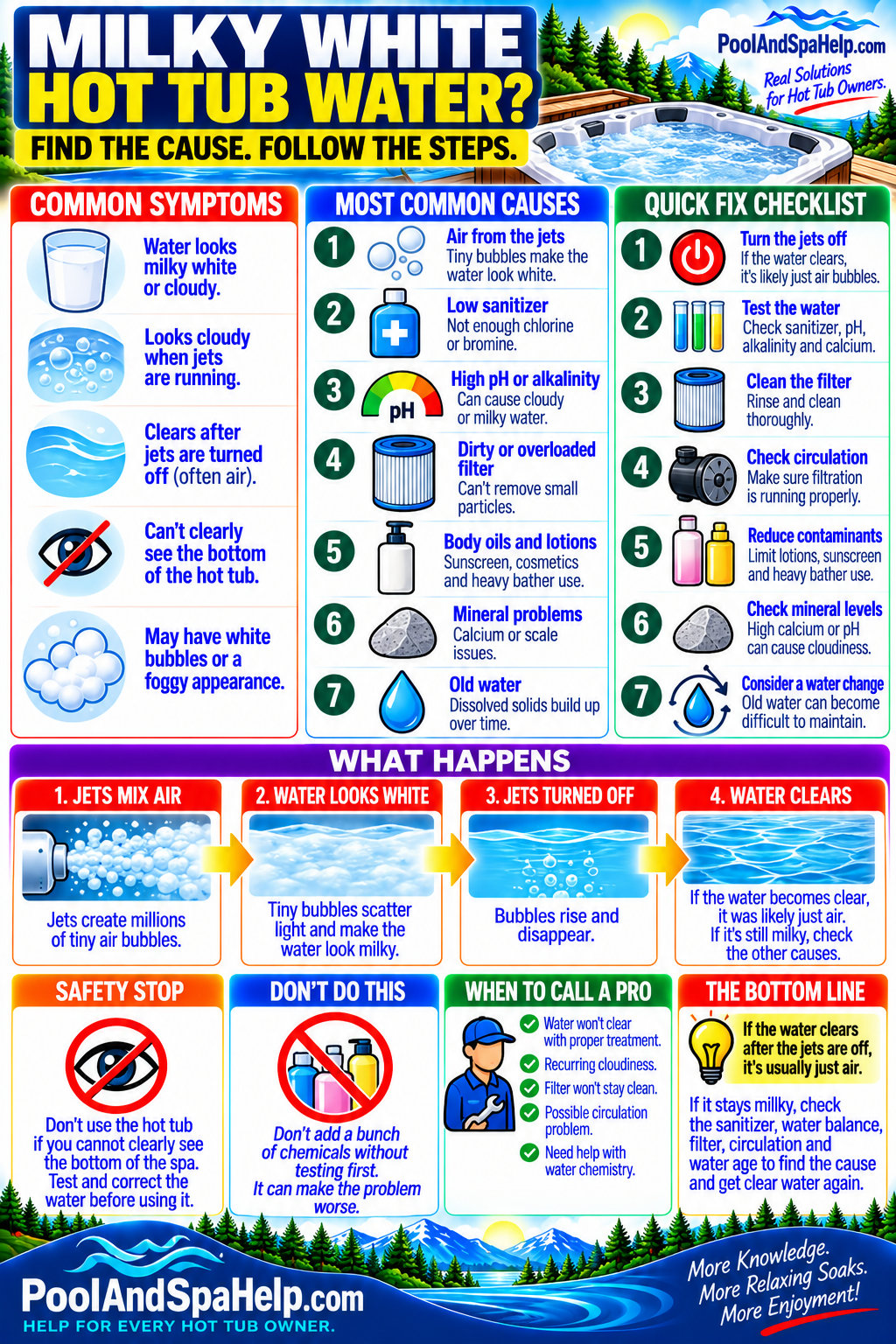
Milky white hot tub water can make perfectly usable water look like something has gone seriously wrong.
Sometimes the water really is cloudy because of poor filtration, water chemistry, contaminants, or a sanitizer problem. But before adding chemicals or changing the water, there’s one very simple test worth doing.
Quick Check: Turn the Jets Off
If your hot tub water looks milky white while the pumps are running, turn the jets off and wait a few minutes.
Watch what happens.
If the water quickly becomes clear:
What you’re seeing may simply be tiny air bubbles created by the jets, not cloudy water.
If the water stays milky or cloudy:
There is probably something suspended in the water, and it’s time to check the water chemistry, sanitizer level, filter, and other possible causes.
This simple test can prevent a lot of unnecessary chemical adjustments.
Safety Stop
Don’t use the hot tub if the water is so cloudy that you cannot clearly see the bottom of the spa.
Poor visibility can be a safety concern, particularly if children are using the hot tub. Severe cloudiness can also indicate that the water is not being adequately sanitized or filtered.
If you aren’t sure about the condition of the water, test and correct the water chemistry before using the spa.
Why Does Hot Tub Water Turn Milky White?
Milky or cloudy hot tub water usually comes from one or more of these:
- Tiny air bubbles from the jets
- Low sanitizer
- High pH or alkalinity
- Calcium or mineral problems
- Dirty or overloaded filters
- Oils, lotions, soaps, or other contaminants
- Heavy bather use
- Poor circulation or filtration
- Old water with a high dissolved-solids load
The appearance can be similar even though the causes are very different.
That’s why I prefer diagnosing the problem before throwing more chemicals into the water.
Step 1: Determine Whether It’s Actually Cloudy
Start with the easiest test.
Turn off the jet pumps and air controls.
Give the water a few minutes to settle.
Water clears quickly
If the milky appearance disappears, you’re probably seeing entrained air.
Hot tub jets mix air into the water to create the massage effect. That air can form thousands of extremely small bubbles that make the water look white or cloudy.
Look closely and you may actually be able to see the bubbles rising toward the surface.
In this situation, the water itself may be perfectly clear.
Water stays cloudy
If the pumps are off and the water remains milky, continue troubleshooting.
Step 2: Test the Water Chemistry
Before adding anything, test the water.
Check:
- Sanitizer
- pH
- Total alkalinity
- Calcium hardness
The exact recommended ranges can vary somewhat depending on the sanitizer system and spa manufacturer, so follow the recommendations for your particular hot tub and chemicals.
Pay particular attention to the sanitizer level.
Hot tubs operate at warm temperatures and relatively small water volumes. Several people entering the spa can introduce a significant amount of contaminants very quickly.
If sanitizer can’t keep up with that demand, the water can become cloudy or milky.
Step 3: Check the Filter
A dirty filter is one of the first mechanical things I would check.
The filter’s job is to remove small particles suspended in the water. As it becomes dirty, water flow through the filter can decrease and filtration performance can suffer.
Remove the filter and inspect it.
Look for:
- Dirt and debris
- Oils
- Discoloration
- Scale
- Damaged filter media
- Pleats that remain dirty after cleaning
Rinse the filter thoroughly according to the manufacturer’s instructions.
A filter that looks relatively clean can still be loaded with oils and contaminants that don’t rinse away easily. Periodic deeper cleaning with an appropriate filter cleaner may be required.
If the filter is old, damaged, or no longer cleans properly, replacement may be the better option.
Step 4: Think About What Went Into the Water
Sometimes the hot tub equipment isn’t the problem at all.
Consider what happened shortly before the water became milky.
A busy evening in the hot tub can introduce:
- Body oils
- Sweat
- Lotions
- Sunscreen
- Cosmetics
- Hair products
- Detergent residue from bathing suits
All of these increase the load on the sanitizer and filtration system.
If the water became cloudy after several people used the spa, heavy bather load is a strong clue.
You may need to correct the sanitizer level and allow the filtration system time to clean up the water.
Step 5: Check Circulation and Filtration
Even properly balanced water can become cloudy if it isn’t being filtered enough.
Make sure the hot tub is actually circulating water as expected.
Check for:
- Weak circulation
- Dirty filters
- Closed valves after servicing
- Pump or circulation-pump problems
- Incorrect filtration settings
- Flow-related error messages
If your hot tub allows the filtration duration to be programmed, make sure someone hasn’t accidentally changed the settings.
This can occasionally happen after programming changes, power interruptions, or when someone is trying to reduce operating costs.
Reducing filtration too much can create water-quality problems.
Step 6: Consider Calcium and pH
A whitish or milky appearance can sometimes be related to minerals coming out of solution.
This becomes more likely when water chemistry—particularly pH, alkalinity, calcium hardness, and temperature—creates conditions favorable to scale formation.
You may also notice:
- White deposits around the waterline
- Rough surfaces
- Scale on fittings
- White flakes or particles
- Scale forming on the heater or other equipment
Don’t assume calcium is the problem based only on the color of the water.
Test first.
Step 7: How Old Is the Water?
Hot tub water doesn’t last forever.
Every time chemicals are added, people use the spa, and water evaporates and is replaced, dissolved material accumulates.
Eventually, maintaining good water quality becomes increasingly difficult.
You may find yourself repeatedly correcting the chemistry only to have cloudy water return.
If the water is old and you’ve been fighting recurring water-quality problems, draining and refilling the spa may be easier than continuing to chase the chemistry.
Always follow the hot tub manufacturer’s draining and refilling instructions.
Milky Water Immediately After Adding Chemicals
If the water suddenly turns milky after adding a chemical, don’t immediately add something else to counteract it.
Give the product time to disperse and retest the water according to its directions.
Some water-care products can temporarily change the appearance of the water.
Adding several corrective chemicals one after another without testing can turn a small water-balance problem into a much larger one.
Most Common Fixes
For genuinely milky hot tub water, the solution is often fairly simple:
Test the water first.
Correct sanitizer and water balance as necessary.
Clean the filter.
Make sure water can circulate properly through it.
Increase filtration if necessary.
Give the filter time to remove suspended material.
Address heavy bather load.
Oils and other contaminants may require additional sanitizer treatment according to your water-care system.
Drain and refill old water.
Sometimes starting over is the most practical solution.
But remember the first test:
Turn off the jets.
If the “cloudiness” disappears within a few minutes, you might not have a water-quality problem at all.
When Milky Water Keeps Coming Back
Recurring cloudy or milky water usually means something is being missed.
Instead of repeatedly adding clarifier or sanitizer, look for the pattern.
Ask yourself:
- Does it happen after heavy hot tub use?
- Does it happen shortly after adding chemicals?
- Is the filter getting dirty unusually quickly?
- Is filtration running long enough?
- Is the sanitizer repeatedly dropping to very low levels?
- Is the water getting increasingly difficult to balance?
- Does the cloudiness disappear whenever the pumps stop?
The pattern often provides a better clue than the appearance of the water itself.
When to Drain and Refill
Consider replacing the water when:
- The water is old
- Chemistry has become difficult to maintain
- Cloudiness repeatedly returns
- The water has been badly contaminated
- Correct chemistry and filtration aren’t clearing it
Draining shouldn’t necessarily be the first solution, but there comes a point where trying to rescue old water costs more time and chemicals than replacing it.
FAQ
Why does my hot tub water look milky when the jets are on?
The jets can mix large amounts of air into the water. Tiny bubbles scatter light and can make otherwise clear water appear milky white. Turn the pumps and air controls off. If the water quickly clears, air is probably responsible.
Why is my hot tub cloudy even though the chemicals are balanced?
Check the filter, filtration time, circulation, water age, and recent bather load. Balanced test results don’t necessarily mean suspended contaminants are being removed effectively.
Can a dirty hot tub filter cause milky water?
Yes. A dirty or contaminated filter can reduce filtration and allow small particles to remain suspended in the water.
Should I add clarifier to milky hot tub water?
Not automatically. Determine why the water is cloudy first. Clarifier may help with certain suspended particles, but it won’t correct poor sanitizer levels, badly unbalanced water, inadequate circulation, or old water.
Can too many chemicals make hot tub water cloudy?
Yes. Incorrect dosing or repeatedly adding chemicals without testing can contribute to water-balance problems. Always test first and follow the chemical manufacturer’s directions.
Is milky hot tub water safe to use?
If you cannot clearly see the bottom of the hot tub, don’t use it. Test the sanitizer and water balance and correct the cause of the cloudiness before using the spa.
The Bottom Line
Milky white hot tub water doesn’t automatically mean something is wrong with the water.
Start with the simplest diagnostic test:
Turn off the jets and watch the water.
If it clears quickly, you’re probably looking at tiny air bubbles.
If it stays milky, work through the basics in order: water chemistry, sanitizer, filter condition, circulation, contamination, mineral balance, and water age.
Diagnosing the cause before adding chemicals is usually faster, cheaper, and far less frustrating than treating cloudy water by guesswork.
Related Articles:
- Hot Tub Cloudy Water
- Hot Tub Water Chemistry: A Simple Guide to Clear, Safe Water
- Hot Tub Water Is Green: Causes, Troubleshooting, and How to Fix It
- White Flakes in Hot Tub Water: What Causes Them and How to Get Rid of Them
Written by Dan Harvickson (Founder of Last Mountain Tech)Pool and Spa Specialist