
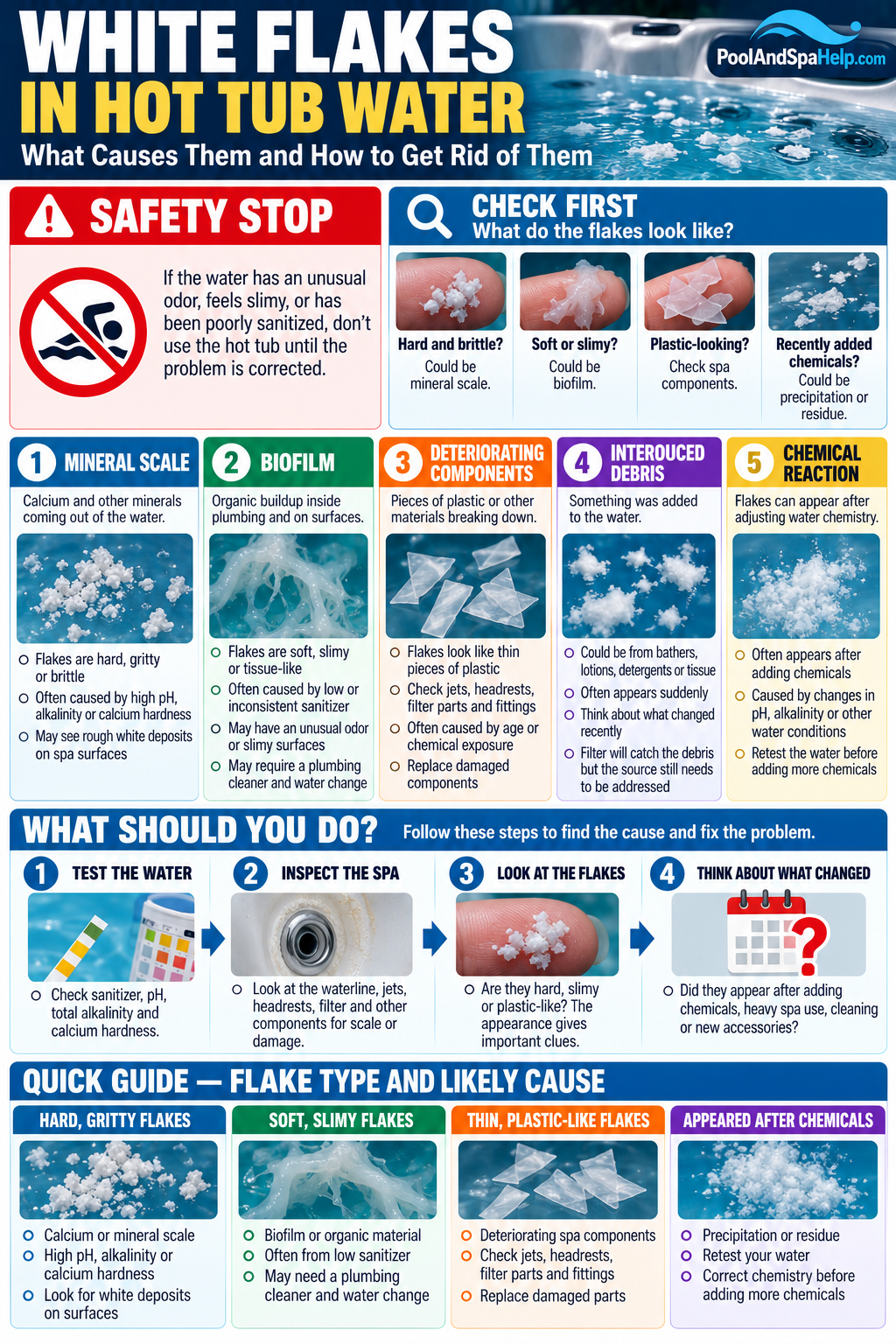
You open the hot tub cover and notice small white flakes floating in the water.
Maybe they look like tiny pieces of paper.
Maybe they crumble between your fingers.
Or perhaps they seem slimy or soft.
White flakes in hot tub water aren’t one specific problem. Several things can create similar-looking debris, and the correct treatment depends on what those flakes actually are.
Common causes include:
- Calcium or mineral scale
- Biofilm
- Deteriorating plastic or components
- Debris introduced into the water
- Residue after certain water treatments
Before adding more chemicals, take a closer look at the flakes.
That can give you your first clue.
SAFETY STOP
If the water has an unusual odor, feels slimy, has been poorly sanitized, or you suspect biological contamination, don’t use the hot tub until the water problem has been corrected.
Maintain sanitizer and water chemistry according to the recommendations for your spa and sanitizer system.
Never mix concentrated pool or spa chemicals together, and follow the product manufacturer’s directions when adjusting the water.
CHECK FIRST — What Do the White Flakes Look Like?
Before treating the water, remove some of the flakes and examine them.
Ask yourself:
Are they hard and brittle?
Think about calcium or mineral scale.
Are they soft, slimy or tissue-like?
Biofilm becomes more likely.
Do they look like actual pieces of plastic?
Inspect the spa components.
Did they appear immediately after adding a chemical or water treatment?
The flakes may be related to precipitation or residue caused by the treatment.
The appearance isn’t always enough for a definite diagnosis, but it’s a useful place to start.
Cause #1 — Calcium or Mineral Scale
One of the most common explanations for white flakes is mineral scale.
When water chemistry encourages calcium and other minerals to precipitate out of the water, deposits can form on:
- Heater surfaces
- Plumbing
- Jets
- Spa shell
- Equipment
Pieces can eventually break loose and circulate through the hot tub.
These flakes are often hard, gritty or brittle rather than soft and slimy.
You may also notice a rough white deposit around the waterline or on other spa surfaces.
What Causes Scale?
Scale becomes more likely when the water is out of balance.
Common contributors include:
- High pH
- High total alkalinity
- High calcium hardness
- High water temperature
- High mineral content in the source water
Hot tubs can be particularly susceptible because warm water encourages some minerals to come out of solution more readily.
What Should You Do?
Test the water.
Check:
- pH
- Total alkalinity
- Calcium hardness
- Sanitizer
Correct the water balance according to the recommendations for your spa and chemical system.
If significant scale has already formed inside the plumbing or heater, correcting the current water chemistry may prevent additional buildup, but it won’t necessarily make existing deposits disappear immediately.
Cause #2 — Biofilm
White flakes aren’t always calcium.
Biofilm can develop inside spa plumbing and other areas where contaminated water circulates.
Unlike mineral scale, biofilm-related material is often:
- Soft
- Slimy
- Stringy
- Tissue-like
You may also notice unusual odors, persistent sanitizer demand, cloudy water or surfaces that feel slippery.
Biofilm can sometimes remain inside plumbing even when the visible water doesn’t look particularly bad.
Why Does Biofilm Develop?
Biofilm can become established when microorganisms attach themselves to surfaces and form a protective layer.
Spa plumbing provides plenty of hidden areas where this can happen.
Conditions that may contribute include:
- Low or inconsistent sanitizer
- Long periods without proper water maintenance
- Contaminated plumbing
- A spa sitting unused with water in the system
- Heavy bather load
- Inadequate cleaning during water changes
Simply scooping the flakes out doesn’t address material that may still be inside the plumbing.
What If You Suspect Biofilm?
Don’t treat it like calcium scale.
A plumbing-cleaning or purge procedure may be required, followed by draining and refilling the spa.
Use products intended for your type of hot tub and follow the spa and chemical manufacturers’ instructions.
Depending on the severity of the contamination, the filter may also need thorough cleaning or replacement.
After refilling, establish the correct sanitizer level and rebalance the water.
Calcium or Biofilm? A Simple Clue
If you’re unsure, the texture can help point you in the right direction.
Hard, brittle or gritty flakes
More consistent with mineral scale.
Soft, slimy or tissue-like flakes
More consistent with biofilm or organic material.
But don’t base the entire diagnosis on one clue.
Look at the rest of the hot tub.
Is there scale around the waterline?
Is the pH high?
Does the water have trouble maintaining sanitizer?
Are surfaces slimy?
The more clues that point in the same direction, the more confident you can be about the cause.
Cause #3 — Deteriorating Spa Components
Sometimes the white material isn’t coming from the water chemistry at all.
It may actually be part of the hot tub.
Plastic components can deteriorate with age, chemical exposure or environmental conditions.
Inspect:
- Jet faces
- Headrests
- Filter components
- Suction fittings
- Plastic trim
- Floating accessories
- Chemical dispensers
- Other plastic parts exposed to the water
If the flakes look like thin pieces of plastic rather than mineral deposits, inspect the spa carefully before changing the water chemistry.
Check the Headrests
Hot tub pillows and headrests deserve special attention.
Depending on their material, age and chemical exposure, they can begin deteriorating.
Pieces may break away and end up floating in the water.
If the flakes appear concentrated near a deteriorating headrest, you’ve probably found a strong clue.
Replacing the damaged component makes more sense than repeatedly trying to chemically treat the water.
Cause #4 — Something Was Introduced Into the Water
Not every mysterious object in a hot tub originated inside the spa.
Possible sources include:
- Laundry detergent residue on bathing suits
- Skin-care products
- Cosmetics
- Lotions
- Cleaning products
- Paper or tissue
- Debris from outside
- Residue from spa accessories
If the problem appeared suddenly, think about what changed.
Was the spa recently cleaned?
Did several people use it?
Was a new chemical added?
Were new accessories installed?
Sometimes the timeline solves the mystery faster than the test kit.
Cause #5 — Flakes Appeared After Adding Chemicals
If the flakes appeared shortly after adjusting the water chemistry, don’t ignore the timing.
Changing pH, alkalinity or other water conditions can sometimes cause dissolved material to precipitate out of the water.
Before adding additional chemicals, retest the water and determine what changed.
Adding one chemical after another without testing can make diagnosis considerably more difficult.
WHITE FLAKES — QUICK DECISION TREE
Step 1 — Feel the Flakes
Hard or gritty?
Check for mineral scale.
Soft or slimy?
Consider biofilm or organic contamination.
Plastic-like?
Inspect spa components.
Step 2 — Test the Water
Check:
- Sanitizer
- pH
- Total alkalinity
- Calcium hardness
Don’t assume the chemistry is correct because the water otherwise looks clear.
Step 3 — Inspect the Spa
Look at:
- Waterline
- Jets
- Headrests
- Filter
- Plastic fittings
- Shell surfaces
Look for scale, deterioration or anything that resembles the material floating in the water.
Step 4 — Think About What Changed
Did the problem begin after:
- Adding chemicals?
- Refilling?
- Heavy spa use?
- A period of poor sanitizer?
- Installing a new accessory?
- Cleaning the spa?
The timing may identify the cause.
What If the White Flakes Keep Coming Back?
Recurring flakes usually mean you’re treating the symptom rather than the source.
If they’re calcium deposits, ask why scale keeps forming.
Check the water balance and source-water chemistry.
If they’re biofilm, simply removing the visible material isn’t enough. The plumbing may still contain contamination.
If they’re pieces of plastic, find the component that’s deteriorating.
The goal isn’t just to remove the flakes. It’s to stop whatever is producing them.
Should You Drain the Hot Tub?
Not necessarily.
A few mineral flakes don’t automatically mean the spa needs to be drained.
But draining and refilling may make sense when:
- The water is already due for replacement
- Chemistry has become difficult to manage
- Significant contamination is suspected
- A plumbing purge is required
- There is a large amount of suspended material
Don’t drain a hot tub in freezing conditions unless you understand how to protect the plumbing and equipment from freeze damage.
Can the Filter Remove White Flakes?
The filter can capture suspended material, but that doesn’t solve the source of the problem.
If scale continues breaking loose, more flakes will appear.
If biofilm is growing inside the plumbing, more material may continue circulating.
If a component is deteriorating, it will continue shedding material.
Clean the filter as part of correcting the problem, but don’t mistake removing the flakes for fixing the cause.
When Should You Call a Technician?
Consider professional help if:
- Large amounts of scale repeatedly return
- You suspect significant contamination inside the plumbing
- The heater or equipment appears heavily scaled
- Plastic pieces seem to be coming from somewhere you can’t identify
- Water chemistry won’t remain stable
- The problem returns immediately after draining and refilling
A technician may be able to determine whether the debris is coming from the water, plumbing or spa equipment.
White Flakes in Hot Tub Water — Quick Reference
Hard, gritty white flakes
Check calcium hardness, pH and alkalinity. Look for scale elsewhere in the spa.
Soft or slimy white flakes
Biofilm or organic contamination becomes more likely. Consider the spa’s sanitation history and plumbing condition.
Thin plastic-looking flakes
Inspect jets, headrests, filter components and other plastic parts.
Flakes appeared after adding chemicals
Retest the water before adding anything else.
Flakes keep returning
Find the source. Removing the visible flakes alone isn’t fixing the problem.
The Bottom Line
White flakes floating in your hot tub don’t automatically mean you need another chemical.
First figure out what the flakes are.
Hard or gritty material may point toward calcium or mineral scale.
Soft, slimy material may indicate biofilm or other organic contamination.
Plastic-looking pieces may be coming from a deteriorating spa component.
Once you know what you’re dealing with, you can correct the actual cause instead of repeatedly treating the symptom.
Test the water. Inspect the spa. Look at the flakes. Then treat the problem that produced them.
Related Articles:
- Hot Tub Cloudy Water
- Hot Tub Water Chemistry: A Simple Guide to Clear, Safe Water
- Why Is My Hot Tub Water Yellow or Brown?
- Why Is My Hot Tub Water Milky White? Causes and Fixes
- Slimy Hot Tub Water: Causes, Fixes, and How to Get Rid of It
- Hot Tub Shell Feels Gritty? How to Identify and Remove the Buildup
Written by Dan Harvickson (Founder of Last Mountain Tech) Pool and Spa Specialist