
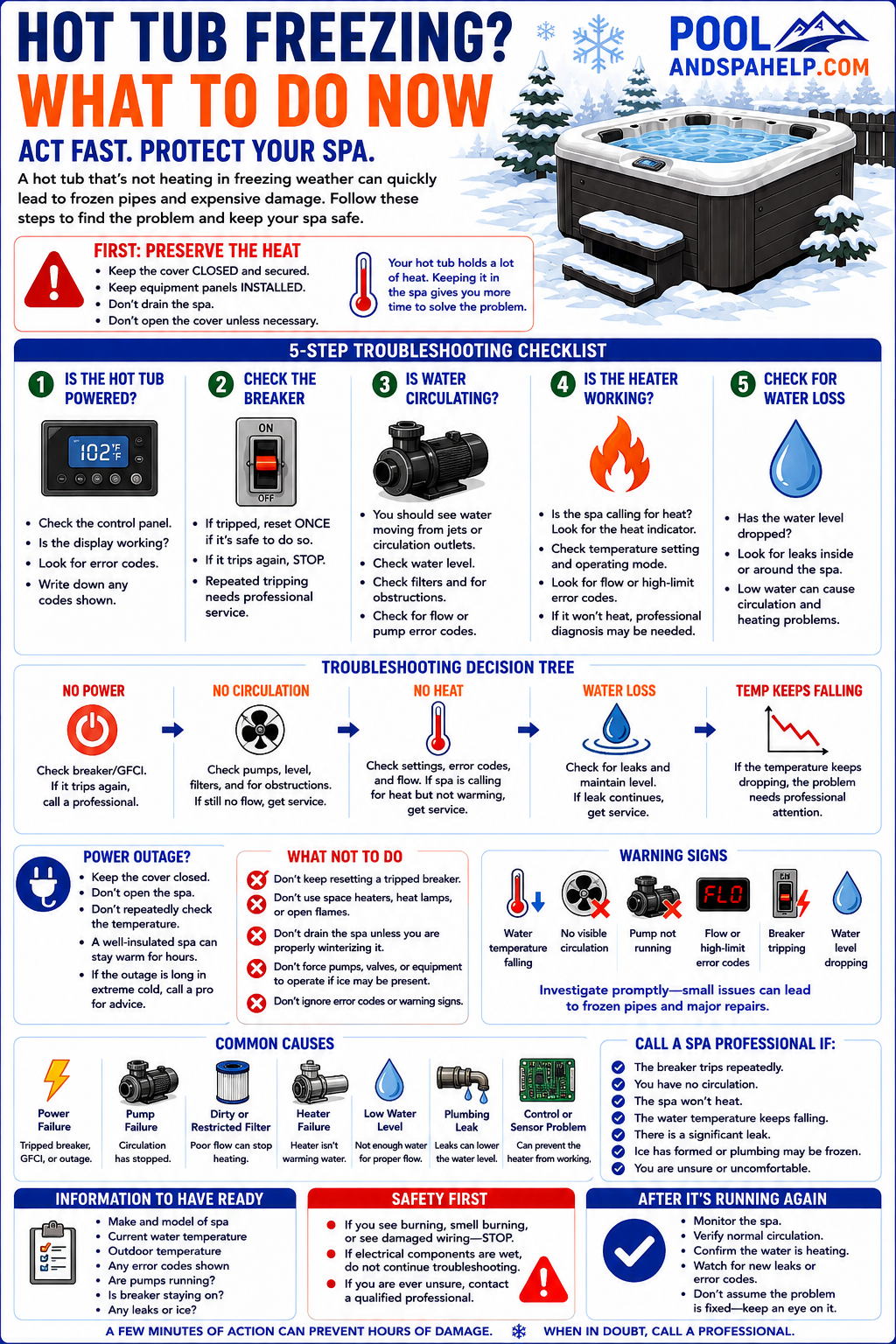
Your hot tub isn’t heating.
The temperature outside is below freezing.
And now the water temperature is dropping.
Don’t panic—but don’t ignore it either.
A hot tub containing hundreds of gallons of warm water usually won’t freeze immediately. The insulated cabinet, warm water, and closed cover can give you valuable time to figure out what’s wrong.
But once water inside the plumbing and equipment begins to freeze, pumps, heaters, fittings, manifolds, and plumbing lines can be damaged.
The goal right now is simple:
Keep as much heat in the spa as possible, determine why it stopped operating, and get professional help if normal operation can’t be safely restored.
Safety First
Before troubleshooting, stop and contact a qualified spa technician or electrician if:
- You smell burning or see signs of overheating.
- Electrical components are wet or submerged.
- The breaker immediately trips again after being reset once.
- You see damaged or burned wiring.
- Water is leaking heavily from the equipment area.
- Equipment appears physically damaged.
- You’re uncomfortable performing any electrical checks.
Never repeatedly reset a breaker that continues to trip.
A breaker trips for a reason. Continually resetting it can create an electrical or equipment hazard.
Also, don’t use portable heaters, heat lamps, open flames, or other improvised heating devices inside the hot tub cabinet.
First: Keep the Cover Closed
If the hot tub is losing temperature, stop opening the cover unnecessarily.
Your spa already contains a large amount of stored heat.
You want to keep it there.
A properly insulated hot tub with a good cover may retain heat surprisingly well, even when the outside temperature is considerably below freezing.
Opening the cover releases some of that heat.
For now:
- Keep the cover securely closed.
- Make sure it is seated properly.
- Keep the equipment access panels installed.
- Minimize unnecessary use of the spa.
- Don’t drain the hot tub unless instructed to as part of proper winterization or emergency service.
Your first defense against freezing is often simply preserving the heat that’s already there.
How Serious Is the Situation?
Before doing anything else, look at the water temperature.
The urgency is very different if your hot tub normally runs at 102°F (39°C) and has dropped to 96°F (36°C) than if the water is approaching freezing.
Also consider the weather.
A spa cooling during a mild overnight freeze isn’t the same situation as a spa sitting without heat during several days of extreme cold.
The colder it is outside—and the longer the spa has been without heat or circulation—the more urgent the problem becomes.
Step 1: Is the Hot Tub Still Running?
Check the control panel.
Is the display working?
If the display is completely blank, you may have lost power to the spa.
If the display is operating, look for:
- Error codes
- Flow warnings
- High-limit errors
- Heater indicators
- Unusual temperature readings
Write down any error code before resetting or changing anything.
That code may tell you exactly which system has stopped the heater.
Related: Hot Tub Error Codes
Step 2: Check the Breaker
If the hot tub appears completely dead, check its breaker or GFCI.
If it has tripped, you can generally try one reset if there are no signs of electrical damage, water intrusion, burning, or another obvious hazard.
If the spa starts normally and continues running, monitor it closely.
If the breaker trips again:
Stop resetting it.
Repeated tripping can indicate problems such as:
- Heater failure
- Pump failure
- Moisture or electrical leakage
- Wiring problems
- Other electrical faults
At that point, professional diagnosis is appropriate.
Step 3: Is Water Circulating?
If the spa has power, check whether water is circulating normally.
Depending on the hot tub, circulation may come from a dedicated circulation pump or one of the main jet pumps.
You may notice:
- No visible circulation
- No water movement from circulation outlets
- An unusually quiet pump
- A humming or noisy pump
- Flow-related error codes
If circulation has stopped, the heater may also be prevented from operating.
That’s intentional.
Most hot tub heaters require adequate water flow before they’re allowed to heat.
Check the Simple Things First
Make sure:
- The water level is high enough.
- Filters aren’t obviously clogged.
- Suction openings aren’t obstructed.
- Valves intended to be open haven’t been closed.
- There isn’t an obvious flow restriction.
A dirty filter can sometimes restrict water flow enough to cause heating or flow problems.
Follow your spa manufacturer’s troubleshooting instructions before removing or testing filters.
Step 4: Is the Heater Operating?
If the pumps are running but the temperature continues to fall, the heating system may not be operating.
Look at the control panel.
Is there a heat indicator?
Is the spa calling for heat?
Check that:
- The temperature setting hasn’t accidentally been lowered.
- The spa isn’t in an Economy, Sleep, or Rest mode you weren’t expecting.
- There isn’t a flow or high-limit error preventing heating.
- The water is actually circulating.
Different control systems handle heating modes differently, so consult the owner’s manual if you’re unsure what a particular setting means.
If the spa is calling for heat but isn’t warming, further electrical testing may be required.
That’s generally the point where a qualified spa technician should diagnose the heating system.
Step 5: Check for Water Loss
Look at the water level.
Has it dropped unexpectedly?
A leak can become particularly serious during freezing weather.
As the water level falls, the spa may eventually lose proper circulation. Once circulation is lost, heating may stop as well.
Check around the spa for obvious signs of leaking water.
If accessible without exposing yourself to electrical hazards, look for visible leakage around the equipment area.
Don’t start dismantling plumbing or electrical components in freezing weather unless you know exactly what you’re doing.
A small summer leak can quickly become a much bigger winter problem.
Troubleshooting Decision Tree
The Hot Tub Has No Power
Check the breaker/GFCI.
Breaker stays on after one reset?
Check whether pumps and heating resume normally.
Breaker trips again?
Stop resetting it and call for service.
The Hot Tub Has Power but No Circulation
Check:
- Water level
- Filters
- Obvious restrictions
- Error codes
If the pump isn’t operating or circulation can’t be restored, arrange service promptly.
Water Is Circulating but Not Heating
Check:
- Temperature setting
- Operating mode
- Error codes
- Heater indicator
If the spa is requesting heat but the water temperature continues falling, the heater or its control system may require professional diagnosis.
The Hot Tub Is Losing Water
Look for an obvious leak and monitor the water level.
If the leak is significant or the water level can’t be maintained, call for service.
Everything Appears to Work but the Temperature Keeps Falling
Compare the actual water temperature with the set temperature.
During extremely cold weather, a spa with poor insulation, a damaged cover, or a heating problem may struggle to recover.
If the temperature continues falling despite normal-looking operation, have the spa inspected.
What If There’s a Power Outage?
A power outage is different because there may be nothing wrong with the hot tub itself.
Your job is primarily to keep the heat that’s already in the spa.
Keep the cover closed.
Keep the equipment panels installed.
Don’t repeatedly open the spa to check the temperature.
A large volume of hot water stores considerable heat, and a well-insulated spa may remain safely above freezing for quite some time.
How long depends on:
- Starting water temperature
- Outdoor temperature
- Wind
- Spa insulation
- Cover condition
- Spa size
- Length of the outage
There’s no universal number of hours that applies to every hot tub.
If the outage continues during extreme cold and freezing becomes a realistic concern, contact a spa professional for guidance.
Don’t Drain the Hot Tub in a Panic
This is important.
If you’re worried about freezing, your first instinct may be:
“I’ll just drain it.”
That can actually make the situation worse if the spa isn’t properly winterized afterward.
Draining the shell doesn’t necessarily remove water from:
- Pumps
- Heater assemblies
- Jet bodies
- Manifolds
- Plumbing lines
- Check valves
- Other low points in the system
Once the large volume of warm water is gone, the small amount of water trapped inside those components can freeze much more quickly.
If you’re going to shut the spa down during freezing weather, it needs to be properly winterized, not simply drained.
Related: Hot Tub Winterizing: Step-by-Step Guide to Protect Your Spa From Freeze Damage
What If Ice Has Already Started Forming?
If you see ice forming in the spa or suspect plumbing or equipment has already frozen, don’t force pumps, valves, unions, or other components to operate.
Frozen components can be damaged, and attempting to operate equipment when water can’t move normally may cause additional problems.
At this point, professional help is the safest approach.
Tell the service company:
- Current water temperature
- Approximate outdoor temperature
- How long the spa has been without heat
- Whether the spa has power
- Whether pumps are operating
- Any error codes displayed
- Whether you see signs of leakage or ice
That information can help the technician understand how urgent the situation is before arriving.
Most Common Reasons a Hot Tub Starts Freezing
Usually, freezing isn’t the original problem.
Something else failed first.
Common causes include:
Power Failure
A tripped breaker, GFCI problem, electrical fault, or utility outage can shut down the entire spa.
Circulation Pump Failure
Without circulation, the heater may be unable to operate and water may sit stationary inside the plumbing.
Dirty or Restricted Filter
Poor flow can trigger safety systems that prevent the heater from operating.
Heater Failure
The spa may continue circulating normally while slowly losing temperature.
Low Water Level
If the water level falls too far, the pump may lose proper flow and the heater may shut down.
Plumbing Leak
A leak can lower the water level and eventually interfere with circulation and heating.
Control or Sensor Problem
Temperature sensors, high-limit sensors, pressure/flow switches, and control boards can prevent heating when a fault is detected.
When to Call a Spa Technician
During warm weather, you sometimes have the luxury of troubleshooting a problem over several days.
During freezing weather, you may not.
Arrange professional service promptly if:
- The breaker repeatedly trips.
- The circulation pump isn’t operating.
- The spa won’t heat.
- Water temperature continues dropping.
- There’s a significant leak.
- Error codes keep returning.
- You suspect frozen plumbing.
- Ice is forming.
- You can’t determine why the spa stopped operating.
Tell the service company immediately that the hot tub is without heat during freezing weather.
That information matters.
A service company may prioritize a potential freeze-up differently from a routine repair.
What to Tell the Service Company
Before calling, collect a few details:
Hot tub make and model:
If known.
Control system:
Balboa, Gecko, Watkins, Jacuzzi, or another system if known.
Current water temperature:
This helps establish urgency.
Outdoor temperature:
Especially important during extreme cold.
Error code:
Write down exactly what’s displayed.
Are the pumps running?
Is the breaker staying on?
Is the spa losing water?
When did you first notice the problem?
Providing this information can save valuable troubleshooting time.
After the Hot Tub Is Running Again
Don’t assume the problem is finished the moment the heater starts.
Monitor the spa until you’re confident that normal operation has returned.
Check that:
- Water is circulating normally.
- The heater continues operating.
- Water temperature is rising.
- The breaker remains on.
- Error codes don’t return.
- The water level remains stable.
- No new leaks appear.
If the spa got extremely cold or partially froze, inspect it carefully as it warms.
Freeze damage can sometimes reveal itself as leaking water once ice begins to thaw.
How to Reduce the Risk of a Winter Freeze-Up
Before extremely cold weather arrives:
- Keep filters clean.
- Maintain the correct water level.
- Repair known leaks.
- Make sure pumps operate normally.
- Verify the heater works.
- Keep the cover in good condition.
- Understand your spa’s operating modes.
- Check the spa regularly.
- Have a plan for extended power outages.
- Know who you’ll call if the spa stops operating.
Related: Running a Hot Tub in Winter
Winter is one of the best times to use a hot tub—but it’s also when small equipment problems deserve faster attention.
Frequently Asked Questions
How quickly will a hot tub freeze?
There’s no single answer. It depends on the starting water temperature, outside temperature, wind, insulation, cover condition, spa construction, and whether any circulation or heating remains.
A hot, covered spa doesn’t instantly freeze when the heater stops.
The smaller amounts of water inside plumbing and equipment are generally the greater concern as temperatures continue falling.
Should I drain my hot tub if the heater stops working?
Not automatically. Simply draining the shell can leave water trapped throughout the plumbing and equipment. If the spa needs to be shut down during freezing weather, it should be properly winterized.
Should I leave the hot tub cover on during a power outage?
Yes. Keeping the cover closed helps retain the heat already stored in the water.
Can I keep using the hot tub if the heater isn’t working?
During freezing weather, focus on diagnosing the heating problem rather than continuing normal use. Opening the cover and using the spa increases heat loss.
Should I keep resetting a tripped hot tub breaker?
No. If a breaker trips again after one reset, stop resetting it and have the cause diagnosed.
What should I do if the hot tub plumbing is already frozen?
Avoid forcing pumps, valves, or other equipment to operate. Contact a qualified spa technician. Frozen plumbing may already be damaged and additional problems can appear during thawing.
Final Thoughts
If your hot tub stops heating during freezing weather, time matters—but panic doesn’t help.
Keep the cover closed.
Preserve the heat already in the spa.
Check for power, circulation, error codes, water loss, and simple flow problems.
If normal operation can’t be restored safely, call for professional help and tell them immediately that the spa is at risk of freezing.
Most importantly, don’t turn a manageable equipment failure into a bigger problem by repeatedly resetting breakers, draining the spa without properly winterizing it, forcing frozen equipment to operate, or using improvised heating methods.
A hot tub usually gives you some time before freezing becomes critical.
Use that time to find the original problem and get the spa heating again safely.
Related Articles:
- Running a Hot Tub in Winter: How to Keep It Safe, Warm, and Efficient
- Hot Tub Winterizing: Step-by-Step Guide to Protect Your Spa From Freeze Damage
- How to Winterize a Swimming Pool: Step-by-Step Guide to Prevent Freeze Damage
- Pool Winter Covers: Which Type Is Right for Your Pool?
Written by Dan Harvickson (Founder of Last Mountain Tech) Pool and Spa Specialist