
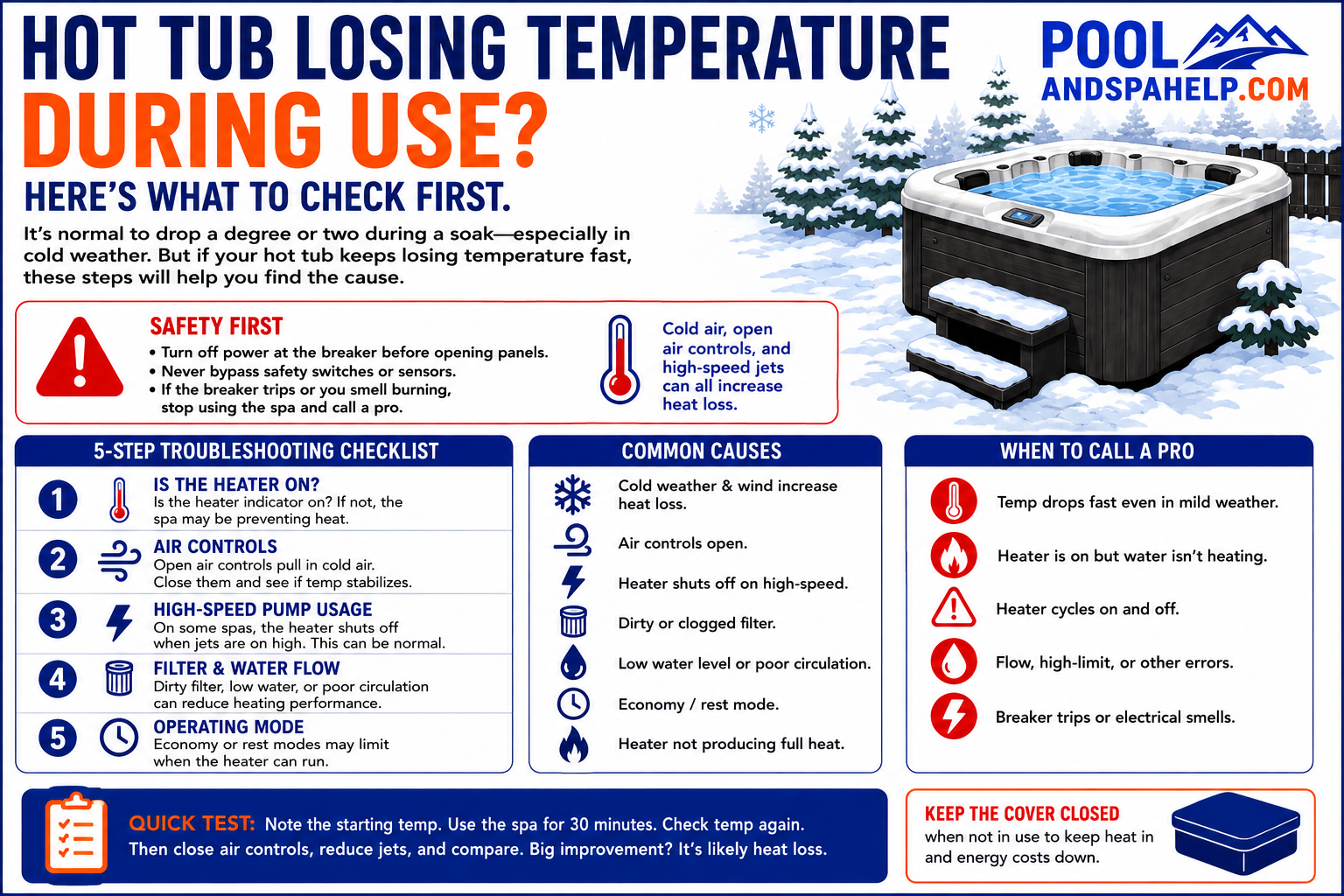
Your hot tub is sitting comfortably at 102°F (39°C).
You get in, turn on the jets, and everything seems fine.
But 20 or 30 minutes later, you look at the display and the temperature has dropped.
Maybe it is down a degree or two. Maybe it keeps falling the longer you use the spa.
A small temperature drop during use can be completely normal, especially in cold weather. But if your hot tub is losing several degrees quickly or cannot maintain temperature during normal use, something may be limiting how much heat the spa can produce.
Before assuming the heater has failed, there are a few things worth checking.
Safety First
Before opening the equipment compartment or inspecting electrical components:
- Turn off power at the breaker before removing equipment covers.
- Never work around energized heater terminals, pumps, or control systems unless you are qualified to do so.
- Do not bypass pressure switches, flow switches, high-limit switches, or other safety devices.
- If the breaker trips, wiring appears damaged, or you smell burning electrical components, stop using the spa until it has been inspected.
For most homeowners, the checks in this article can be performed without working on live electrical equipment.
First: How Much Temperature Is the Hot Tub Actually Losing?
Before troubleshooting anything, determine whether the temperature loss is abnormal.
A hot tub with the cover removed is constantly losing heat to the surrounding air.
That heat loss increases when:
- The outside temperature is very cold
- There is strong wind
- The jets are running
- Air controls are open
- The blower is operating
- Several people are using the spa
- The water is being heavily circulated
Dropping a degree or two during a long soak, particularly during cold winter weather, doesn’t necessarily mean something is wrong.
A spa dropping several degrees relatively quickly under mild conditions deserves a closer look.
Quick Test
Before your next soak:
- Record the starting water temperature.
- Note the outdoor temperature.
- Run the spa as you normally would.
- Check the temperature again after approximately 30 minutes.
- Pay attention to whether the heater indicator remains on.
That last detail can provide an important clue.
Check First: Is the Heater Actually Running?
Look at the topside control panel while the spa is operating.
Most hot tubs display a heater symbol, indicator light, or message when the control system is calling for heat.
If the water temperature is below the set temperature but the heater isn’t being activated, the problem may not be the heater itself.
The control system may be preventing the heater from operating because of:
- Low water flow
- A pressure or flow switch problem
- A sensor issue
- An active error condition
- Economy or energy-saving mode
- Pump operating configuration
If the heater indicator is on continuously but the temperature continues falling, move further down the troubleshooting process.
Quick Decision Tree
Temperature drops mostly when the jets are running
Check:
Are the air controls open?
Yes → Close the air controls and watch the temperature.
No → Check whether the heater remains on when the jet pump switches to high speed.
Heater shuts off when the jets are turned on
This can be normal on some hot tubs.
Some spas do not have enough available electrical capacity to operate every high-load component simultaneously.
Depending on the spa’s electrical configuration, switching a jet pump to high speed may cause the control system to temporarily disable the heater.
During cold weather, the spa can then lose heat faster than it can recover it.
Heater indicator is on but the temperature continues falling
Check:
- Filter condition
- Water level
- Circulation
- Heater operation
If the spa has good water flow but cannot maintain temperature even though the heater should be operating, the heating system may need further testing.
Heater indicator isn’t coming on
Check:
- Heating or operating mode
- Set temperature
- Error messages
- Water flow
- Sensors or control-system problems
Most Common Causes
1. Cold Outdoor Temperatures
This is one of the most common explanations, especially in winter.
With the cover removed, a hot tub exposes a large surface of warm water directly to cold air.
The greater the difference between the water temperature and outdoor temperature, the faster heat escapes.
A hot tub sitting at 102°F (39°C) on a mild evening may maintain temperature easily.
The same spa at 102°F when it is -10°F (-23°C) outside has a much harder job.
If the spa only loses temperature during very cold weather, there may be nothing wrong with it.
What to Do
Keep the cover closed until you’re ready to enter the spa and avoid leaving the hot tub uncovered longer than necessary.
If possible, sheltering the spa from strong winds can also reduce heat loss.
2. Air Controls Are Open
This one is easy to overlook.
Many hot tubs use venturi air controls to mix outside air with the water coming from the jets.
That creates the strong, bubbly massage people expect from a hot tub.
But in cold weather, you’re also pulling cold outside air into the water.
The effect can be surprisingly noticeable.
Quick Test
Close the air controls while leaving the jets running.
If the hot tub maintains its temperature considerably better, the air injection was contributing to the heat loss.
You don’t necessarily have to stop using the air controls. Just understand that using them aggressively in cold weather can cause the spa to cool faster.
3. The Heater Turns Off When the Jet Pump Runs on High
This is another situation that can appear to be a heater problem when the spa is actually operating as designed.
Hot tubs have limits on how much electrical current they can draw.
On some configurations, the spa can operate:
Heater + low-speed pump
but not:
Heater + multiple pumps on high speed
When additional pumps are activated, the control system may automatically shut off the heater.
The water then begins losing heat while you’re using the spa.
How to Check
Watch the heater indicator while switching the jets from low to high speed.
If the heater indicator disappears when the pump switches to high speed and returns when the pump slows down, this may be normal operation for your spa.
Check the owner’s manual for your particular model and electrical configuration.
4. Dirty or Restricted Filter
The heater depends on water moving through it.
If the filter becomes dirty, water flow through the heating system can decrease.
Depending on the control system, restricted flow may:
- Reduce heating performance
- Cause the heater to cycle
- Trigger a flow-related error
- Prevent heating altogether
Quick Test
Turn off power to the spa, remove the filter, restore power, and briefly operate the hot tub for testing purposes only.
If heating performance improves significantly without the filter installed, clean or replace the filter.
Do not operate the hot tub without a filter as a permanent solution.
5. Low Water Level
A low water level can allow the pump to pull air into the plumbing.
That can reduce circulation through the heater and may eventually cause a flow-related error.
Make sure the water level is high enough to properly supply the filter compartment and pump suction.
If you hear gurgling or see large amounts of air entering the jets, check the water level first.
6. Economy or Energy-Saving Mode
Some hot tubs have Standard, Ready, Rest, Economy, or similar operating modes.
Depending on the control system, these modes can change when the spa is allowed to heat.
In an economy-type mode, the heater may only operate during scheduled filtration cycles.
That can be perfectly acceptable when the spa isn’t being used, but it can also cause the temperature to drop during a long soak.
Check the topside display and confirm that the spa is in the heating mode you expect.
7. Poor Water Circulation
A hot tub can sometimes have enough flow to avoid displaying an error but still have weaker circulation than normal.
Possible causes include:
- Dirty filter
- Partially closed valve
- Debris in the plumbing
- Air trapped in the pump
- Weak circulation pump
- Pump problem
If the heater is repeatedly cycling on and off, poor flow becomes more suspicious.
8. Heater Isn’t Producing Full Heat
If the control panel says the heater is operating but the spa continues losing temperature under conditions where it previously maintained heat, the heater itself may need to be tested.
A technician can check:
- Voltage supplied to the heater
- Heater current draw
- Heater resistance
- Control-board heater output
- Heater relay operation
- Temperature sensor readings
An indicator on the display only tells you that the control system wants the heater to operate.
It doesn’t prove that the heater is actually producing heat.
A Simple Way to Separate Normal Heat Loss From a Heating Problem
Try this test when the spa is already at its set temperature.
Test 1 — Normal Operation
Use the spa normally for approximately 30 minutes and record how much the temperature drops.
Test 2 — Reduced Heat Loss
On another similar day:
- Close the air controls
- Use fewer high-speed jets
- Keep unnecessary pumps or blowers off
Then compare the temperature loss.
If the spa maintains temperature much better during the second test, you’re probably dealing primarily with heat loss exceeding the spa’s available heating capacity.
If the temperature continues dropping quickly even with minimal jets and air injection, investigate the heating and circulation systems.
When to Book Service
Consider having the hot tub inspected if:
- The temperature drops rapidly even in mild weather
- The spa previously maintained temperature but suddenly cannot
- The heater indicator is on but the water isn’t heating
- The heater repeatedly turns on and off
- Flow or high-limit errors appear
- Water circulation seems weaker than normal
- The breaker trips
- The spa cannot recover its temperature after use
These symptoms point more strongly toward a flow, heater, sensor, control-board, or electrical problem.
Service Call Prep
Before contacting a technician, write down:
- Hot tub make and model
- Set temperature
- Starting water temperature
- Temperature after approximately 30 minutes of use
- Outdoor temperature
- Whether the heater indicator stays on
- Whether the temperature drops faster with the jets on high
- Whether closing the air controls makes a difference
- Any error messages displayed
This information can help the technician narrow down the problem before arriving.
What to Expect During a Service Call
A technician will typically confirm that the spa has proper water flow and determine whether the control system is actually energizing the heater.
Depending on the symptoms, they may test:
- Pump operation
- Circulation flow
- Pressure or flow switches
- Temperature sensors
- Heater resistance
- Voltage at the heater
- Heater current draw
- Control-board relays
The goal is to determine whether the spa cannot produce enough heat or whether it is simply losing heat faster than the system can replace it.
Those are two very different problems.
Why Does a Hot Tub Lose Heat Faster While You’re Using It?
A covered hot tub is relatively easy to keep warm.
Once you remove the cover, everything changes.
Heat escapes from the surface of the water through evaporation and exposure to cooler air.
Turn on the jets and water movement increases that heat loss.
Open the air controls and cold outside air is mixed directly into the water.
Add several bathers and run multiple pumps, and the spa’s heating system may struggle to keep up—especially if the control system temporarily disables the heater while high-speed pumps are operating.
That’s why a hot tub can maintain 102°F perfectly while sitting covered but slowly lose temperature during use.
Frequently Asked Questions
Is it normal for a hot tub to lose temperature while using it?
A small temperature drop can be normal, particularly during long soaks or cold weather. Rapid or excessive temperature loss should be investigated.
Why does my hot tub cool down when I turn the jets on?
The jets increase water movement and heat loss. If the air controls are open, cold outside air is also being mixed into the water. Some spas may also disable the heater when high-speed pumps are operating.
Why does my heater turn off when I turn the jets on?
Some hot tubs are configured so the heater and certain high-speed pumps cannot operate simultaneously because of electrical load limitations. This can be normal operation.
Do hot tub air controls make the water colder?
They can. Air controls pull outside air into the jet stream. During cold weather, this can noticeably increase heat loss.
Can a dirty filter make my hot tub lose temperature?
Yes. A severely restricted filter can reduce water flow through the heater, causing reduced heating performance or flow-related errors.
How quickly should a hot tub recover after use?
Recovery time depends on heater size, water volume, outdoor temperature, insulation, electrical configuration, and how much temperature was lost. The important thing is that the temperature should begin climbing once normal heating resumes and the cover is replaced.
Related Hot Tub Heating Problems
If your hot tub isn’t just losing temperature during use, the symptom may point to a different heating problem.
Hot Tub Not Heating
Start here if the spa isn’t producing heat at all.
Hot Tub Won’t Heat Past 80°F
Use this guide if the spa heats normally at first but stops well below the set temperature.
Hot Tub Heater Turns On Then Off
Start here if the heater repeatedly cycles instead of staying on long enough to reach the set temperature.
How a Hot Tub Heating System Works
Understanding how the pump, heater, sensors, and control system work together can make heating problems much easier to diagnose.
Hot Tub Freezing? What to Do Before It Causes Damage
Still Not Sure What’s Causing the Temperature Drop?
A hot tub losing temperature during use doesn’t automatically mean the heater needs to be replaced.
Start by determining when the heater operates, when it shuts off, and what changes when the jets or air controls are activated.
Those observations can often tell you whether you’re dealing with normal heat loss, limited heating capacity, restricted water flow, or an actual heating-system problem.
And that’s much better than replacing parts until the hot tub gets warm.
Written by Dan Harvickson (Founder of Last Mountain Tech) Pool and Spa Specialist