
Once your pool is winterized, there’s one more important decision to make: how are you going to cover it?
Pool winter covers come in several different styles, and they don’t all do the same job.
Some are inexpensive and mainly keep leaves and debris out. Others are designed to support weight and provide an additional level of safety around the pool. Some let rain and melting snow drain through, while others completely block sunlight and water.
The right choice depends on your pool, your climate, your budget, and what you expect the cover to do over the winter.
Here’s how the most common pool winter covers compare.
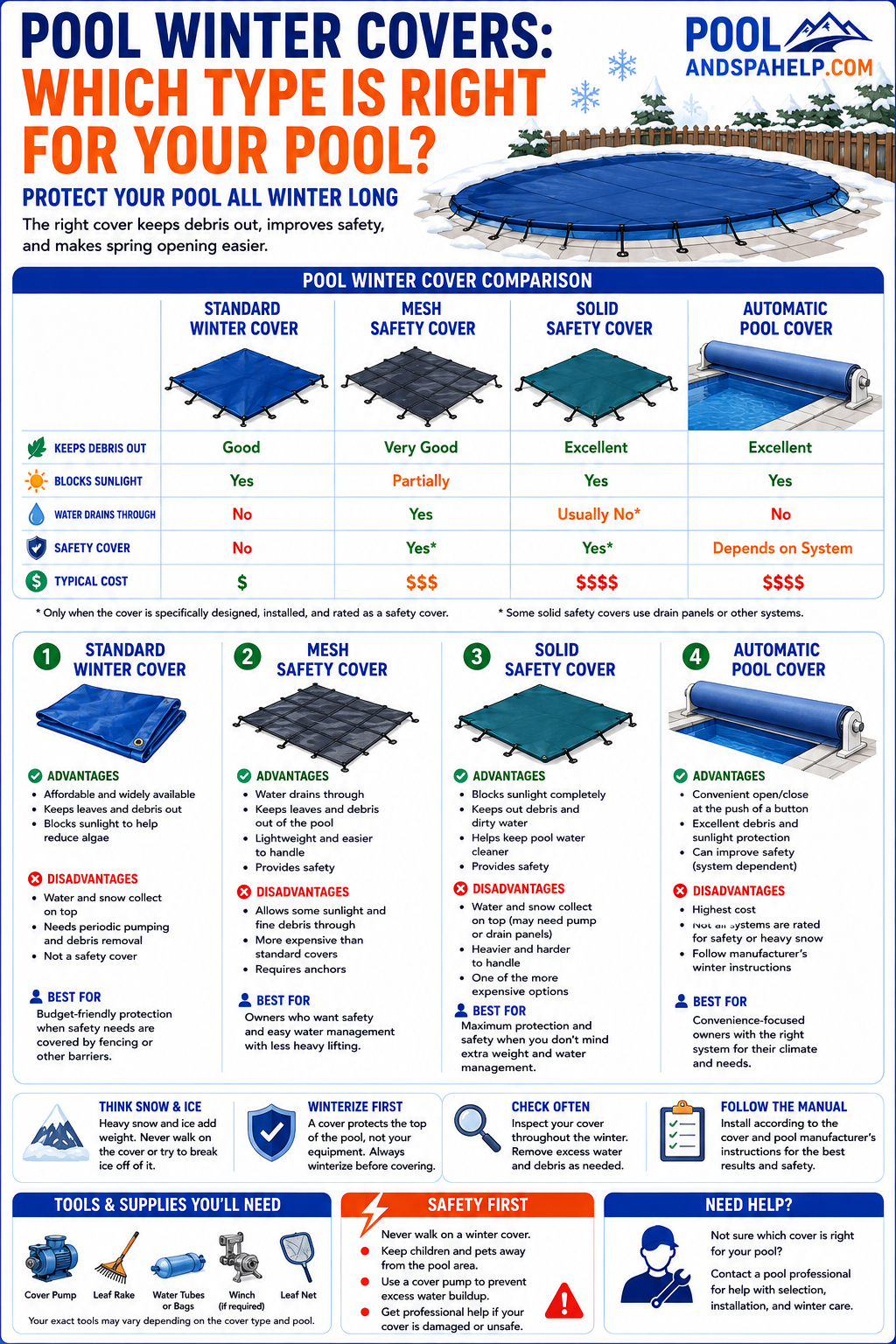
Quick Comparison: Pool Winter Cover Types
| Cover Type | Keeps Debris Out | Blocks Sunlight | Water Drains Through | Safety Cover | Typical Cost |
|---|---|---|---|---|---|
| Standard winter cover | Good | Yes | No | No | $ |
| Mesh safety cover | Very good | Partially | Yes | Yes* | $$$ |
| Solid safety cover | Excellent | Yes | Usually no** | Yes* | $$$$ |
| Automatic cover | Excellent | Yes | No | Depends on system | $$$$ |
* Only when the cover is specifically designed, installed, and rated as a safety cover.
** Some solid safety covers use drain panels or other systems to manage water.
1. Standard Winter Pool Covers
A standard winter cover is usually the simplest and least expensive option.
These covers are typically made from a tarp-like material and stretch across the pool. Water bags, cables, weights, or other anchoring methods may be used depending on whether the pool is inground or above ground.
Advantages
Standard winter covers are affordable, widely available, and do a good job of keeping leaves and other debris out of the pool.
Because they’re solid, they also block sunlight. That can help reduce algae growth while the pool is closed.
Disadvantages
Rain and melting snow collect on top of the cover, so the water may need to be removed periodically with a cover pump.
Leaves and other debris can also accumulate on top.
Most importantly, a standard winter cover should not be treated as a safety cover.
It may look strong when stretched across the pool, but it isn’t designed to support a person or pet.
Best For
A standard winter cover can be a good choice if:
- You want an inexpensive winter cover.
- Your main concern is keeping debris out.
- The pool area is already securely fenced or otherwise protected.
- You don’t mind occasionally removing water and debris from the cover.
For many pool owners, this is the basic no-frills option that gets the job done.
2. Mesh Safety Covers
Mesh safety covers are anchored around the perimeter of an inground pool and stretched tightly across the surface.
Unlike a standard winter tarp, a properly installed safety cover is designed to provide a much stronger barrier over the pool.
The mesh material also allows rain and melting snow to drain through the cover instead of collecting on top.
Advantages
One of the biggest benefits is convenience.
Because water can drain through the mesh, you generally don’t have a large puddle sitting on top of the cover after every rain or spring thaw.
Leaves and larger debris stay above the pool and can be removed from the cover.
Mesh covers are also relatively lightweight compared with solid safety covers, which can make installation and removal easier.
And, of course, a properly rated and installed safety cover provides an important additional layer of protection around the pool.
Disadvantages
The same mesh that allows water through can also allow some sunlight and fine contaminants into the pool.
That can sometimes mean dirtier or greener water when the pool is opened in spring, especially if the water warms up well before opening.
Mesh safety covers are also considerably more expensive than basic winter covers and normally require anchors installed around the pool.
Best For
A mesh safety cover may be a good choice if:
- Safety is an important consideration.
- You don’t want to pump water off the cover.
- Your area gets significant rain or melting snow.
- You want a cover that’s relatively easy to handle.
- You don’t mind potentially doing a little more cleanup when opening the pool.
3. Solid Safety Covers
Solid safety covers work similarly to mesh safety covers, but the material doesn’t normally allow sunlight or water to pass directly through it.
That provides excellent protection from debris and sunlight.
Advantages
A solid cover can leave the pool considerably more isolated from the outside environment.
Sunlight is blocked, leaves stay out, and dirty rainwater isn’t constantly draining into the pool.
That can help keep the water in better condition throughout the off-season and potentially make spring opening easier.
Like mesh safety covers, properly rated and installed solid safety covers also provide an additional level of protection around the pool.
Disadvantages
Water management is the big difference.
Because a fully solid cover doesn’t allow rainwater and melting snow to simply drain through, that water has to go somewhere.
Some solid safety covers incorporate mesh drain panels, while others may require a cover pump.
Solid covers can also be heavier and more difficult to handle than mesh covers.
And they’re generally one of the more expensive winter cover options.
Best For
A solid safety cover may make sense if:
- Safety is a priority.
- Keeping the pool as clean as possible is important.
- You want to block sunlight from reaching the pool.
- You’re willing to manage water accumulating on the cover.
- You don’t mind paying more for a premium winter cover.
Mesh vs. Solid Safety Cover: Which Is Better?
This is one of the most common decisions when choosing a pool winter cover.
Neither is automatically better.
It comes down to what matters more to you.
Choose Mesh If…
You’d rather have rain and melting snow drain through the cover and want something relatively lightweight and easy to manage.
The tradeoff is that some fine debris and sunlight may make their way through.
Choose Solid If…
You want to keep as much sunlight, debris, and outside water out of the pool as possible.
The tradeoff is additional weight, usually a higher price, and the need to manage water on covers that don’t have a drainage system.
In climates with plenty of snow and spring melt, water management is worth thinking about before choosing between the two.
4. What About Automatic Pool Covers?
Automatic pool covers deserve a separate mention because they’re a little different.
An automatic cover opens and closes using a motorized system and can be extremely convenient during the swimming season.
But owning an automatic cover doesn’t necessarily mean you can simply close it in fall and forget about the pool until spring.
Snow and ice loads can become significant, and automatic cover systems have specific operating and winter-care requirements.
Some automatic covers may be designed and rated for particular loads or safety applications, while others may have different limitations.
Check the Manufacturer’s Instructions
If your pool has an automatic cover, follow the manufacturer’s instructions regarding winter use.
Don’t assume the cover can safely support accumulated snow, ice, standing water, people, or pets simply because the material appears strong.
Depending on the system and climate, another winter-cover strategy may be recommended.
What About Above-Ground Pool Winter Covers?
Above-ground pools typically use a different style of winter cover.
A solid cover is commonly stretched across the top of the pool and secured around the outside of the pool wall using a cable and winch system or another manufacturer-approved method.
An air pillow may also be used beneath the cover on some pools.
The pillow isn’t intended to hold the entire cover above the water. Its purpose is generally to help manage ice expansion and direct water and debris toward the outside areas of the cover.
As with an inground pool, accumulated water and debris should be managed throughout the winter.
Avoid pulling the cover excessively tight. The cover and securing system should be installed according to the pool and cover manufacturer’s instructions.
Don’t Forget About Snow and Ice
If you live somewhere with real winters, snow load matters.
A little fluffy snow can eventually become a considerable amount of heavy snow, ice, and water as temperatures fluctuate.
Avoid walking onto the cover or attempting to break ice off it.
Sharp tools can damage the cover, and working over a covered swimming pool can be dangerous.
For safety covers, follow the manufacturer’s recommendations for snow accumulation and removal.
For standard covers, keep an eye on accumulated water and debris so excessive weight doesn’t pull the cover into the pool or damage its anchoring system.
A Pool Cover Doesn’t Replace Proper Winterization
A winter cover protects the top of the pool.
It doesn’t protect your plumbing, pump, filter, heater, chlorinator, or other equipment from freezing.
Before covering the pool, the pool itself still needs to be properly prepared for winter.
That may include:
- Balancing the water.
- Lowering the water level when required.
- Draining and protecting equipment.
- Winterizing plumbing.
- Removing or protecting accessories.
- Adding appropriate winter chemicals when required.
- Following manufacturer-specific winterization procedures.
Related: How to Winterize a Pool
Which Pool Winter Cover Should You Choose?
For many pool owners, the decision can be simplified to three questions.
Want the cheapest practical option?
A standard winter cover may be all you need.
Want safety and easier water management?
Consider a mesh safety cover.
Want safety plus maximum protection from sunlight and debris?
A solid safety cover may be worth the additional cost and maintenance.
There isn’t one winter cover that’s best for every pool.
A relatively inexpensive cover may be perfectly adequate for one backyard, while another pool owner may decide the convenience and added protection of a safety cover are worth the investment.
The important thing is understanding what the cover is — and just as importantly, what it isn’t designed to do.
Frequently Asked Questions
Is a pool winter cover necessary?
A winter cover isn’t always technically required, but it can greatly reduce the amount of leaves, debris, and contamination entering a closed pool. In colder climates, it’s a normal part of winter pool care.
Is a mesh or solid pool cover better?
Mesh covers make water management easier because rain and melting snow can drain through them. Solid covers block more sunlight and debris but may require water to be pumped off. The better option depends on which tradeoff matters more to you.
Can you walk on a pool safety cover?
Don’t treat a pool cover as a walking surface. Even when a cover is specifically rated as a safety cover, it should be used according to the manufacturer’s instructions rather than as a platform for walking across the pool.
Can you use a regular tarp as a pool winter cover?
A properly sized pool winter cover is generally a better choice. Pool covers are designed around the securing methods, dimensions, and conditions associated with covering a swimming pool.
Should a winter pool cover touch the water?
Many traditional winter covers are designed to rest on or near the pool water rather than being suspended high above it. Installation varies by cover type, so follow the instructions supplied with your particular cover.
Do you need to pump water off a pool cover?
If you have a solid cover without a drainage system, accumulated rainwater and snowmelt may need to be removed. Mesh covers allow water to drain through, while some solid safety covers incorporate drainage panels.
Final Thoughts
Choosing a pool winter cover isn’t simply about finding something big enough to cover the pool.
Think about safety, debris, sunlight, snow, water management, convenience, and cost.
For some pools, a basic winter cover makes perfect sense. For others, investing in a mesh or solid safety cover can make winter maintenance and spring opening much easier.
Whichever type you choose, install it correctly, inspect it periodically throughout the winter, and remember that the cover is only one part of protecting your pool during freezing weather.
A properly winterized pool and the right winter cover will give you the best chance of uncovering a clean, damage-free pool when warm weather returns.
Related Articles:
- How to Winterize a Swimming Pool: Step-by-Step Guide to Prevent Freeze Damage
- How to Winterize a Pool Heater: Protect It From Freeze Damage
- Hot Tub Winterizing: Step-by-Step Guide to Protect Your Spa From Freeze Damage
- Running a Hot Tub in Winter: How to Keep It Safe, Warm, and Efficient
- Hot Tub Freezing? What to Do Before It Causes Damage
Written by Dan Harvickson (Founder of Last Mountain Tech) Pool and Spa Specialist