
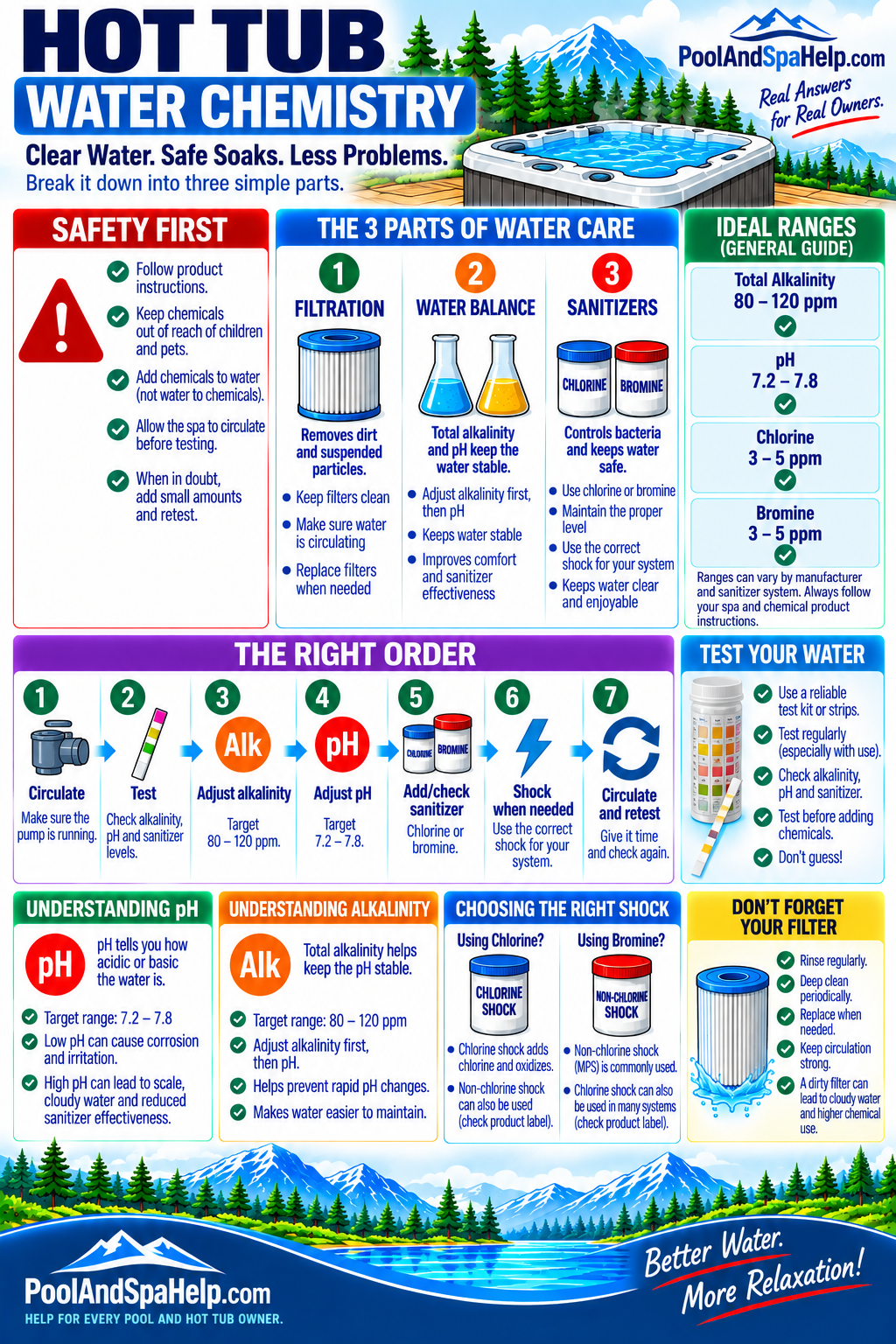
Hot tub water chemistry can seem complicated when you first start looking at test strips, bottles of chemicals, sanitizer levels, pH, alkalinity, shock, and filtration.
It becomes much easier when you stop thinking of water care as a long list of chemicals and break it into three basic categories:
- Filtration
- Water balance — alkalinity and pH
- Sanitizing — chlorine or bromine, plus shock
All three work together. Good chemistry can’t completely compensate for poor filtration, and good filtration can’t make unsanitized water safe.
The other important part is doing things in the right order. Constantly adding chemicals without knowing what should be adjusted first can turn a relatively simple water problem into a frustrating one.
This guide explains the basics, what each part does, and a practical order for maintaining your hot tub water.
Quick Guide: The Basic Hot Tub Water-Care Sequence
For routine water care, think of the process this way:
Circulate and filter → Test the water → Adjust alkalinity → Adjust pH → Check/add sanitizer → Shock when needed → Circulate → Retest
You won’t necessarily need to adjust everything every time you test the water.
If your alkalinity and pH are already within the recommended ranges, leave them alone and move on to your sanitizer.
The goal isn’t to add chemicals.
The goal is to maintain stable, clean water using only what the water actually needs.
The Three Parts of Hot Tub Water Care
1. Filtration
Before worrying about chemicals, remember that your hot tub has a physical water-cleaning system too.
The filter removes suspended debris and particles as water circulates through the spa. If the filter is dirty, clogged, damaged, or the spa isn’t circulating enough, water quality can suffer even when the chemical readings look reasonable.
Regularly:
- Inspect the filter
- Rinse debris from the filter
- Deep-clean it periodically according to the filter manufacturer’s recommendations
- Replace worn or damaged filters
- Make sure the spa is actually circulating water
- Check that suction areas and filter openings aren’t obstructed
A dirty filter can contribute to cloudy water, poor circulation and increased sanitizer demand.
If you’re fighting a persistent water problem, the filter should be one of the first things you check.
2. Water Balance: Alkalinity and pH
This is where many hot tub owners get confused.
Alkalinity and pH are related, but they aren’t the same measurement.
What Is pH?
pH tells you how acidic or basic the water is.
For most hot tubs, a typical target range is approximately:
pH: 7.2–7.8
Always follow the recommendations for your particular sanitizer, spa and chemical products.
When pH is too low, the water is more acidic. This can contribute to corrosion, equipment damage and uncomfortable water.
When pH is too high, you may experience problems such as scale, cloudy water and reduced sanitizer effectiveness.
What Is Total Alkalinity?
Total alkalinity measures the water’s ability to resist rapid changes in pH.
A useful way to think about it is:
pH is where the water is. Alkalinity helps keep it there.
For many hot tubs, a common total alkalinity target is roughly:
80–120 ppm
However, recommended ranges can vary depending on the sanitizer and chemical system being used, so follow the instructions for your products.
Why Do I Adjust Alkalinity Before pH?
This is one of the most important concepts for beginners.
Adjust total alkalinity first. Then adjust pH.
If alkalinity is significantly out of range, you may adjust the pH only to have it move again.
Think of alkalinity as helping stabilize the environment in which you’re trying to set the pH.
So instead of:
pH → alkalinity → pH again → more chemicals → frustration
use:
Alkalinity → pH
After making an adjustment, allow the water to circulate according to the chemical manufacturer’s directions before testing again.
Don’t keep adding chemical because the test strip didn’t immediately show the result you expected.
3. Sanitizer: Chlorine or Bromine
Sanitizer controls microorganisms in the water.
The two most common traditional hot tub sanitizers are chlorine and bromine.
Whichever system you use, you need to maintain an appropriate sanitizer residual rather than waiting until the water looks dirty.
Clear water isn’t necessarily sanitized water.
Chlorine
Chlorine is commonly used because it works quickly and is widely available.
The appropriate level depends on the chlorine product and system you’re using. Follow your spa and sanitizer manufacturer’s recommended range.
Bromine
Bromine is another common choice for hot tubs.
It behaves differently from chlorine and is often used with a bromide reserve or bromine bank that is activated by an oxidizer.
This is where shock starts causing confusion.
What Is Hot Tub Shock?
Shock is often treated as though it’s simply another name for sanitizer.
It isn’t quite that simple.
Shocking is the process of adding an oxidizing product to help break down contaminants and, depending on the water-care system, regenerate or activate sanitizer.
Two broad categories you’ll commonly encounter are:
Chlorine Shock
A chlorine-based shock both oxidizes contaminants and adds chlorine.
Depending on the product, it may be used with a chlorine sanitation system and can also be used in some bromine systems.
Non-Chlorine Shock
Non-chlorine shock, commonly based on potassium monopersulfate (MPS), oxidizes contaminants without adding chlorine.
It is commonly used with bromine systems because it can help activate bromide into active bromine, and it can also be used with some chlorine-based maintenance programs.
But don’t choose shock based only on the words “chlorine” or “bromine” on your sanitizer container.
Follow the instructions for the particular sanitizer system and shock product you’re using.
Different products and systems can have different dosing and compatibility requirements.
What Shock Should I Use With Chlorine?
If you’re using a chlorine sanitation system, you may encounter both:
- Chlorine-based shock
- Non-chlorine shock
Either may have a place in a chlorine water-care program depending on the products and manufacturer’s instructions.
A chlorine shock increases the chlorine level while oxidizing contaminants.
A non-chlorine shock primarily provides oxidation without directly adding chlorine sanitizer.
Don’t assume that every chlorine spa should automatically receive the same type or amount of shock. Check the labels of both your sanitizer and shock products.
What Shock Should I Use With Bromine?
This is where terminology can make water care unnecessarily confusing.
A bromine spa doesn’t necessarily require a product called “bromine shock.”
In many bromine systems, an oxidizer is used to convert bromide ions into active bromine sanitizer.
Depending on the system, that oxidizer may be:
- Chlorine-based shock
- Non-chlorine shock such as MPS
Again, follow the instructions for the particular bromine system you’re using.
The important concept is that bromide reserve and active bromine aren’t the same thing. The oxidizer helps activate the bromide so it can function as sanitizer.
The Correct Order for Balancing Hot Tub Water
This is the part worth remembering.
Step 1 — Make Sure the Water Is Circulating
The pump and filtration system need to be operating properly.
Chemicals need to mix throughout the water, and you’re going to have difficulty maintaining good water quality if circulation is poor.
Step 2 — Test the Water
Test before adding chemicals.
Depending on your system, you’ll usually be checking:
- Total alkalinity
- pH
- Chlorine or bromine
- Other parameters recommended for your system
Don’t add chemicals simply because it’s the day you normally add them.
Test first.
Step 3 — Adjust Total Alkalinity
If alkalinity is outside the recommended range, correct it first.
Add the appropriate product according to its directions, circulate the water, and retest when directed.
Don’t immediately start adjusting everything else at the same time.
Step 4 — Adjust pH
Once alkalinity is where you want it, check the pH.
If necessary, use the appropriate pH increaser or decreaser.
Allow the water to circulate and retest according to the product directions.
Step 5 — Check Your Sanitizer
Now check the chlorine or bromine level.
If it’s low, add the appropriate sanitizer according to the manufacturer’s instructions.
Maintain the recommended sanitizer residual even when the water looks perfectly clear.
Step 6 — Shock When Needed
Shock according to your water-care program and product directions.
Shocking may be needed after heavy use, when contaminant load is high, as part of routine maintenance, or when you’re correcting certain water-quality problems.
Use a shock product that’s appropriate for your sanitation system.
Step 7 — Circulate and Retest
Give the chemicals time to circulate and work.
Then retest.
Trying to correct several readings simultaneously makes it much harder to know which adjustment caused the next reading.
What’s Wrong With Your Hot Tub Water?
Sometimes your first clue isn’t a test result.
It’s simply that the water looks, smells or feels wrong.
Use the symptoms below as a starting point.
| Water Problem | Common Causes | What to Do |
|---|---|---|
| Cloudy water | Low sanitizer, poor filtration, water imbalance | Cloudy Water |
| Foamy water | Detergent residue, lotions/oils, old water | Foamy Water |
| Green water | Sanitizer problem, organic contamination, metals | Green Water |
| Milky white water | Water balance, calcium, suspended particles | Milky Water |
| Yellow or brown water | Metals, source water, contamination | Yellow/Brown Water |
| White flakes | Calcium scale or biofilm | White Flakes |
| Bad-smelling water | Low sanitizer, contaminants, old water | Smells Bad |
| Slimy water | Low sanitizer, biofilm or contamination | Slimy Water |
Don’t Try to Fix Bad Water by Adding More of Everything
This is a common mistake.
The water looks bad, so the owner adds sanitizer.
Then shock.
Then pH increaser.
Then something for cloudy water.
Then another chemical recommended on the bottle at the pool store.
Pretty soon, nobody knows what the water actually needed in the first place.
Start with the basics:
Is the water circulating and filtering properly?
Then:
What do the test results actually show?
Correct one part of the water chemistry logically instead of treating every possible problem at once.
When Should I Change the Hot Tub Water?
Chemical treatment can’t compensate indefinitely for old water.
Over time, dissolved material accumulates from chemicals, sweat, lotions, cosmetics and everything else introduced into the spa.
Eventually, maintaining the water can become increasingly difficult.
How often you need to drain and refill depends on factors including:
- Spa size
- Number of users
- Frequency of use
- Water-care system
- Source-water quality
- How well the water has been maintained
If you’re constantly fighting chemistry despite good filtration and proper maintenance, draining, cleaning and refilling may be more practical than continuing to add chemicals.
A Fresh Fill Doesn’t Mean Balanced Water
Fresh water still needs to be tested.
Source water can have high or low alkalinity, unusual pH, hardness issues, metals and other characteristics that affect spa chemistry.
After filling:
Circulate → Test → Adjust alkalinity → Adjust pH → Establish sanitizer
Then follow the startup instructions for your particular sanitation system.
This gives you a much better starting point than assuming fresh water is automatically ready for use.
Hot Tub Water Chemistry FAQ
Should I adjust pH or alkalinity first?
Generally, adjust total alkalinity first, then pH.
Because alkalinity helps buffer pH, correcting pH first when alkalinity is significantly out of range can result in having to adjust the pH again.
Do I add sanitizer before balancing the water?
For a normal fresh fill or routine balancing process, establish your basic water balance first — particularly alkalinity and pH — and then establish the appropriate sanitizer level.
If you’re dealing with contaminated water or another unusual situation, the treatment procedure may be different.
Can I use chlorine shock in a bromine hot tub?
Some bromine systems use chlorine-based shock as an oxidizer to activate bromide into bromine. Non-chlorine shock may also be used in many systems.
Follow the instructions for your particular bromine and shock products rather than assuming all bromine systems use the same procedure.
Can I use non-chlorine shock with chlorine?
Non-chlorine shock can be used with many chlorine sanitation programs as an oxidizer without directly adding more chlorine.
Check the instructions for the products you’re using.
Why does my pH keep changing?
Unstable alkalinity can make pH harder to control, but aeration, chemical additions, source water and other factors can also affect pH.
If you’re constantly chasing pH, check your total alkalinity instead of repeatedly adding pH adjuster.
Can the water be safe if it’s crystal clear?
Appearance alone can’t tell you whether water is properly sanitized.
Clear water can still have an inadequate sanitizer level.
Test it.
Keep Hot Tub Water Care Simple
You don’t need to memorize every chemical on the shelf to understand basic hot tub water care.
Remember the three parts:
Filtration removes physical material from the water.
Water balance keeps alkalinity and pH where they should be.
Sanitizer controls microorganisms, while shock provides oxidation and supports the sanitation process depending on the system being used.
And when you’re unsure what order to follow:
Circulate → Test → Alkalinity → pH → Sanitizer → Shock as needed → Circulate → Retest
Once you understand that sequence, hot tub chemistry becomes much easier to troubleshoot.
Instead of asking “What chemical should I add?”, start asking:
“Which part of the water-care process is actually out of balance?”
That’s the question that usually leads you toward the right solution.
Related Articles:
- How to Balance pH and Alkalinity in Pools and Hot Tubs
- Hot Tub Water Smells Musty? What to Check and How to Fix It
- Hot Tub Shell Feels Gritty? How to Identify and Remove the Buildup
Written by Dan Harvickson (Founder of Last Mountain Tech) Pool and Spa Specialist